Parisa Hafezi
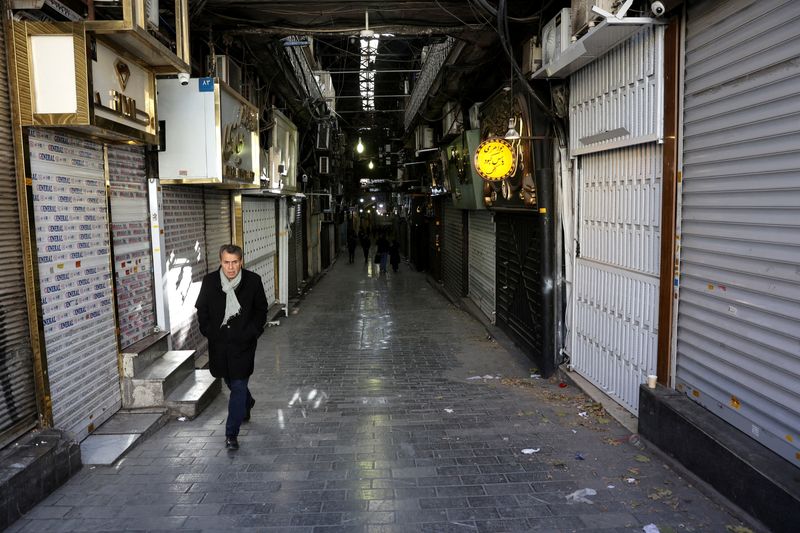
DUBAI (Reuters) – Iran’s bazaar traders, the financial backbone of the 1979 Islamic revolution, have turned against the clerics they helped bring to power, exacerbating economic turmoil and turning into full-scale anti-government protests.
Frustration among bazaar merchants, from small-time shopkeepers to large wholesalers, has grown over decades as their political and economic influence in Iran has eroded while the elite Revolutionary Guards tightened their grip on the economy, creating vast and tightly controlled power networks.
“We are struggling. We cannot import goods due to U.S. sanctions because only the Guards or people linked to them control the economy. They only think about their own interests,” said a trader in Tehran’s historic Grand Bazaar who asked not to be named.
In late December, a wave of protests swept the country in Tehran’s Grand Bazaar, posing one of the most serious challenges ever to the clerical leadership, with hundreds of shopkeepers denouncing the sharp depreciation of the rial currency.
The demonstrations quickly expanded and turned political, challenging the legitimacy of the Islamic Republic. Protesters burned effigies of Supreme Leader Ayatollah Ali Khamenei and chanted “Death to the dictator” but were undeterred by security forces armed with tear gas, batons and, in many cases, live ammunition.
Iran’s rulers, while acknowledging economic difficulties, accuse their long-time foes the United States and Israel of fomenting unrest. They appear bent on retaining power at all costs, and are backed by a security apparatus honed over decades of suppressing ethnic insurgencies, student movements and protests over economic hardship and social freedoms.
The combination of international sanctions and the Guard’s vast economic empire limits the government’s ability to ease the dire economic situation.
Tehran-based analyst Saeed Leilazi said the government had lost control of the situation.
“What is striking is that the riots started in the bazaar. For merchants, the core problem was not inflation but price fluctuations, which left them unable to decide whether to buy or sell,” he said.
The economic gap between ordinary Iranians and the clergy and security elite, as well as economic mismanagement and state corruption (reported even in state media), have stoked discontent at a time when inflation has made many goods more expensive than most people can afford.
In 2025, the Iranian rial has lost nearly half its value against the U.S. dollar, and the official inflation rate reached 42.5% in December.
From oil to construction industry controls
The Guard, founded by the Islamic Republic’s late founder Ayatollah Ruhollah Khomeini, first gained an economic foothold after the Iran-Iraq war in the 1980s, when clerical rulers allowed them to invest in Iran’s leading industries.
Their influence has grown exponentially over the decades thanks to Khamenei’s full support and the opportunities created by Western sanctions that effectively exclude Iran from the global financial and trading system.
The Guard now controls vast sectors of the economy, from oil to transport, communications and construction.
Another trader said the crisis was not over yet as the Guard had long been adept at defending its economic interests.
“The government wants to solve the problem but lacks the means and power in the system. The economy is not controlled by the government,” said the 62-year-old carpet seller in Tehran.
Every aspect of the country’s sanctions-hit oil business is subject to the Guard’s growing influence – from a fleet of shadow tankers secretly transporting sanctioned crude to logistics and front companies that sell oil primarily to China.
A senior Iranian official who spoke on condition of anonymity said: “No one knows how much of the oil revenue the Guards earn from selling Iranian oil returns to the country… Their power is too great to be questioned.”
During his presidency from 2013 to 2021, pragmatist Hassan Rouhani repeatedly clashed with the Guards, publicly accusing them of resisting budget cuts, while his efforts to curb their business networks and assets were largely thwarted.
Agency relies on guards to end riots
Even as it relinquishes economic power, the clerical establishment still relies on its loyal forces—the Guards and its affiliated Basij military units—to violently suppress national uprisings, student unrest, and protests against economic hardship and maintain political order.
An insider close to Rouhani said: “Given the sensitive situation in which the country faces foreign threats, Khamenei cannot anger the National Guard by curbing their economic influence. Those in power need them to quell protests and deal with foreign threats.”
The US human rights group HRANA said that since the protests began on December 28 and spread across the country, 544 people have been verified dead, including 496 protesters and 48 security personnel, and 10,681 people have been arrested. Reuters could not independently verify these statistics.
Authorities did not reveal the number of casualties, but officials said many members of the security forces were killed by “terrorists and rioters” linked to foreign enemies including the United States and Israel.
(Writing by Parisa Hafeez; Editing by Frances Kerry)
