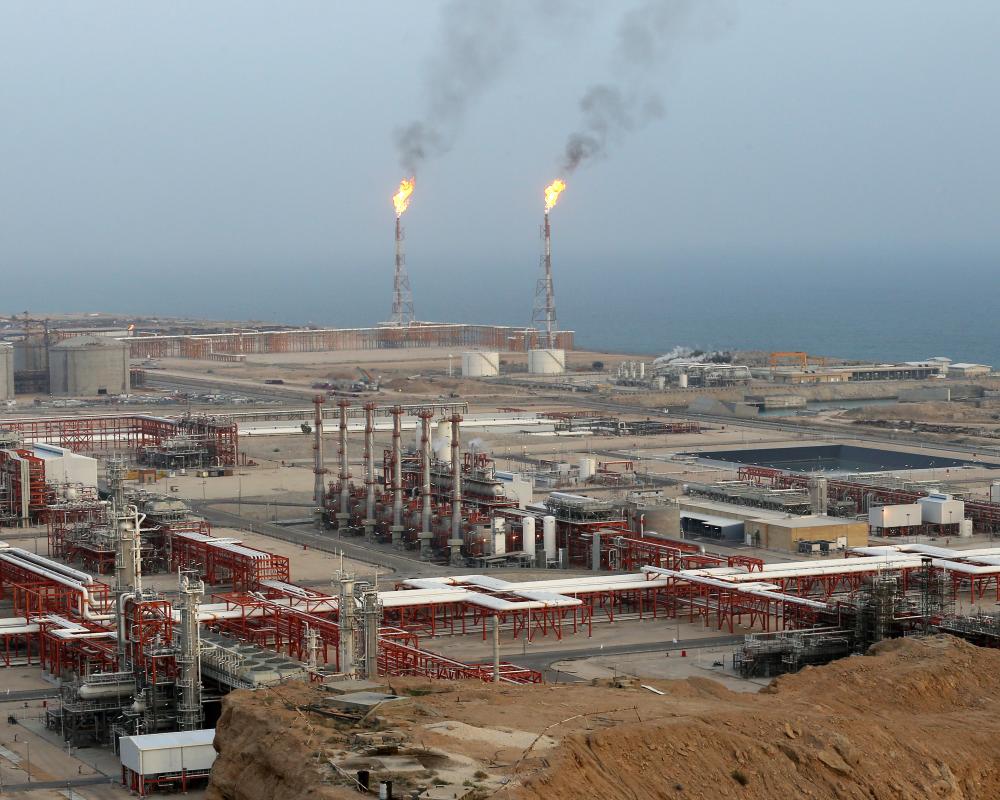
Iran has threatened to attack energy infrastructure across the Gulf in retaliation for an Israeli attack on its largest gas field, the first attack on its fossil fuel production since the war began.
Iran’s Revolutionary Guards threatened to strike back against multiple energy facilities in Saudi Arabia, the United Arab Emirates and Qatar “in the coming hours” after state media reported missiles targeted the giant South Pars oil field, the world’s largest natural gas reserve.
Israeli media have widely reported that the attack on the South Pars gas field shared by Iran and Qatar was carried out by Israel with the consent of the United States.
Related: Middle East Crisis Live: Israel reportedly co-ordinated attack on Iranian gas fields with US; Tehran confirms intelligence minister killed
The attack on the heart of Iran’s natural gas infrastructure marks a major escalation in U.S. and Israeli military operations. The two countries have so far largely spared Iran’s oil and gas industry and helped curb a surge in global oil prices.
Oil prices climbed to $110 a barrel on Wednesday afternoon as growing threats to Gulf oil and gas infrastructure stoked fears of further disruptions to global supplies as an ongoing blockage in the Strait of Hormuz continued.
Iranian state media identified Saudi Arabia’s Samref refinery and Jubail petrochemical complex, the UAE’s al-Hosn gas field and Qatar’s Mesaieed Petrochemical Complex and Holding and Ras Laffan refinery as targets of the regime.
“These centers have been directly and legally targeted and will be targeted in the coming hours. Therefore, all citizens, residents and employees are asked to leave these areas immediately and move to a safe distance immediately,” the warning said.
Eskandar Pasalal, the governor of Asaluyeh, the Iranian capital, condemned the escalation of the conflict between the United States and Israel as “political suicide.” He told Iranian state media that “the pendulum of war has shifted” toward “total economic war.”
Qatari government spokesman Majid Ansari warned that attacks on energy infrastructure “pose a threat to global energy security as well as to the people of the region and their environment.”
The international oil benchmark rose 5% to a high of $108.60 (£81.48) a barrel, while the European gas benchmark rose more than 7.5% to over €55.50 (£47.95) per megawatt hour.
The third week of the war began with an Iranian attack on the UAE’s Shah gas field, one of the largest in the world. Iraq’s Majnu oil field and Fujairah, the UAE’s largest port and oil storage facility, were also hit by Iranian drones and missiles.
Daily oil exports from the region are down at least 60% from pre-war levels due to the impact of drone and missile attacks and Iran’s effective control of exports through the Strait of Hormuz. That’s forcing its Gulf neighbors to cut oil and gas production as pipelines and storage facilities reach their capacity.
But Iran’s hydrocarbon infrastructure has been largely unaffected. The U.S. attack on Khag Island, home to Iran’s oil processing center and the heart of its economy, targeted military assets but left its oil export facilities unaffected over the weekend.
In the weeks since the war began, Iran has continued to ship crude oil tankers through the Strait of Hormuz without interruption, while threatening to burn ships carrying crude from neighboring Gulf states.
Early last week, global oil prices topped $116 a barrel for the first time since May 2022 as traders began to calculate the toll of the war on global oil and gas supplies.
Fossil fuel tankers have struggled to leave the Gulf since the Islamic Revolutionary Guard Corps seized control of the Strait of Hormuz earlier this month. One-fifth of the world’s seaborne oil trade before the war was carried through the Strait of Hormuz.
In addition to delivery constraints, Gulf producers have been forced to shut down their own oil and gas fields as they reroute as much oil as possible through pipelines around the strait and to fill storage facilities.