


Killings of Iranian Tyrants supreme leader ali khamenei The United States and Israel launched an unprecedented joint military attack on Saturday Epic Fury Operation It sparked widespread celebrations from Iranians around the world – and President Trump said it would give them their “best chance” of “taking back their country.” Meanwhile, in Iran, the lack of internet prevents Iranians from easily communicating about day-to-day situations. Over the course of three days, with a limited VPN connection, one witness currently in Tehran (her identity is being withheld for her safety) shared her experience of living in a country at war with The Washington Post’s Natasha Pearlman.
Scumbags are everywhere – and by scumbags, I mean the Iranian military.
Two days ago, they stationed pickup trucks on Shariati Street near a major hospital, pointing machine guns at passers-by.
They make themselves look scary; they cover their entire face, leaving only their eyes exposed, and just stare at others. It seems like they just want to scare everyone. Everything I tell you is what I saw with my own eyes; it’s not just what I heard – it’s my own direct observation.


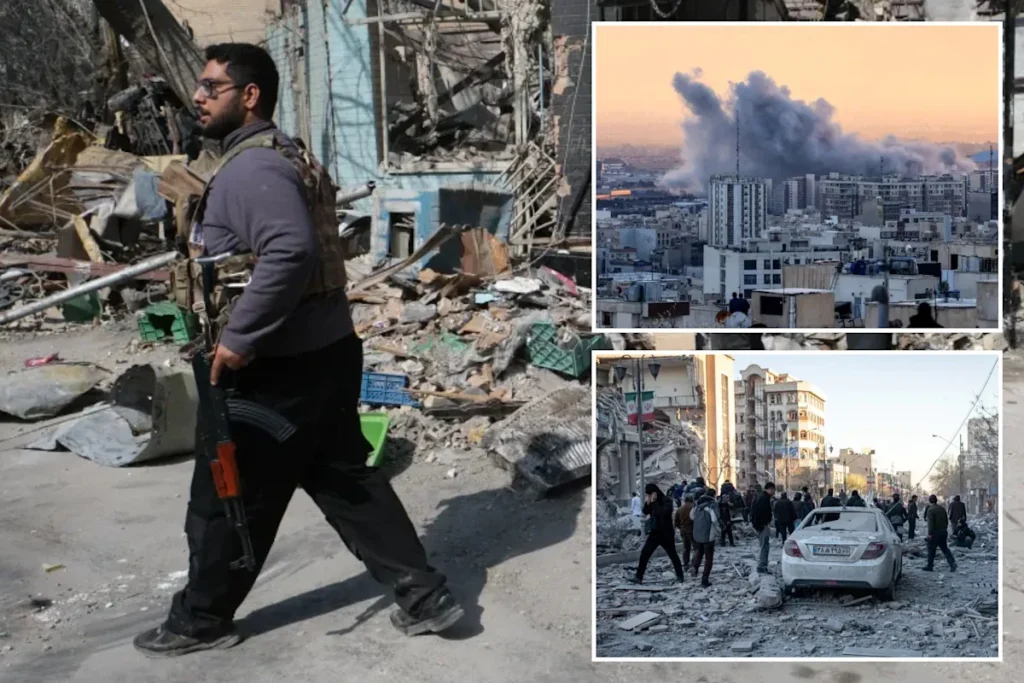
A militiaman armed with an automatic assault rifle walks past the ruins of a storefront in Tehran on Thursday. Getty Images
Then there were scores of militiamen on motorcycles, in teams of two – one driving, one riding behind with a stick or weapon – walking up and down the streets. About two nights, around eight or nine o’clock in the evening, they gathered a bunch of idiots chanting “Allahu Akbar” and “Death to Israel.”
They turned on loudspeakers and loudly played “Noha” (mourning hymns) and other gibberish in the streets of Dowlat and Shariati. These lunatics are everywhere.
As scary as this was, many people were happy. Because, at last, the attack on our persecutors has come.

On Saturday, February 28, the United States and Israel launched an airstrike on Iran, killing Iran’s Supreme Leader Ayatollah Ali Khamenei. Since then, young, heavily armed militias have emerged on the streets – but many insiders are buoyed by the prospect of regime change. AFP via Getty Images
Generally speaking, there has been a “war atmosphere” for about a month. But the two weeks before the war actually began were far more intense. Everyone is talking about it. We are preparing what we might need in case something happens.
Everyone was out buying groceries; it was weird. But what’s very interesting is that 70 percent of the people say, “God, tell them to fight faster. Why don’t they fight?”
Every day when people meet, they’re like, “Hey, how are you? Oh, man, they haven’t fought yet.” That’s what people do.
Regarding the security climate, in Tehran and larger places, they put up a lot of checkpoints on the streets during this time, mostly to harass and intimidate people.
But no one was intimidated.
The day the attacks started – because people didn’t have any internet – it wasn’t easy to know what was going on. Everyone was funneled into Iran International Television Network to get as much attention as possible.
Then, when they reported the news of Khamenei’s killing, everyone’s phone started ringing. My friends and I were at someone’s house, and within five minutes of the news breaking, we could hear screaming, clapping, and cheering coming from all the houses.

Rescue workers and others search for victims after a strike broke out in Tehran on March 3. ISNA/AFP via Getty Images
It was dark, and at midnight, a group of us went out. There we saw people pouring into the streets. They come by car or on foot.
It’s unbelievable that most women don’t wear headscarves.
And then we also heard that the regime told militias and soldiers that they had been given permission to shoot anyone they saw celebrating.
But the strange thing is that the guards at these checkpoints are mostly young kids – maybe 17 or 18 years old. They had apparently just been given guns and told to stand there and scare people.
It sounds strange to say it, but even in the midst of these insider threats, even when the bombs were falling, people were still happy.
Yesterday, one of our friends had surgery and we went to a nearby hospital. There were six of us in the hospital elevator: five were nurses (three we knew, plus two others), and one person said, “Oh, this is a really bad event, they’re attacking ordinary people,” because we were in the hospital and saw something.
But then two of the nurses turned around and said, “Well, this is war after all, but we’re all happy. Eventually, we’ll be free.”
Even in these tough, stressful conditions, we’re happy – thank God they hit them.
People are really happy that Khamenei is finally dead.
Everyone is paying attention to this news, waiting to see who will be eliminated next. There’s this wave of energy. Among young people, this feeling is very strong.
But you can’t say they weren’t stressed or worried, because even if the missiles they fired were very accurate and hit their target, the intensity of the explosion would still affect ordinary people in nearby houses.
And older people are more stressed because they still remember the situation and the war from 1980 to 1988.
And, everything is closed: all the shops. As Iran’s Nowruz holiday (the Persian New Year, which starts on Friday, March 20) approaches, it is the peak sales period, but everyone is forced to close their doors. So although there was anxiety, people were really happy.
One thing we’re interested in: during that 12-day war in June 2025, people fled north or elsewhere to hide and stay safe.
But this time – for now – only a few people left on the first or second day; the rest stayed in Tehran and we lived a strangely normal life. People will not leave because they have great faith that Israel and the United States can achieve their goals.
That’s why when you go out, the shops are closed but the cars are still driving on the streets – life seems much more normal than it did during those 12 days last year.
What happens next? Who do we want to take over this country?
Now, of course, most people are supporters of the exiled Iranian Crown Prince Reza Pahlavi. Whoever you talk to says Pahlavi will come, the king will come. But now there are conflicting reports that Khamenei’s son wants to succeed him – it’s unclear whether he is dead or alive – but there are serious concerns.
I’m one of those people who’s worried; I don’t think the regime is going to let the country off easily. But most people want them gone.

Thick smoke billows from Tehran on Tuesday after an attack. AFP via Getty Images
There was a lot of discussion about electing someone from within Iran because they said Reza Pahlavi had not been to Iran and had not experienced or knew certain things. But now, the majority supports Reza Pahlavi.
For me and the people around me, we’re really glad this happened.
As the bombs fell, we excitedly walked up to the rooftops to see where they would hit next. And then we started dancing and clapping and celebrating – like, “Yeah! They found where these scumbags are again!”
We hope that the matter can be resolved in favor of the people as soon as possible. It was a stressful situation, but we actually did well together and enjoyed – if that’s not too weird a word – war situations.
All we can hope for is that good things happen to everyone. The Islamic Republic is doing “good things.”
But they need to be struck and destroyed – because they usually don’t leave.
In other parts of the world, when there is a war, even if there are no alerts like in Iran, they keep the internet open so that, for example, when Israel declares that it is staying away from certain areas, people understand. But these bastards chopped it off on purpose so more people would die. This makes the situation worse.
But as long as the regime in Tehran falls, people here will accept the status quo in Tehran. Yesterday, a woman said to me: “I want them gone, even at the cost of my own life. Just let them go.”
People have reached that point.