


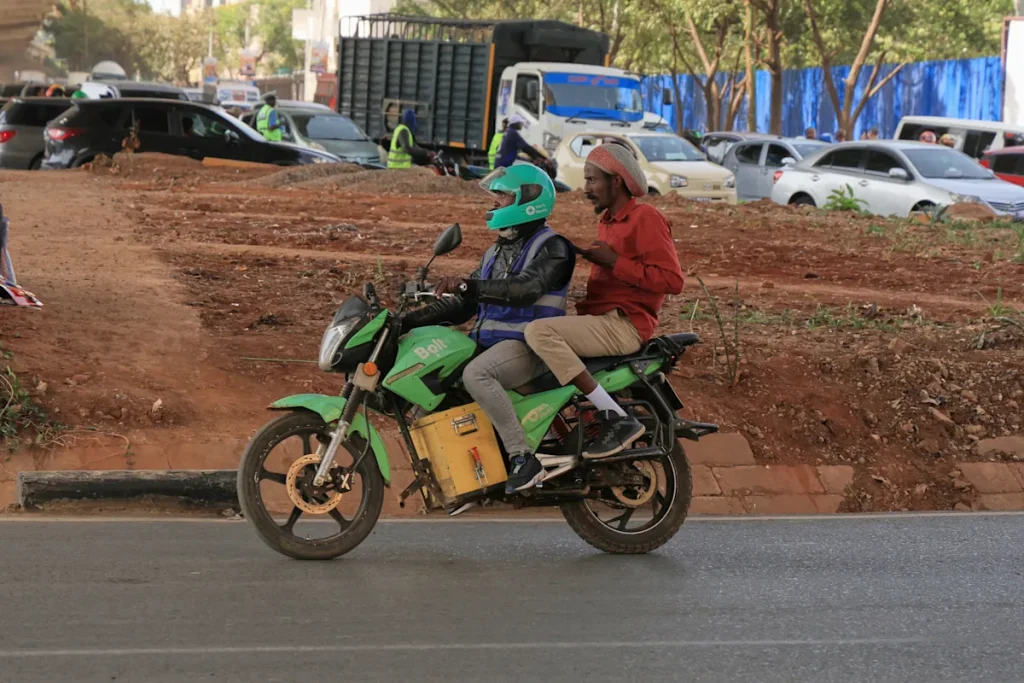
NAIROBI, Kenya (AP) — For weeks, popular Kenyan podcaster and radio show host Francis Kibe Njeri has been using his social media platforms to shine a spotlight on a problem he says many electric motorcycle riders face, but few in the industry acknowledge: Batteries cannot be replaced online, and motorcycles can be remotely disabled after periods of inactivity.
Electric motorcycles, also known as e-bikes or e-bikes, are becoming popular across Africa, led by companies such as Ampersand, ARC Ride and Roam. Spiro, the continent’s largest e-bike company, operates more than 1,200 battery charging and swapping stations and has deployed about 60,000 electric motorcycles, according to its latest public filings in late 2024.
In his widely shared post, Njeri claimed that the remote locking features of some operators rendered e-scooters unusable, leaving riders who depended on e-scooters for a living in limbo. He is one of many calling for a more open, standardized battery system.
“It’s unfair that we buy bikes but the battery remains the property of the manufacturer and we can only use their charging stations and not charge at home,” Njeri said.
Electric bike riders take to the streets
In November, hundreds of Kenyan e-bike riders took to the streets in Nairobi and the coastal city of Mombasa, chanting slogans and waving placards demanding more battery-swapping stations and an open network.
“Every time I can’t find a transfer point, I lose up to 500 Kenyan shillings ($4.50),” said Nairobi rider Oscar Okite. Oscar Okite said he adopted an e-bike to reduce operating costs, but said the scarcity of transfer points limited his earning potential. “We need battery networks that work everywhere, not just in cities.”
Electric motorcycles powered by replaceable lithium-ion batteries are cheaper to use than gas-powered bikes. Most of these companies say passengers can save up to 40% on daily operating expenses because electricity is cheaper than fuel and maintenance is simpler.
However, access to battery-swapping stations, which are hubs where passengers swap depleted batteries for fully charged ones within minutes, remains uneven. Networks run by Spiro, Ampersand and their rivals already have dozens of stations in Nairobi and other urban centres, but gaps remain outside major corridors and in remote areas.
“When I get close to the right place to swap, it’s awesome,” Njeri said. “But leave two or three towns and you can get stuck.”
E-bike ecosystem limits flexibility
Electric motorcycle companies in Africa have mostly established vertically integrated systems, where vehicles, batteries and charging infrastructure are designed to operate within a single brand’s ecosystem.
The latest data from the African Electric Vehicle Alliance shows that East Africa has more than 89 active electric vehicle companies, followed by 46 in Southern Africa, 39 in West Africa and 19 in North Africa. There are only six such companies in Central Africa.
Most are e-bike companies, with 16% offering tricycles.
East Africa also accounts for the majority of EV investment, at $207 million as of September, followed by West Africa at $173 million and Southern Africa at $100 million.
The backbone of the e-bike business is the battery-swapping network, an energy system that has proven effective in parts of Asia and Europe. But critics say a fragmented system in which batteries and charging stations are tied to specific brands because of their proprietary technology is hampering growth, despite support from government policies.
Eric Tsui, commercial manager at asset finance company Watu Africa, said: “The lack of interoperability between charging stations and battery swapping stations remains one of the biggest bottlenecks in scaling up the industry.”
“The worst-case scenario, from both a financing and consumer perspective, is that many interchange stations are unable to serve all passengers,” he said. “We need interoperability so that batteries can be charged or replaced at any station, regardless of operator.”
Businesses say sharing is complicated
Shared switching networks are critical to scaling electric vehicles. But the investment cost is higher.
Building a network involves not just batteries and charging stations, but also land, security, software systems and ongoing maintenance. Companies need millions of dollars to achieve a return on investment. Standardizing battery sizes, safety protocols and payment systems across companies also involves complex technical and commercial negotiations.
Spiro CEO Kaushik Burman said he’s open to tethering if it’s done safely, pointing to battery safety standards in place in Singapore and India. He added that his company welcomes “manufacturers who want to build e-bikes that can run on our battery system.”
“We will do integration, testing and certification before allowing them in,” he said. “However, openly allowing any battery to enter any switching station without integration would be a recipe for disaster and we cannot accept it.”
There are signs of change
Ampersand announced plans in January to expand its battery swap network to other electric motorcycle manufacturers, allowing compatible bikes to use its infrastructure in the first system of its kind in Africa.
“This open platform approach means more manufacturers can enter the market without having to build separate charging infrastructure,” said Josh Whale, CEO of Ampersand. “In the electric vehicle space in Africa, one company often controls the bike and battery network, but that is not how the energy market should work.”
Ampersand sees itself as a battery “gas station” into which e-bikes with battery packs that meet quality and safety standards should be able to plug in, Whale said. E-bikes from other companies, such as Wylex Mobility, can be plugged into Ampersand’s network in Kenya and Rwanda, expanding their reach for riders.
Passengers say the changes are long overdue.
“When I can’t switch on time, my business suffers,” said Kevin Macharia, an e-bike rider in Nairobi who sometimes refuses rides and delivery requests when the rates are lower because he fears he will risk traveling too far from the switching station. “We use electric cars to make more money, not to sit on the side of the road.”
___
AP’s climate and environment coverage receives financial support from multiple private foundations. The Associated Press is solely responsible for all content. Find AP’s criteria for working with charities, supporter lists and grant coverage at AP.org.