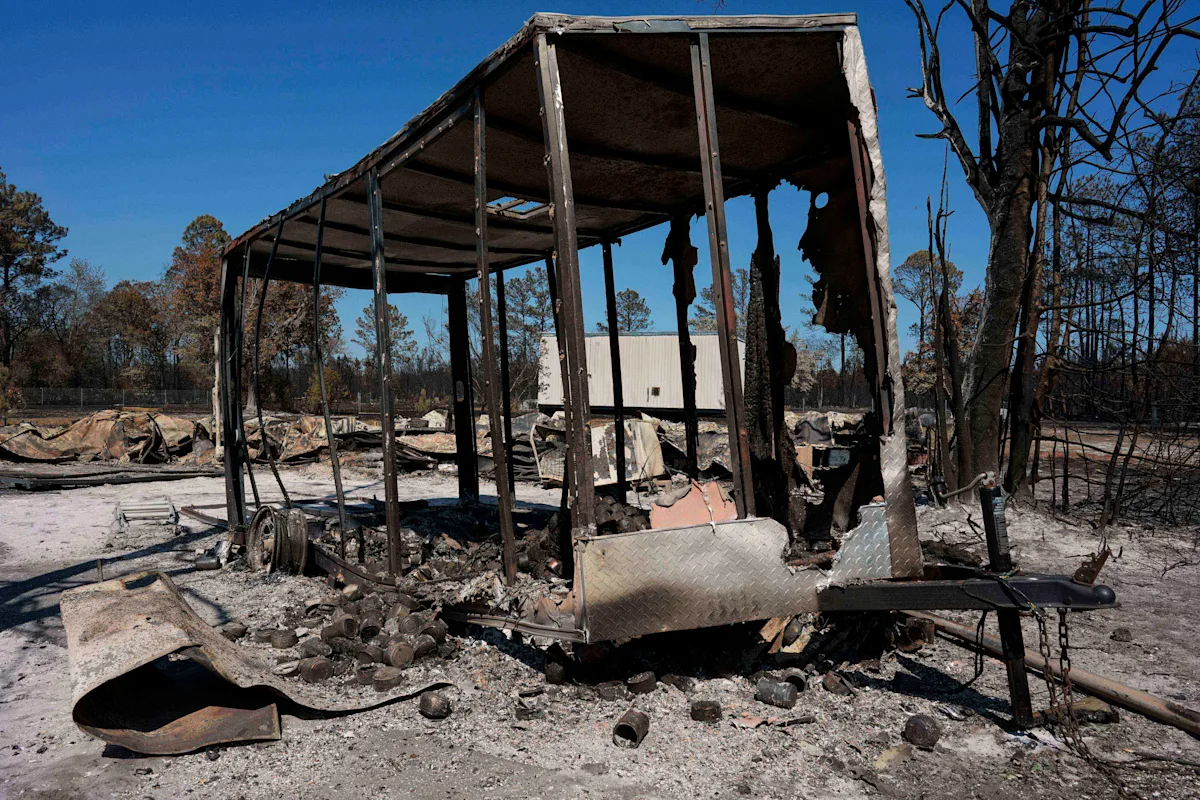
Fire scientists say wildfires are generally considered a bigger problem in western North America, but in the east they are becoming more intense, frequent and destructive, such as this week’s fires in Georgia that destroyed more than 50 homes.
Researchers blame a variety of factors, including climate change that makes fuels drier and more flammable, record droughts, Hurricane Helene that killed tens of millions of tons of trees, and large areas where dense forests and large populations try to coexist.
So far this year, 2,802 square miles (7,258 square kilometers) of land in the United States have burned in wildfires, mostly in Nebraska, an area with rare large-scale wildfires that are 88% above the 10-year average for this time of year, according to the National Interagency Fire Center. This comes as much of the country has recorded its warmest winter and a drought in March and April.
“The warmer the temperatures, the more fires you’re going to see. The fire season is longer, there’s probably going to be more lightning, and the fuels are drier,” said Mike Flannigan, a fire scientist at Thompson Rivers University in British Columbia, Canada. “I think we’re going to see more fires in the east. We’re going to see more intense fires.”
Fires intensify in eastern region
The number of fires, their likelihood of occurring and the amount of land burned increased across much of the southeastern United States from 1984 to 2020, according to a 2023 study by University of Florida fire ecologists Victoria Donovan and Carissa Wonkka.
“Historically and today fires in the East are much smaller than in the western United States, so they may not always cause the same concern as fires in the West. But we’re now starting to see this shift in dynamics in the East, and we’re starting to quantify it,” Donovan said Thursday. “Although the changes we’re seeing in the East are much smaller than the changes we’ve quantified in the West, we think it’s important to start addressing this issue now.”
Three months ago, Donovan, Wonka and other fire scientists created a new network for fire researchers to study eastern fires, Wonka said, because some of the issues experts learned from the West might not apply to the East.
Although fires in the West are larger, more pronounced, and spread faster, more people are caught in the fires in the East, which scientists call the Wildland-Urban Interface (WUI).
“We found that 45 percent of all large wildfires in the East burned parts of the wildland-urban interface, and 55 percent burned, so many of the large wildfires were associated with WUI fires,” Donovan said.
Additionally, forests in the east are denser and less likely to be sparse than those in the west, Donovan said.
Hurricane Helen creates a ‘ticking time bomb’
A week ago, federal and state officials studied the drought, weather and millions of dead trees left by Hurricane Helene in 2024 and issued recommendations to be wary of fires, said Nick Nauslar, fire science and operations officer for the National Weather Service at the National Interagency Fire Center in Boise, Idaho.
“They’re thinking, you know, they’re probably going to see more fires and the fires they encounter are going to be more difficult to control,” Nosrael said. “A lot of the areas where Helen caused damage were warmer and drier than normal. So there’s potential there. You have excess fuel because now (the trees) are dead and at the mercy of weather and climate. And then if you get dry and windy conditions, if you get a fire, it’s more likely to catch fire and spread.”
In Georgia alone, 13,954 square miles (36,142 square kilometers) of forestland were hit by Hurricane Helene, downing more than 26 million tons of pine trees and 30 million tons of hardwoods, according to a November 2024 timber damage assessment from the University of Georgia and the Georgia Forestry Commission.
“A lot of us are concerned about the accumulation of fuel after Helena. It’s a ticking time bomb,” said Marshall Shepherd, a professor of meteorology at the University of Georgia.
Dry air can make it worse
But it’s not just downed trees, the dry air also increases the likelihood of fires. Nauslar and Flannigan say it’s not just a lack of rain, but the low humidity in the air itself that’s causing the problem.
“As we warm… the atmosphere’s ability to absorb moisture from dead fuels — not live fuels, but dead fuels — increases almost exponentially as temperatures increase,” Flannigan said. “Drier fuels are more likely to catch fire, meaning more fuel is dry and available to burn, which can lead to higher-intensity fires that are difficult to extinguish.
“That’s what we’re seeing now starting to invade the east,” Flannigan said. Human-caused climate change is clearly at play, he said.
___
AP’s climate and environment coverage receives financial support from multiple private foundations. The Associated Press is solely responsible for all content. Find AP’s criteria for working with charities, supporter lists and grant coverage at AP.org.