NUSERAT, Gaza Strip (AP) — In a wheelchair, Haneen al-Mabhouh dreams of rebuilding her family and holding a new baby in her arms. She dreams of walking again. But she said the loss of her leg has put her life in Gaza on hold as she awaits further treatment abroad.
In July 2024, she and her family were sleeping when an Israeli airstrike destroyed her home in central Gaza. All four of her daughters were killed, including her 5-month-old baby. Her husband was severely burned. Al-Mabhouh’s legs were crushed by rubble and doctors had to amputate her right leg above the knee.
“For the past year and a half, I haven’t been able to move around and live like other people. For the past year and a half, I haven’t been able to have children,” she said at her parents’ home.
A ceasefire in Gaza has lasted two months, but the deal has been slow to bring help to the thousands of Palestinians whose limbs have been amputated by Israeli bombings over the past two years. The World Health Organization estimates that there are approximately 5,000 to 6,000 war amputees, 25% of whom are children.
Those who have lost limbs are struggling to adapt, facing shortages of prosthetics and long delays in medical evacuation from Gaza.
The World Health Organization said a critical shipment of prosthetic supplies recently arrived in Gaza. This appears to be the first significant shipment in the past two years.
Loay Abu Saif, head of the Medical Assistance for Palestinians (MAP) disability program, and Nevin Al Ghussein, acting director of the Center for Artificial Limbs and Polio in Gaza City, said Israel has imported almost no ready-made prosthetics or materials to make them since the war began.
COGAT, the Israeli military agency responsible for coordinating aid, did not respond when asked how many prosthetic supplies came in during the war or its policy on such supplies.
‘My future is paralyzed’
She said Al-Mabhouh was sleeping in her arms when the strike hit their home in Nuserat. During the weeks she spent recovering in hospital, Mabhu had no idea her children had been killed.
She underwent multiple surgeries. She still had trouble moving her hands. Her remaining leg was still broken and held together with a stick. She needs bone grafts and other treatments that can only be done outside Gaza.
She was put on a medical evacuation list 10 months ago but has still not been granted permission to leave Gaza.
She was living at her parents’ house, waiting for the chance to leave. She needed help changing her clothes, couldn’t even hold a pen, and she was still grieving for her daughter. “I never heard her say ‘mom,’ saw her first tooth or watched her take her first steps,” she said of her child.
She dreamed of having a new child, but she couldn’t do it until she got treatment.
“This is my right to live, my right to have another child, my right to take back what I lost, my right to walk, my right to just walk again,” she said. “Now my future is paralyzed. They destroyed my dreams.”
Medical evacuation remains slow
The United Nations said the ceasefire did not increase the medical evacuations of 16,500 Palestinians who are waiting abroad to receive vital treatment – not just amputees but also patients with multiple chronic illnesses or wounds.
As of December 1, 235 patients had been evacuated since the ceasefire began in October, less than five a day. In the months leading up to this, the average was about three a day.
Israel said last week it was ready to allow patients and other Palestinians to leave Gaza through the Israeli-controlled Rafah crossing between Gaza and Egypt. But it is uncertain whether that will happen, as Egypt, which controls the other side of the crossing, has demanded that Rafah also open to allow Palestinians to enter Gaza, as required by the ceasefire agreement.
Dr. Richard Piepelkorn, the World Health Organization’s representative in the occupied Palestinian territories, told The Associated Press that the backlog was caused by a lack of countries to accept evacuated patients. He said new medical evacuation routes needed to be opened, especially to the Israeli-occupied West Bank and east Jerusalem, where hospitals were ready to receive patients.
For those who wait, life comes to a standstill
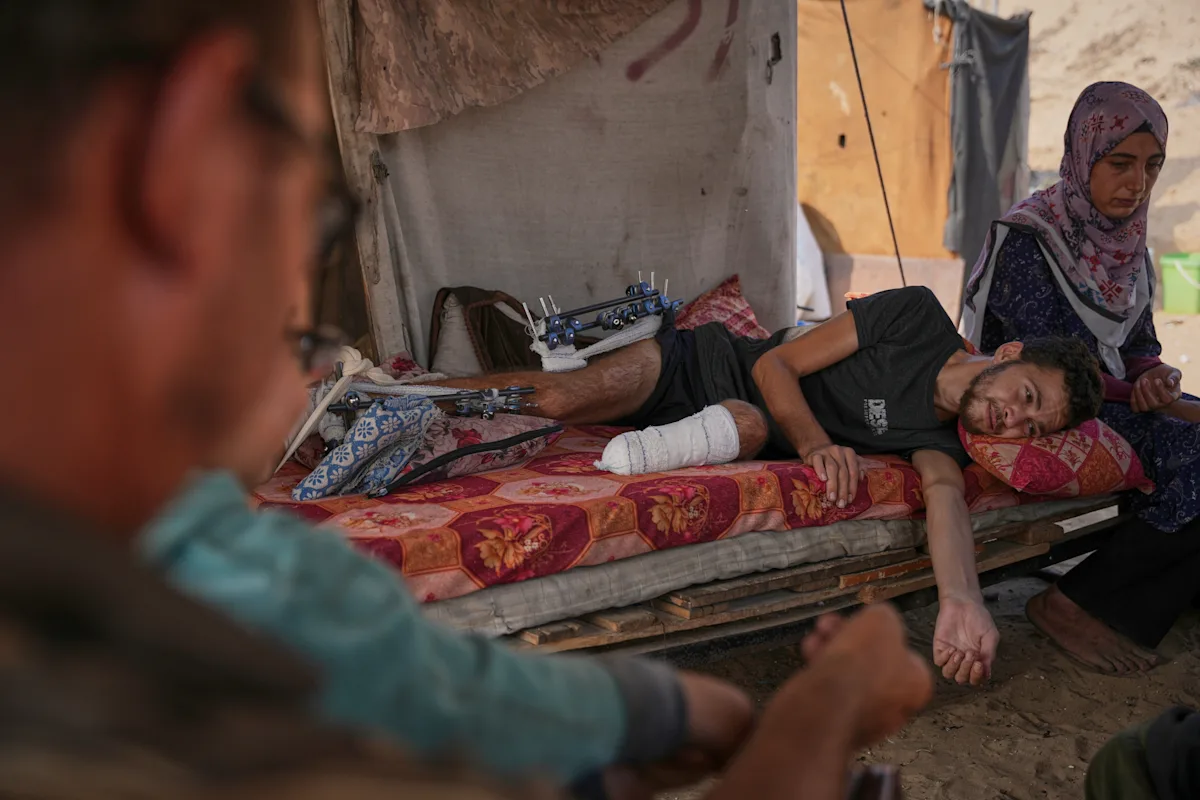
Yassin Ma’ruf lay in a tent in central Gaza, his left foot amputated and his right leg barely held in place by a stick.
The 23-year-old and his brother were forced to flee in May when they came under Israeli shelling as they returned from their home in northern Gaza. His brother was killed. Ma’ruf lay bleeding on the ground when a stray dog attacked his injured left leg.
Doctors said his right leg would also need to be amputated unless he could travel abroad for potentially life-saving surgery. Maloof said he couldn’t afford painkillers and couldn’t make the regular trips to the hospital to have his bandages changed.
“If I want to go to the bathroom, I need two or three people to hold me,” he said.
Before the war, Mohamed al-Naggar had been studying for a degree in information technology at a Palestinian university.
Seven months ago, the house where his family had taken refuge was attacked and shrapnel pierced his left leg. Doctors amputated his leg above the knee. His right leg was also seriously injured, and shrapnel still remained in parts of his body.
Despite four surgeries and physical therapy, 21-year-old al-Naggar is still unable to move.
“I want to travel abroad, wear prosthetics, graduate from university and be normal like young people outside Gaza,” he said.
Gaza faces prosthetic limb shortage
The World Health Organization said in an October report that some 42,000 Palestinians suffered life-changing injuries during the war, including amputations, traumatic brain injuries, spinal cord injuries and severe burns.
The situation has “slightly improved” for those who require assistance, but “there remains an overall critical shortage of assistive products” such as wheelchairs, walkers and crutches. The World Health Organization said in a statement to The Associated Press that Gaza has only eight prosthetists capable of making and fitting prosthetic limbs.
Al Ghussein, director of the Center for Prosthetics and Polio in Gaza City, one of two still operating in the area, said the center received a shipment of materials to make prosthetics before the war began in 2023. Another small shipment came in in December 2024, but there has been no news since.
Al Ghussein said the center had provided prostheses to 250 cases during the war, but supplies were running out.
No prefabricated prosthetic limbs or limbs have come in, said MAP’s Abu Saif, who said Israel did not ban them but its procedures caused delays “that they ultimately ignored.”
Ibrahim Khalif wants a prosthetic right leg so he can find a job as a manual laborer or cleaning houses to support his pregnant wife and children.
In January, he lost a leg in an Israeli airstrike in Gaza City while he was out collecting food.
“I used to be the provider for my children, but now I’m sitting here,” Khalif said. “I think about who I was and what I have become.”