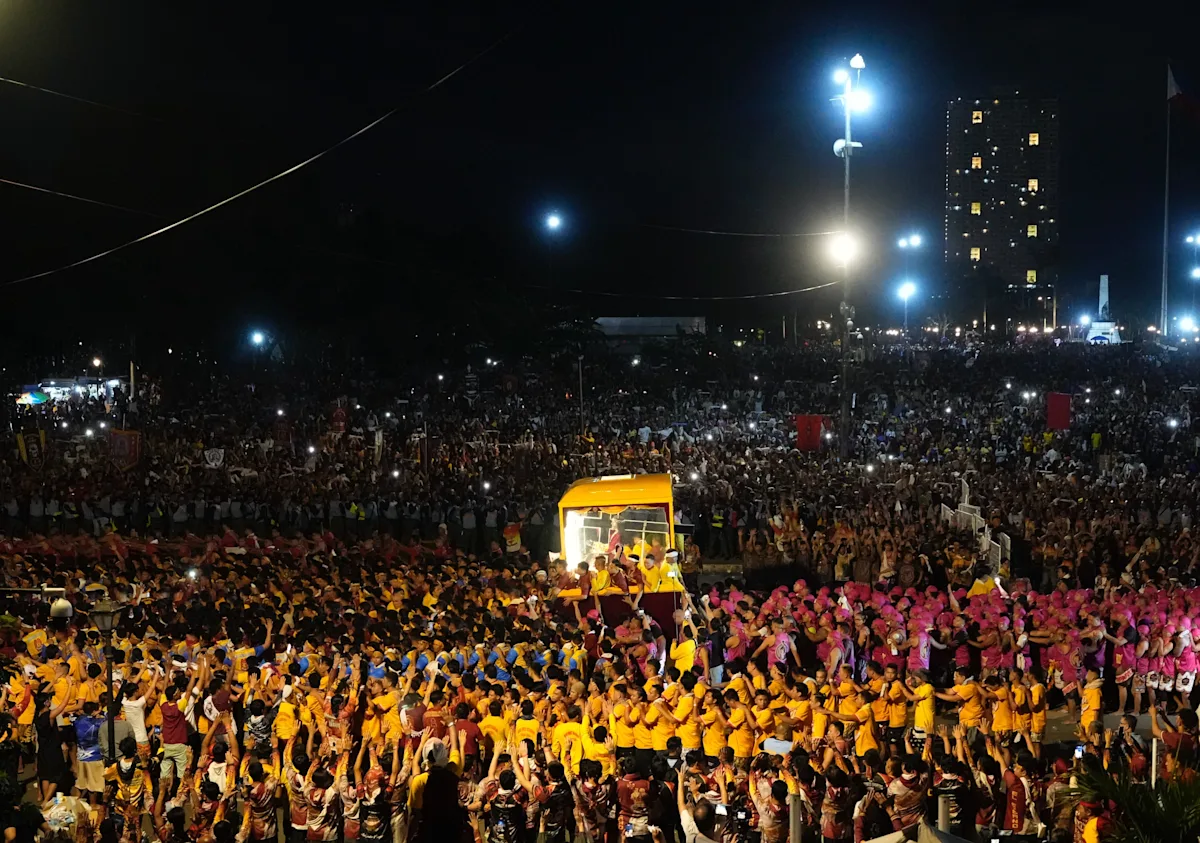
MANILA, Philippines (AP) — A large group of Filipino Catholics took part in an annual march in the Philippine capital Friday to commemorate a centuries-old statue of Jesus Christ, with some using the rally to express anger over a corruption scandal involving influential lawmakers.
After a midnight mass attended by tens of thousands of worshipers at Manila’s Waterfront Park, a wooden statue of Jesus of Nazareth was placed on a horse-drawn carriage before dawn before a procession that Manila Mayor Isco Moreno claimed could attract millions of worshippers throughout the day and into the night.
One of Asia’s major religious spectacles, processions of the life-size statues often raucously wind through nearly six kilometers (3.7 miles) of congested narrow roads near Manila’s heavily fortified presidential palace and are a security nightmare for authorities.
Some 15,000 police officers, supported by intelligence agents, were deployed to maintain order. Authorities implemented gun and alcohol bans, banned the use of drones and backpacks, and jammed cell phone signals along the parade route. First aid tents manned by government and Red Cross medical personnel were set up along the route.
Around 10 a.m., hundreds of thousands of worshipers, many wearing maroon shirts emblazoned with images of the Nazarene, scrambled to get closer to the carriage carrying the statue. Many people tried to climb onto the carriage or throw small towels at volunteers on the carriage to wipe parts of the cross and statue, believing that the statue of the Nazarene could heal illnesses and help provide good health, jobs and a better life.
This year’s Nazareth march coincides with growing public anger over a major corruption scandal that broke out last year, involving dozens of members of the House and Senate who allegedly received huge kickbacks from construction companies. The scandal involves thousands of substandard or non-existent flood defense projects across the archipelago, which is prone to some of Asia’s deadliest flash floods.
Several government engineers and construction company executives have been detained as they face corruption trials. Many Filipinos have expressed frustration at the delay in implementing President Ferdinand Marcos Jr.’s vow before last Christmas to jail lawmakers accused of wrongdoing.
As they marched, large numbers of worshipers repeatedly chanted: “Jail them now, jail them now.”
The anomalies are said to have begun years ago under former President Rodrigo Duterte and may involve a large number of government officials and lawmakers whose lavish lifestyles, limousines, private jets and mansions sparked street protests, some led by the dominant Roman Catholic Church.
In his homily at a mass held at the Rizal Park Grandstand before the march, Bishop Rufino Sescon criticized officials who were implicated in the corruption scandal by witnesses during televised congressional hearings but who refused to resign despite public outrage.
“Today in our country there are people who refuse to step down, even though they made mistakes and were caught, even though they caused hardship to the people, even though the poor are suffering, even though the country is being flooded and destroyed,” Sescon said. “Enough, enough. Have mercy on the people. Have some shame. Voluntarily step down in the name of mercy and love;”
Venus Lopez, a 62-year-old believer who held a replica of the statue of Nazareth, made a similar appeal.
“I want those corrupt government officials to disappear. They don’t deserve to be in power,” Lopez told The Associated Press, adding that she would pray to the people of Nazareth to help them drive corrupt officials out of government.
This life-size statue, wearing a crown of thorns and carrying a cross, is believed to have been brought to Manila from Mexico in 1606 by Spanish missionaries on a galleon. The ship carrying it caught fire, but the charred statue survived. Some believe the statue’s endurance from fires and earthquakes over the centuries, as well as heavy bombing during World War II, is evidence of what they say is mystical powers.
The spectacle reflects the unique characteristics of Catholicism in Asia’s largest Catholic country, including folk superstition. Dozens of Filipinos crucify themselves on Good Friday, another tradition to emulate the sufferings of Christ that draws huge crowds every year.