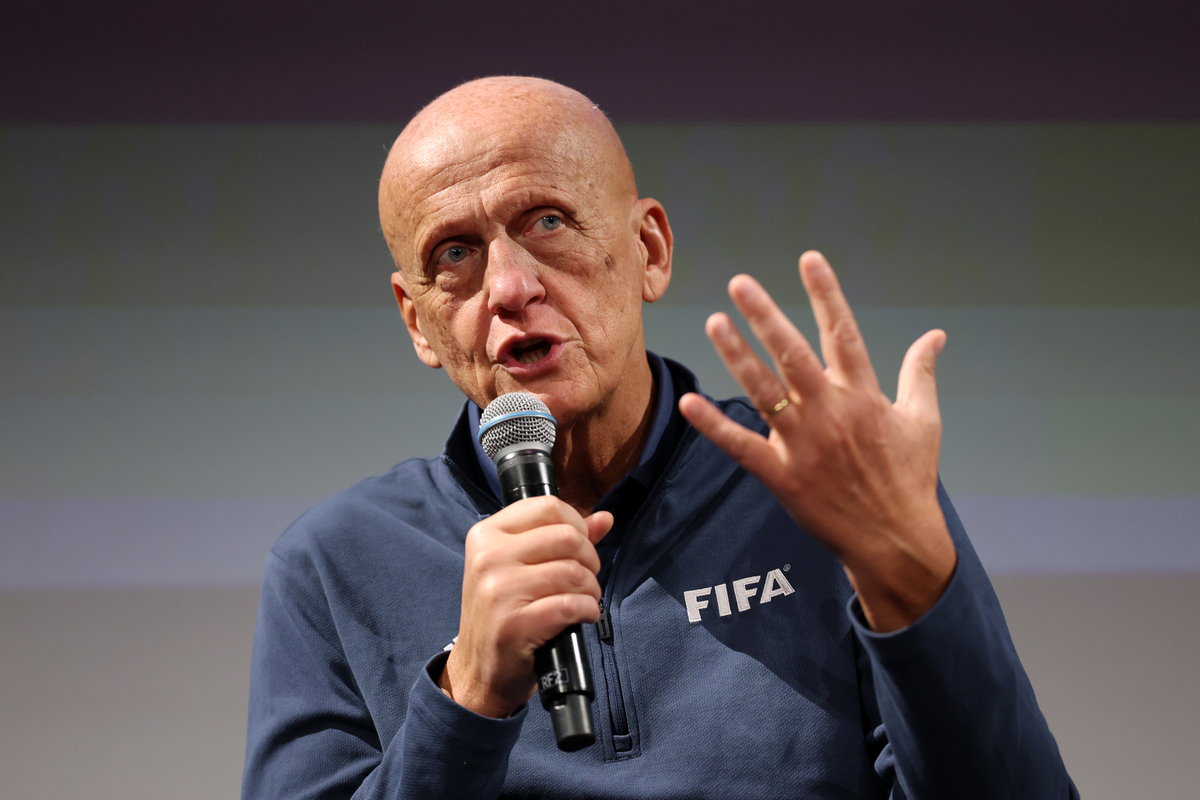
Legendary former referee Pierluigi Collina has given his opinion on the raft of VAR and officiating reforms set to come into effect during the 2026 FIFA World Cup in North America: “The goal is to eliminate as much time as possible”.
Collina explains upcoming VAR and refereeing changes
Collina is a member of the UEFA Referees Committee and the Chairman of the FIFA Referees Committee. He attended the International Football Association Board (IFAB) annual general meeting in Wales on Saturday.
advertise
IFAB oversees and sets the rules of the competition. Its members met in Wales on Saturday to discuss and decide on a number of changes, including new measures to combat time wasting and allowing VAR to intervene in second yellow card decisions, rather than just straight red card incidents.
“Our goal is to eliminate or as far as possible eliminate the waste of time that affects the excitement of the game,” Collina told Gazzetta dello Sport of the upcoming changes to Saturday’s decision.
WASHINGTON, DC – DECEMBER 5: Pierluigi Collina, Chairman of the FIFA Referees Committee, attends the official draw for the FIFA 2026 World Cup at the John F. Kennedy Center for the Performing Arts on December 5, 2025 in Washington, DC. (Photo by Kevin Dickey/Getty Images)
advertise
“Last year we introduced the ‘eight-second rule’ for goalkeepers, which was a huge success. Corners were rarely awarded. The deterrent worked.”
“Given the amount of time wasted with so many goal kicks and free kicks, we felt we needed to find a solution.”
Another rule that will be introduced at the FIFA World Cup is a 10-second limit on the time players can leave the pitch after a substitution has been announced. If a player fails to leave the field within the allotted 10 seconds, the substitute will not be allowed to take the field until the next stoppage of play or one minute after the end of the game.
“We’ve done something to get substitutes off the pitch from their nearest position. Time limits are a more effective deterrent than yellow cards, which are sometimes seen as some sort of ‘trade’,” Collina said. “MLS results in recent years show this measure is effective,” he added.
advertise
Importantly, VAR will now be able to intervene in the decision of a second yellow card, whereas previously this was not the case.
Just two weeks ago in Serie A, Pierre Kalulu was wrongfully sent off for a second foul in one of the biggest games of the season, the Italian derby between Inter Milan and Juventus, but referee Federico Lapena was unable to refer the incident for review. This will no longer be the case as this is not a direct red card incident.
MILAN, ITALY – FEBRUARY 14: Juventus player Pierre Kalulu walks off the field after being sent off for a second yellow card foul by referee Federico Lapena (not pictured) during the Serie A match between Inter Milan and Juventus at the Giuseppe Meazza Stadium on February 14, 2026 in Milan, Italy. (Photo by Marco Luzani/Getty Images)
advertise
Some may argue that VAR should always be able to intervene for a second yellow card foul, not just a straight red card incident.
“When we decided to trial VAR in 2016, the technology was very different,” Collina explained. “The protocol was written from scratch and took inspiration from other sports such as rugby, which video officials had no previous experience of. The situation today is very different.
“We’ve been talking about this for a few years and unfortunately, until now, some people haven’t considered it a priority, which is a real shame.”
VAR can now also review corner kick decisions, something that was not possible before.
RIYADH, SAUDI ARABIA – DECEMBER 22: Detailed view of the corner flag inside the stadium before the Italian Super Cup final between SSC Napoli and FC Bologna 1909 at the King Saud University Stadium in Riyadh, Saudi Arabia on December 22, 2025. (Photo by Yasser Bakhsh/Getty Images)
advertise
“A corner kick is the restart of the game and it always takes a certain amount of time,” Collina said. “Normally you have to wait until the centre-backs come up and the kicker often has to go the length of the field. At that point it might just take one look at the image to realize that the decision was wrong.
“Does it make sense to let the corner kick go and hope not to score? It’s better to correct the original decision and postpone it.”