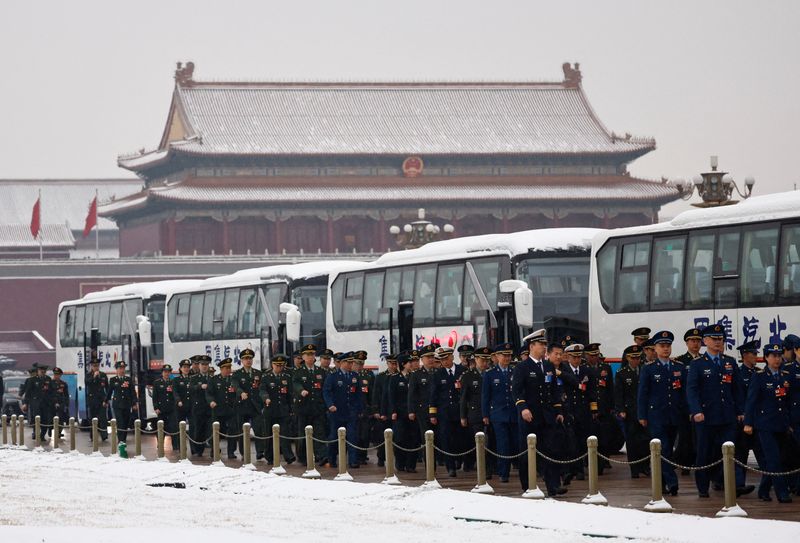
Author: Laurie Chen and Eduardo Baptista
BEIJING, March 5 (Reuters) – China announced on Thursday that it is now a world leader in research and development of artificial intelligence and other key areas such as quantum technology, and vowed to accelerate efforts to achieve greater technological self-reliance.
The claim was made in a government report released at the opening session of the National People’s Congress, China’s rubber-stamp parliament.
A report from the National Development and Reform Commission said: “Currently, our country is leading the world in research and development and application in the fields of artificial intelligence, biomedicine, robotics, quantum technology, etc., and has made new breakthroughs in independent chip research and development.”
In the opening paragraphs of Prime Minister Li Qiang’s major government work report, the government emphasized its commitment to technology, a so-called “new high-quality productivity” area. This is even more prominent than last year’s report.
New high-quality productivity will account for the majority of projects in the yet-to-be-released five-year plan for 2026-2030, the report said.
China is competing with the United States for dominance in key technologies. This has led to intense trade friction between the two sides, with both sides imposing export controls on some key products and resources – especially advanced chips in Washington’s case, and rare earths and critical minerals in Beijing’s case.
Shedding reliance on Western technologies such as chips and aircraft has been a major theme in Beijing, as has gaining leadership in emerging industries such as artificial intelligence.
Humanoid robots and data centers
A major government work report outlines how the country plans to increase investment in some cutting-edge scientific areas, such as machine-brain interfaces. China is also doubling down on investments in industries it dominates, such as quantum technology, physical artificial intelligence (the technology that powers humanoid robots) and 6G.
“Beijing is making artificial intelligence, especially physical artificial intelligence, a major area of focus,” said Kyle Chan, China technology fellow at the Brookings Institution think tank.
“Beijing aims to use artificial intelligence and robotics to improve productivity and performance in sectors ranging from manufacturing and logistics to education and healthcare.”
In the broader artificial intelligence industry, China is seeking to challenge the leadership of U.S. tech giants and startups, with Beijing pledging to build “hyper-scale” computing clusters backed by cheap and plentiful electricity and to support the building of an open-source AI community.