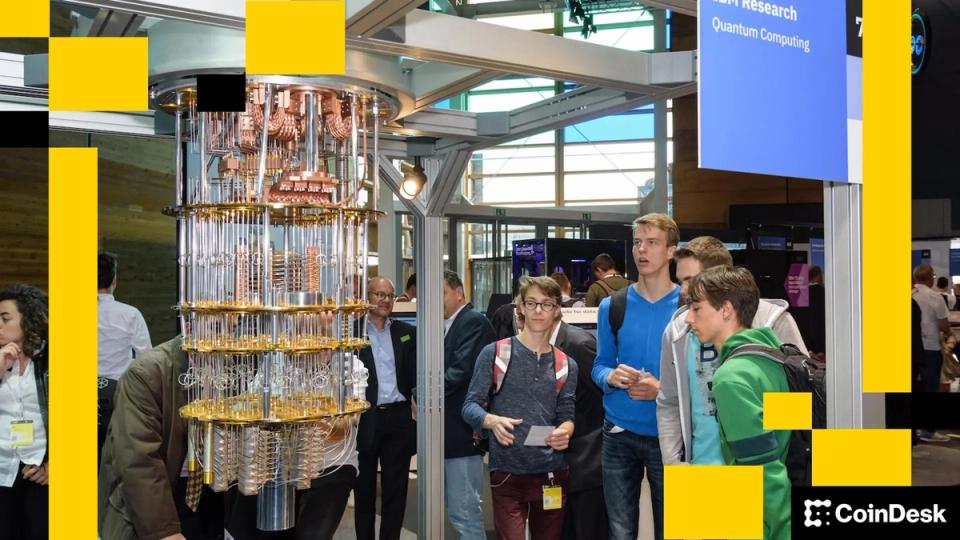
Wall Street brokerage Benchmark said quantum computing poses a theoretical threat to Bitcoin, but the risk remains remote and controllable.
Benchmark analyst Mark Palmer is generally bullish on the entire encryption industry, saying that while quantum machines may eventually destroy some encryption systems, Bitcoin has time and engineering paths to develop before that happens.
“While recent headlines have heightened concerns that quantum advances could undermine the cryptographic foundations of protocols, our analysis shows that this risk is real but distant, and that there is sufficient time and technological flexibility to adapt before the threat becomes severe,” Palmer said in Thursday’s report.
Quantum computing represents a looming crypto-apocalypse, as it has the potential to disrupt the mathematical lock and key system that protects nearly all digital assets. While it would take a classical computer trillions of years to guess a Bitcoin private key, a sufficiently powerful quantum computer could obtain that key from a public address in minutes, effectively allowing an attacker to uncover and drain the wallet at will.
how it works
Palmer wrote that the protocol’s main vulnerability lies not in its SHA-256 hashing algorithm used for mining (the mechanism for minting new Bitcoins), but in the Elliptic Curve Digital Signature Algorithm (ECDSA) that protects users’ private keys. Once a public key is compromised, typically when a Bitcoin is spent, it is theoretically vulnerable to a quantum attack.
However, Palmer emphasized that a quantum computer capable of breaking ECDSA does not yet exist and is unlikely to be available for at least the next 10-20 years (and possibly longer).
The analyst said today’s quantum systems are small, error-prone and cannot perform continuous computation at the scale needed to threaten blockchain infrastructure. Furthermore, only a small portion of the total Bitcoin supply (estimated at 1-2 million BTC) is held in addresses with exposed public keys. These include early Satoshi-era coins and reused wallets, but even these haven’t actually been attacked yet.
Benchmark noted that spending Bitcoin triggers a brief window in which public keys are broadcast to the network’s mempool, creating a theoretical opportunity for attackers to intercept and redirect funds. However, such a scenario requires an extremely powerful, fault-tolerant quantum system and flawless execution.
heated debate
Although the threat is old, quantum threats to Bitcoin have become a hot topic recently.
Leading Bitcoin developers and advocates are fighting back (much like Palmer), arguing that machines capable of breaking Bitcoin’s cryptography don’t exist today and are unlikely to exist decades from now. Meanwhile, some investors and Wall Street analysts are weighing the real threat it poses to Bitcoin.
Strategy (MSTR) executive chairman Michael Saylor believes that quantum computing, while often causing a stir, threatens all forms of digital security from banking to internet communications, not just Bitcoin.
On the other hand, Christopher Wood, global head of equity strategy at Jefferies, removed a 10% allocation to Bitcoin from his model portfolio, citing long-term security concerns posed by advances in quantum computing.
Regardless of the debate, the industry is taking preemptive measures against this potential long-term threat.
Coinbase’s announcement of a Quantum Advisory Council earlier this month marks a turning point in the way quantum risk is managed: moving it from a theoretical conversation to a structured institutional strategy.
Even Ethereum takes this threat seriously and has elevated post-quantum security to its primary strategic focus, forming a dedicated “post-quantum” team.
no systemic risk
It’s not all doom and gloom for Benchmark’s Palmer.
Even in the worst-case scenario, where some early coins are lost to a quantum attack, Palmer believes there is no systemic risk to the integrity of the protocol.
From an investor’s perspective, quantum computing is a long-term technology consideration rather than an immediate threat or investment thesis-breaker.
Palmer added that near-term drivers of Bitcoin prices remain focused on liquidity conditions, regulatory developments and institutional adoption, rather than speculative timelines surrounding quantum supremacy.
Read more: Bitcoin’s quantum argument is resurfacing and markets are starting to take notice

