Looking back to 2025, metal currencies have decisively won the sound currency or depreciation trade against Bitcoin. Gold is having one of its best years on record, rising 65%, while Bitcoin is down 7% year to date.
The two assets have posted similar returns through August, both up about 30%. Since then, gold has surged while Bitcoin has fallen sharply.
This disparity reinforces the argument that gold wins the devaluation trade, while Bitcoin lags firmly behind.
Bitcoin is still in recovery mode, struggling in the $80,000 range, after a 36% correction from its all-time high in October.
Despite price weakness, capital flows tell a different story.
Bitwise managing director Bradley Duke noted that despite gold’s strong performance, Bitcoin exchange-traded product (ETP) flows will exceed gold ETP flows in 2025.
The U.S. Spot Bitcoin ETF debuted in January 2024, marking the first year of institutional adoption, and the following year saw continued strong participation even as prices failed to keep up.
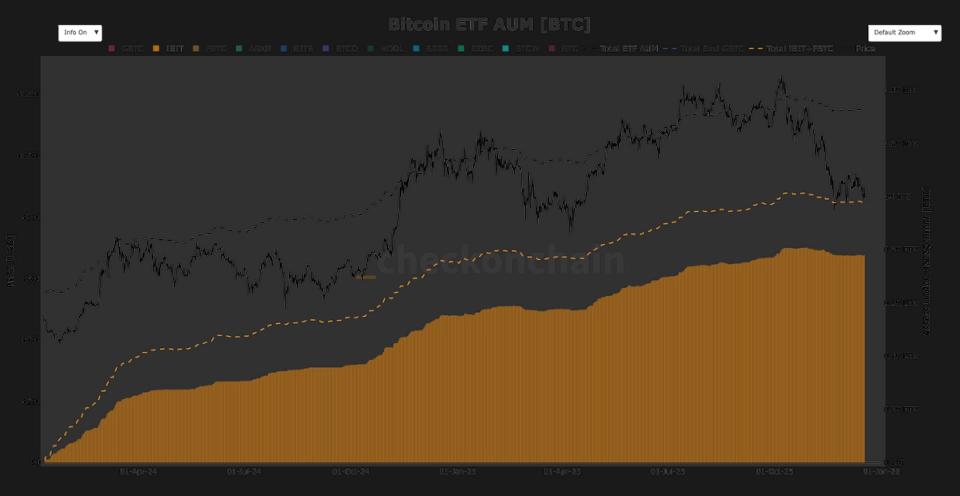
The most significant takeaway from the current Bitcoin price correction is the resilience of ETF investors. Despite the 36% price drop, Bitcoin ETF assets under management (AUM) fell by less than 4%.
Data from Checkonchain shows that U.S. ETFs held 1.37 million Bitcoins at their peak in October and still held approximately 1.32 million Bitcoins as of December 19. This suggests that most of the selling is not coming from ETF holders. BlackRock’s iShares Bitcoin Trust (IBIT) has strengthened its dominance during this correction and now holds just under 60% of the market with approximately 780,000 Bitcoins under management.
It’s clear that Bitcoin’s correction was not driven by ETF outflows.