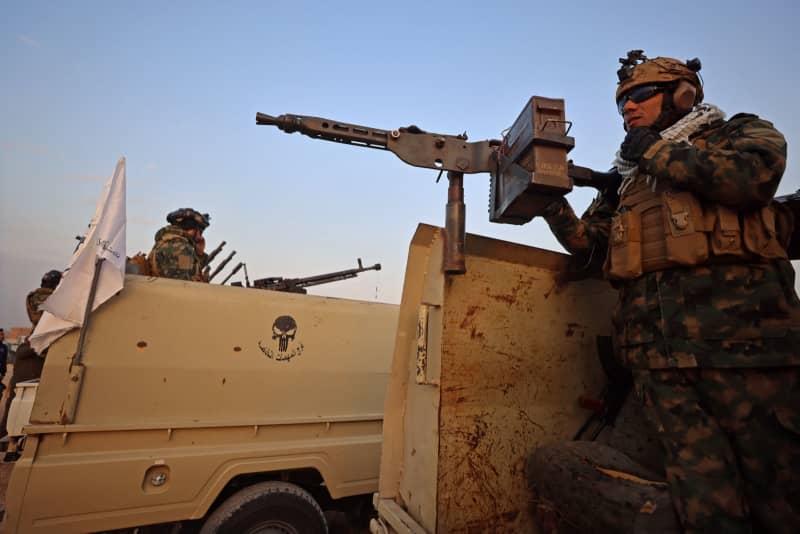
According to some media reports, including Iran International, thousands of Iraqi militiamen have crossed into Iran to help Tehran suppress the ongoing protests.
Sheikh Ghaith Al-Tamimi, a prominent Iraqi Islamic theology scholar and founder of the Iraqi Pluralism Center, said in comments: “The Iraqi government has no interest or reason to send reserve forces to Tehran, and Iran does not need additional reinforcements from Baghdad.” Jerusalem Post.
According to some media reports, including Iran International, thousands of Iraqi militiamen have crossed into Iran to help Tehran suppress the ongoing protests. “The Iraqi government has no interest or reason to send reserve forces to Tehran,” Sheikh Tamimi said, adding that he did not rule out that some Shia militants with direct ties to, financed and trained by Iran “may have left, but that would be voluntarily and certainly not subject to sanctions from the Iraqi state.”
Sheikh Tamimi believes that these voluntary tasks are “both secondary and marginalized” and do not make a significant contribution. Drawing on the previous situation of Shia sects sending volunteers to support Hezbollah in its war with Israel after October 7, Sheikh Tamimi said, “We saw a considerable number of militants going to Lebanon to fight alongside Hezbollah. But Hezbollah did not trust their military capabilities and did not provide them with any key roles, leading them to eventually return to Iraq.” However, he continued, “A small number of fighters did go, but I reiterate that their recruitment will not be approved by the Iraqi government.”
The volunteers are likely to be deployed to minority-populated areas such as Ahvaz, home to the Ahwazi Arabs, an oppressed ethnic and linguistic minority in Iran with a strong sense of Arab Sunni identity, or they will be deployed to Iran’s Kurdish regions.
He continued: “Theoretically, I doubt that the Islamic Revolutionary Guard Corps (IRGC) will open territories for Iraqi militias to carry out armed missions; that is very doubtful.” He added: “Let us not forget that the Basij is a paramilitary branch of the IRGC with approximately 8 million members.” The Basij has penetrated every level of Iranian society. Its branches are spread across Iran and are present in every university and government agency, including health care, law enforcement, and other social and cultural institutions. Its main role is to maintain domestic security – from enforcing social norms and dress codes to suppressing dissent and protests.

Sheikh Ghaith Al-Tamimi, a famous Iraqi Islamic theology scholar and founder of the Iraqi Pluralism Center. (Image credit: Courtesy of Sheikh Qais Tamimi)
“In addition there is the Islamic Revolutionary Guard Corps and various intelligence agencies,” Tamimi said. “I doubt that a brutal police state like Iran needs additional reinforcements from Baghdad.”
Iran is a theocratic and authoritarian regime that “rules its people with an iron fist.” “I doubt the protesters will be able to overthrow the rule of Iran’s Supreme Leader Ali Khamenei,” Sheikh Tamimi said. “The protesters succeeded in exposing and discrediting the government’s legitimacy. But let me tell you: without outside intervention – especially from the United States – overthrowing Khamenei will be challenging, if not impossible.”
Iraqis broadly support overthrow of Khamenei regime
He explained that overthrowing Khamenei would be welcomed by the vast majority of Iraqis. Still, he said, we cannot rule out real concerns about the day after Khamenei leaves office and its impact on Iraqi and wider regional security.
Yet there is another Iraq: one loyal to the Ayatollahs. Powerful and influential Shiite political and paramilitary groups – such as the armed wing of the Badr Organization and the Iranian-backed Fatah alliance in the Iraqi parliament – benefit from Iran’s huge investments in training and funding. These proxies maintain close ties with Tehran and work with Iranians in Iraq.
One of them is Amir Mousavi, a former Iranian defense official who is close to Iran’s supreme leader. Mousavi has been Tehran’s central figure in Baghdad since at least January 2020, when Abu Mahdi al-Muhandis was assassinated by the Americans.
Mousavi has become a political analyst celebrity whose fame extends beyond the borders of Iraq and Iran. He has been a regular on major Arabic-language news channels, often aligned with Iran and Türkiye, such as Al Jazeera, Al Mayadeen and Al Alam.
Mousavi’s fluency in Arabic and his deep-seated hatred of Israel played an important role in his emergence as a well-known figure in regional media. As protests continue in the Islamic Republic, Mousavi is frequently invited to speak on Iraqi and regional channels.
Regarding the protests, he described them as “unrest” driven by “agitators” and orchestrated by “foreign state actors.” In a recent interview with Iraqi television, he called the protesters “terrorists” working with “foreign infiltrators” who were “trained and equipped with maps and lists of people they were ordered to assassinate.” He claimed that those behind these infiltrators were “specifically three neighboring countries” that Tehran authorities are aware of and will “target soon.”
In addition, he claimed that all signs point to these three countries providing funding, training and facilitation for “these dark forces” to enter Iran and cause instability and terrorism. He said Tehran wants those countries to “fess up, apologize and cooperate with Tehran to reveal where their cells are implanted in the Islamic Republic of Iran.”
Mousavi declined to name the three countries, saying “Tehran wants to give them a chance to come clean.” One such country may be the autonomous Kurdish region of Iraq (Kurdistan Regional Government, KRG), which Iran’s Revolutionary Guards have long targeted with ballistic missiles and claimed to have attacked the “Mossad spy network,” among other accusations. Other candidates could be Azerbaijan, Afghanistan, and possibly Israel.
Suzan Quitaz is a Kurdish-Swedish journalist and Middle East researcher. She is an Israeli journalist and the podcast host of the Jerusalem Center for Security and Foreign Affairs’ Arabic and English series “Exposing Lies – Voices of Truth from the Middle East.” She has previously worked as a field producer and reporter for several Qatari media outlets.