Authors: David Hood-Nunho, Evan Garcia, and Joseph Akers
BATON ROUGE, La., May 9 (Reuters) – As a child, Leona Tate, one of the “New Orleans Four” and the first black students to desegregate public schools in the Deep South, endured racial slurs and death threats as armed U.S. Marshals escorted them to class.
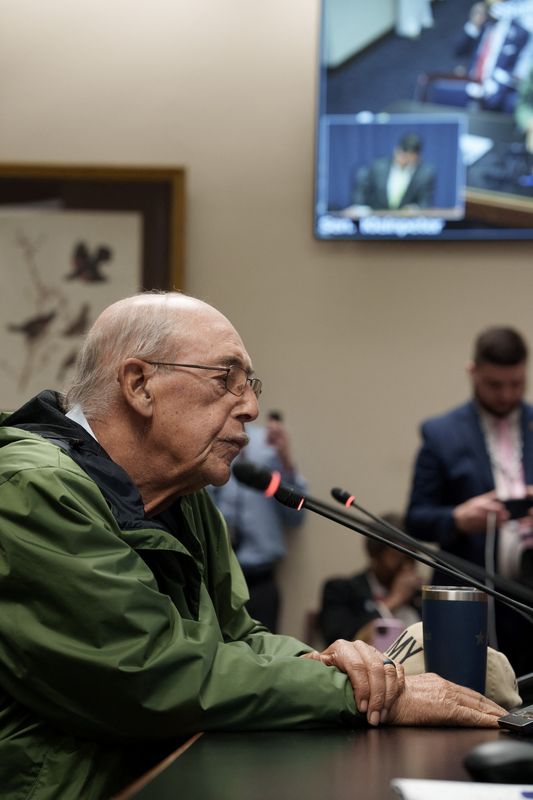
More than sixty years later, Tate told Republican state lawmakers on Friday that their proposal to eliminate at least one majority-Black congressional district brought back painful memories.
“I need you to understand what it feels like to stand here, walking past the mob as a kid, and now watching elected officials do the same thing the mob was trying to do – just with better suits and parliamentary procedures,” she told a Senate committee hearing at the state Capitol in Baton Rouge.
For more than eight hours, black members of Congress, clergy, activists and constituents delivered sometimes emotional, angry and deeply personal testimony. Outside the hearing room, protesters cheered them on.
“Let him talk!” they chanted at one point after Republican committee chairman Caleb Kleinpeter cut off a Democratic colleague’s microphone during a heated exchange. Mike McClanahan, president of the state chapter of the NAACP, the nation’s largest civil rights organization, was forcibly prevented from entering the room by Senate security.
The raucous hearing mirrored last week’s election chaos in Louisiana, where the ruling struck down a landmark civil rights law and gave Republicans a chance to draw a new congressional map that removes one or both of the state’s two majority-Black districts held by Democrats.
Black voters make up one-third of Louisiana’s electorate and generally support Democrats. Republicans already control the other four districts.
The Supreme Court’s ruling came a day after Gov. Jeff Landry postponed the U.S. House of Representatives primary scheduled for May 16, even though tens of thousands of ballots had already been mailed.
Voters who arrived at polling places early this week found signs posted on their doors announcing that House races had been canceled while other races were still ongoing. It remains unclear what will happen to ballots that have already been cast and when the primary may be rescheduled.
Kleinpeter told reporters after the hearing that questions about the process must be resolved by the Louisiana secretary of state. “The truth of the matter is the Supreme Court ruled these maps were unconstitutional,” he said. So “we’re continuing to draw new maps.”
Political struggle continues to expand
Louisiana is the latest frontline in a national redistricting war that began last year in Texas and spread this week across the American South, including Tennessee, Alabama and South Carolina, where Republicans responded to the Supreme Court ruling by launching similar efforts to eliminate majority-Black districts.
Democrats had begun their own redistricting push, but their ambitions took a serious hit Friday when the Virginia Supreme Court threw out a new voter-approved map that could flip four Republican seats. What had been a fairly equal partisan race to redraw the congressional map ahead of the November midterm elections has now shifted decisively toward Republicans, who will defend their slim majority in the U.S. House of Representatives.
In Baton Rouge, voting rights advocates warned that the sudden suspension of House primaries was causing widespread chaos.
“People are not sure what’s happening with these ballots, that the election is happening or not happening,” said Sarah Whittington, advocacy director for the American Civil Liberties Union of Louisiana, which has sued to block Landry’s move. “I think invalidating one part of the ballot and claiming the rest is valid just undermines overall confidence in the system.”
Landry’s office did not respond to a request for comment.
Democratic U.S. Rep. Cleo Fields said activists and Democratic lawmakers were still urging people to vote in a district the U.S. ruled unconstitutional. Supreme Court.
“Today is a congressional election; tomorrow, it’s state legislative elections, city council elections, school board elections,” he said in an interview.
fiery words
In the hearing room Friday, many black leaders recalled the civil rights movement and argued the new map would mark a return to state-sponsored racial discrimination.
“Louisiana has elected four African Americans to Congress since Reconstruction — you see all of them,” said Fields, who sat with U.S. Rep. Troy Carter, former U.S. Rep. Cedric Richmond and William Jefferson.
Senators reviewed a series of different plans Friday, including three proposed by Republican state Sen. Jay Morris that could lead to Republicans winning five or all six of the state’s U.S. House districts.
“This map was prepared without regard to race, partisanship or voting patterns,” Morris said of the map that could result in a Republican sweep. But activists and Democratic state senators believe the outcome will inevitably diminish the political power of black Louisianans.
“You have a choice in front of you,” Tate said. “You can draw a map that reflects what’s actually happening in Louisiana: a state where Black voices belong in the halls of Congress. Or you can draw a map that tells my grandchildren, ‘Your voice doesn’t matter.'”
Some critics warn Republicans that if they move forward, they will eventually pay the price, both at the ballot box and in the history books.
“This redistricting issue is about more than lines on a map,” said Baptist Pastor Brandon Boutin. “This is about the sanctity of democracy. It’s about whether every citizen has equal value in the eyes of the law.”
(Reporting by David Hood-Nuño and Evan Garcia in Baton Rouge, Louisiana, and Joseph Axe in New York; Editing by Jesse Mesner-Hage and Cynthia Osterman)