Ross Cobb
Dec 16 (Reuters) – A new White House order aimed at reining in proxy advisory firms marks an important step in a broader Republican effort to reduce the role of investors and hand more power to chief executives, corporate governance analysts and lawyers said.
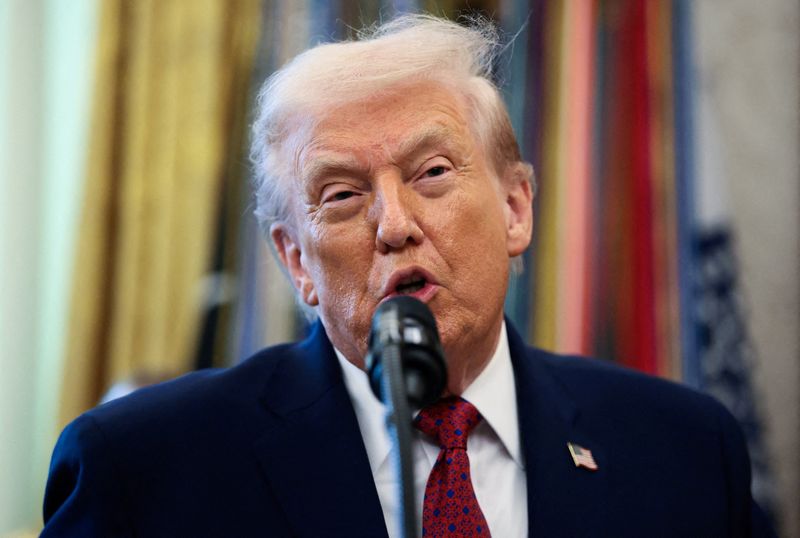
President Donald Trump last week told the Securities and Exchange Commission and other agencies to increase oversight of proxy advisers Institutional Shareholder Services and Glass, Lewis & Co, which help mutual fund companies and other large institutional investors decide how to vote in corporate elections.
Their clients hold key positions in some of the world’s largest Fortune 500 companies, making their advice impactful.
Trump’s order said the agency companies frequently used their power to “advance and prioritize aggressive politically motivated agendas,” including supporting environmental and social issues at the expense of shareholder returns. The directive goes to the heart of a debate among U.S. and European shareholders: how much issues such as climate change or workforce diversity should factor into investment decisions.
“This is not just a fiduciary duty. This is geopolitical warfare being fought through financial markets,” said Sarah Wilson, chief executive of Minerva Analytics, a U.K.-based proxy adviser. Minerva’s clients, primarily in the European Union and the U.K., want to retain their holdings of Russell 3000 stocks but are concerned that Trump’s order and similar actions by Republican-led states could disrupt their investment processes, she said.
“Our clients are not ardent socialists, they want good returns over time and are well risk-adjusted,” Wilson said.
Trump’s order, among other things, directs the SEC to consider “amending or repealing all rules relating to shareholder proposals,” concerned that investor activists could be stripped of one of their key tools to pressure companies.
Shareholders often make their voices heard by supporting proxy measures that call for limits on CEO pay or voting on board directors, which are seen as increasing accountability. If these agencies carry out Trump’s orders, it will be more difficult for investors to pressure companies through proxy campaigns, undermining shareholder power.
Sanford Lewis, a lawyer representing shareholder activists, said the order is premised on issues like diversity or the environment not being relevant to financial performance, although many investors and proxy advisers do believe strong ESG policies can enhance a company’s long-term value.
Lewis said the White House is “trying to impose their views on investors.”
Meanwhile, U.S. business trade groups applauded the order, saying it would remove politics from business decisions and protect returns. Charles Crane, executive vice president for policy at the National Association of Manufacturers, said Trump’s planned measures would guard against the companies’ outsize influence and address issues including what he called “investment advisers’ overreliance on these under-regulated entities.”
Ropes & Gray attorney Michael Littenberg said the order should be viewed as part of a broader debate about how to balance strong markets and investor protections.
“We are in the midst of what may be a once-in-a-generation realignment of governance,” he said.
A White House official, who spoke on condition of anonymity, said the order was intended to sharpen investors’ focus on maximizing returns. “The only thing this executive order disrupts is the monopolistic conduct of foreign-owned proxy advisers who seek to advance a radical political agenda,” the official said.
Germany’s Deutsche Boerse acquired most of top proxy adviser Institutional Shareholder Services in 2020. Glass Lewis is owned by Canadian private equity firm Peloton Capital and its chairman Stephen Smith.
Since taking office earlier this year, Trump and his appointees have moved to reduce shareholder influence on several fronts, including giving boards more control over annual meeting votes and imposing new filing requirements on big index fund managers BlackRock and Vanguard Group if they pressure management.
Proxy advisers have been targeted by top CEOs such as Elon Musk and Jamie Dimon and have received support from multiple Democratic officials and pension fund leaders. Faced with broader resistance to support for ESG investing, these companies have taken steps such as supporting fewer environmental shareholder resolutions.
Even before Trump’s order, the shifts had not shielded them from continued scrutiny from Washington and Republican-led states, although both companies had some legal successes, such as overturning a new Texas law that would have limited their ability to provide ESG advice.
In that sense, Trump’s order continues to put pressure to reduce shareholder participation, said Dan Crowley, a partner at the law firm K&L Gates in Washington.
The order “perpetuates the illusion that investors care either about ESG considerations on the one hand and monetary returns on the other, when the reality is that most large investors care about ESG considerations precisely because of their potential impact on long-term, risk-adjusted returns.”
(Reporting by Ross Cobb in Boston. Additional reporting by Simon Jessop in London. Editing by Dawn Kopecki and Nick Ziminski)