The Trump administration has renewed its push to resolve Russia’s war in Ukraine, alarming European governments who fear Washington is laying the groundwork to issue an ultimatum to Kyiv on Moscow’s terms.
The flurry of diplomatic contacts has alarmed Ukrainian and European diplomats as President Trump and his team have embraced Russia’s case for the war. The war was launched in 2022 by Vladimir Putin to conquer Ukraine and destroy its democratic government, triggering Europe’s worst conflict since World War II.
This is the latest tug-of-war on Trump’s Ukraine policy since he took office again. The president has repeatedly expressed anger and frustration at Ukraine’s insistence on self-defense, only to reverse course days or weeks later, tentatively embracing the European partnership, the NATO alliance and the prospect of victory in Kyiv.
The administration appeared to be settling on a long-term approach this week, releasing a national security strategy document on Friday that claimed Europe had “unrealistic expectations” about the outcome of the war and suggested it would work to cultivate political “resistance” to Europe’s “current trajectory.”
Read more: ICC prosecutor says Putin’s arrest warrant won’t disappear even if Ukraine peace talks succeed
“Cognitively and practically, the North Atlantic Treaty Organization should not be viewed as an expanding alliance,” the document said, a nod to Russia’s long-standing arguments to defend its military posture on the continent.
Americans overwhelmingly oppose, two to one, Trump’s current approach – which would force Ukraine to give up its sovereign territory, including land that Russia failed to gain on the battlefield despite suffering more than a million casualties. A recent Gallup poll found that Republicans are more opposed to Trump’s policies on Ukraine than on any other issue.
Still, the president’s advisers appear enthusiastic about a plan that would force Ukraine to cede territory in exchange for non-binding commitments to secure the country’s remaining territories moving forward.
Former real estate developer Steve Witkoff and Trump’s son-in-law Jared Kushner are leading the current effort, shuttling between Moscow and Florida, where they have hosted Ukrainian diplomats, to develop a peace plan. Kushner negotiated the Abraham Accords with Middle Eastern countries during Trump’s first term. The current framework is based on a 28-point document drafted in consultation with Russia.
Telephone conversations between Witkov and his Russian counterpart, transcripts of which were leaked last month, show Witkov giving Moscow advice on how to win Trump’s sympathy. Russian officials also expressed confidence to local media that the Trump team understood their demands.
According to a transcript obtained by Der Spiegel, French President Macron said in a conference call with European leaders this week that “in the absence of clear security guarantees, the United States risks betraying Ukraine on territorial issues.”
“They are playing games,” German Chancellor Friedrich Merz said of the Americans on the same call, “both with you and with us.”
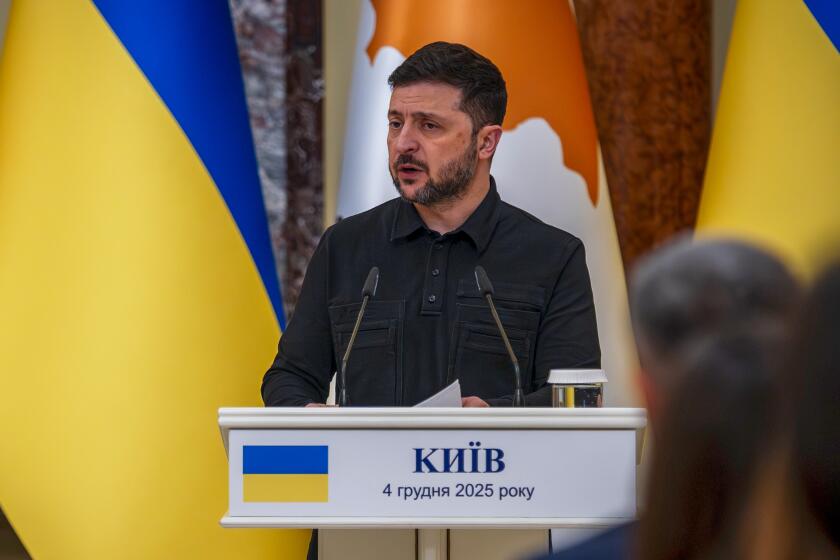
In Ukraine, prominent analysts question whether soldiers and generals on the battlefield will support a peace plan that would give up territory. Ukrainian President Volodymyr Zelensky insisted to Trump that the country’s territorial integrity and future security must be the cornerstone of a viable peace deal.
But experts say if Trump eventually loses patience, it could jeopardize Ukraine’s ability to fight.
“It’s important that the United States still provides intelligence assistance and has so far been willing to sell weapons to European countries and transfer them to NATO,” said Brian Taylor, director of the Moynihan Institute for Global Affairs at Syracuse University.
The United States has stopped direct aid to the war in Ukraine and instead agreed to a NATO arrangement to sell arms and equipment to Europe, which would then be provided to Kiev.
“If the United States even stops doing that – if the United States is not even willing to sell weapons to European countries, that would be a pretty radical policy change – then Europe is going to have to continue on the path it is on, which is to build up its own defense production capabilities,” Taylor said.
Read more: Trump’s security strategy lashes out at European allies and asserts U.S. power in the Western Hemisphere
Macron, Merz and other European allies, including British Prime Minister Keir Starmer and Britain’s king, have implored the president to remain steadfast in his support for Ukraine and increase pressure on Moscow, which they insist could ultimately change Putin’s calculus over time.
European leaders are debating whether to deploy some of the $220 billion in Russian assets frozen in European banks to Kyiv in the form of aid since Russia’s full-scale invasion, or whether to keep the funds as a focus of future negotiations.
“If the Trump administration and Europe are willing to do this, it will put real pressure on Russia’s increasingly stressed military and economy,” said Kyle Balzer, a scholar at the conservative American Enterprise Institute. “Russia’s economic growth has been hit hard by falling energy prices and Russia’s growing defense burden. The Russian military is inflicting casualties that the Russian people cannot forever ignore.”
Trump told reporters this week that about 7,000 Russian soldiers are dying on the battlefield every week – a staggering number in modern warfare. By comparison, fewer than 4,500 American soldiers died during the eight years of the U.S. war in Iraq.
“This pressure will have a decisive impact only if the Trump administration stops pinning its hopes on Putin that Russia can strike a favorable deal in exchange for deals that benefit U.S. businesses,” Balzer added. “The West must attack Russia’s resolve and convince Putin that he cannot achieve his goals. Continue to give Putin hope and that will become less likely.”
Get the Los Angeles Times California politics newsletter. In-depth reporting on legislation, politics and policy insights from Sacramento, Washington and beyond in your inbox twice a week.
This story originally appeared in the Los Angeles Times.
