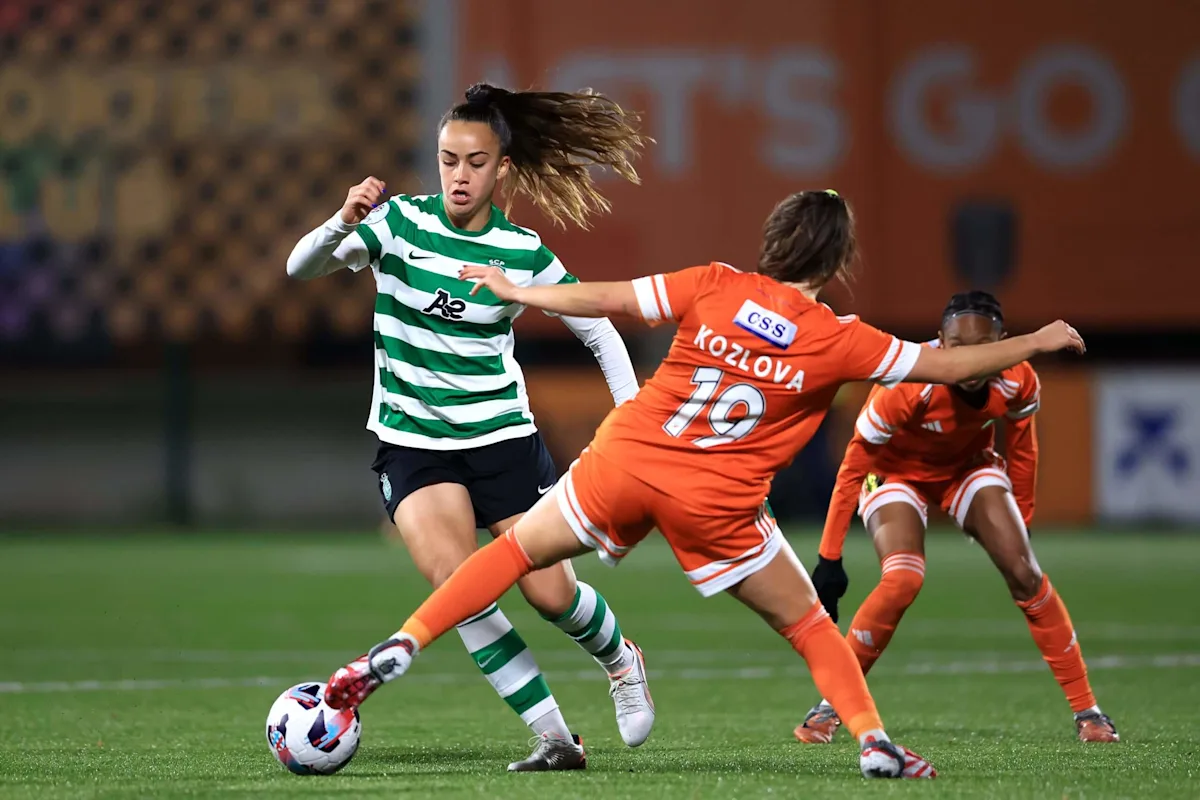
Glasgow City striker Nicole Kozlova knew what she wanted in her next team before joining the Scottish club: possession of the ball, creating chances, a place for her to flourish. Many teams have promised this. But Kozlova could do better; she used artificial intelligence (AI) to corroborate their claims.
In addition to being a football player, Kozlova works as a data analyst at Twelve Football, an analytics company founded five years ago that now incorporates artificial intelligence (AI) through machine learning systems. She’s using the technology to enhance her decision-making skills, which companies like Twelve believe could benefit the entire women’s soccer world.
advertise
In a world increasingly influenced by and responsive to artificial intelligence, football is no exception. At the top end of the men’s game, the recruiting and scouting headquarters resembles more a Silicon Valley tech startup than a club’s data department. Artificial intelligence can help predict injury risk, improve set-piece defense or analyze key performance indicators, such as how far a player leans back when taking a free kick.
Last week, Chelsea announced a multi-year global partnership with industrial artificial intelligence company IFS, adding that the partnership would also embed the company’s AI technology into “football performance, operational excellence and fan engagement,” according to a club statement.
While IFS’s partnership with Chelsea includes the women’s football team, overall the women’s team’s relationship with AI remains limited compared to the men’s team.
A key reason is to obtain the data needed for artificial intelligence. The men’s game is equipped with body-tracking technology, but the women’s game, even at its top level, still suffers from inaccuracies such as yellow card counts or assist counts. Collection is still limited to event data or on-ball action, and relies on the availability of cameras on the pitch and in training sessions, which not every women’s team or league can offer.
advertise
Kozlova’s story is situated in a unique moment of opposites.
Kozlova took an in-depth look at the data after learning of the possibility of signing for Glasgow City in the Scottish Premiership in the summer of 2024 after her spell with Volsk Krapoltava in the Ukrainian top flight.
Glasgow’s last season (2023-24) was one of the worst in the franchise’s recent history. After winning 15 of the last 16 SWPL titles, the Champions League regulars finished the season nine points behind Rangers and Celtic, who won the title on goal difference.
However, the numbers tell a more nuanced story. As promised, Glasgow City created quality chances and prioritized possession; something they had just failed to do against the top two.
advertise
“Teams can advertise their style of play or the way they want to play, but if you look at it it could be completely different,” Kozlova said. “I raised the issue with them. They said they knew it, but last season, the trend was more positive. The data supports that.”
Kozlova moved to Scotland. She finished her first season as the club’s top scorer with 23 goals in all competitions. Glasgow are second in the league, three points behind champions Hibernian.
This season, the Glasgow side are now top of the table using TwelveFootball for match and scouting analysis, five points ahead of Celtic and Rangers.
For Kozlova, the experience was an expression of agency and self-empowerment in a space that has been difficult for players and clubs outside the senior ranks to compete. Last year, Kozlova helped a friend evaluate basic statistics for a club trying to sign her. The data shows that the club’s expected goals were far exceeded. “I told her this seemed like a club where its luck would run out in six months. Six months later, it did.
advertise
Indeed, beneath the upper echelons of the international and domestic game, autonomy and visibility can feel like rare currencies due to limited scouting networks, immature infrastructure and limited access to agents.
“Visibility is one of the biggest challenges facing women’s football right now,” Kozlova said. She put together a presentation that not only showcased her skills but analyzed exactly the gaps where Glasgow City needed her. “Smaller leagues, clubs not in the top 15 of the Champions League and some national teams don’t get enough attention.
“That data helps build your case and prove that if you’re not one of the big players or one of the big clubs, you might get an opportunity.”
Improving the playing field is a common thread running through the debate over the use of artificial intelligence in the women’s game.
advertise
“We have a lot of contact with women’s teams in big and small clubs,” says Markus Lådö, co-founder of Twelve. “They do see AI as an opportunity to get really advanced analytics without having the resources. Top clubs, in the Premier League, most have their own data science departments, but in women’s football it’s a different story.”
Lådö says Twelve works with clubs in different ways.
The premium package includes adapting the learning model to the type of competition or recruitment strategy the club wants to implement, with artificial intelligence responding. These can span multiple seasons or years and focus on a specific endgame, such as a major tournament.
Twelve has also developed an artificial intelligence analysis tool called Earpiece, which can analyze large amounts of global competition data and transform complex information into simple and easy-to-read messages through WhatsApp. More similar to ChatGPT, it enables clubs to explore player strengths and weaknesses and even request shortlists for certain attributes, without initially seeing numbers, like chatting with a coach or sporting director.
advertise
This method of operation is not without controversy. Last year, Seattle Reign head coach Laura Harvey sparked a backlash against the use of artificial intelligence when she admitted on a podcast that she used ChatGPT to brainstorm tactics and formations during the 2025 NWSL season (even leading to her decision to field a back five in two games).
Xavi’s admission led many fans and pundits to criticize her for normalizing the outsourcing of expertise to technology at a time when opportunities for female coaches and analysts remain at a premium and women’s institutions require clubs to invest more in infrastructure and staff numbers.
as Competitor Reports emerged last year that the transformative impact of artificial intelligence could threaten the future of traditional Scouting, with many fearing the loss of their jobs.
According to Twelve, the cost of a year of their AI technology can range from €25 (£22, $30) per month for a generative AI project to €9,000 per year for a personalized project. This is far less than what it would cost a club to hire a full-time data analyst or scout.
advertise
Ida Höglund Persson, director of decision science at Twelve, said that for many women’s soccer clubs that don’t have sophisticated scouting networks or in-house sentinels of data analysts, technology like Earpiece could prove invaluable.
“The difference is that you don’t need a data scientist who actually does the programming, because the first step for a football club is to hire a data scientist and they try to provide everything to the club,” Persson said.
Instead, Persson believes Twelve does the heavy lifting for data scientists, allowing them to be more active in leveraging insights from the data itself and making it available to clubs and organizations, rather than getting bogged down in programming and presentations themselves.
“Then they can spend time actually working on those insights and how to leverage them,” she said.
advertise
Clubs Twelve has worked with include Hammarby’s men’s and women’s teams, with whom Twelve began working with the latter when it re-entered Sweden’s top flight in 2017. Hammarby have since won the league twice, finishing runners-up last season, and have produced a number of young players who have made lucrative moves to the Women’s Super League (WSL), including forward Ellen Wangerheim (Manchester United), forward Kasinka Tandberg (Tottenham Hotspur) and defender Smilla Holmberg (Arsenal).
Current Fiorentina coach Pablo Pinones-Arce was Hammarby’s head coach from 2020 to 2023, leading the club from seventh place in his first season to winning the club’s first league title since 1995 in his final season.
“I’m not going to use artificial intelligence in the way people think it is,” he said. “I don’t ask what the AI competition is going to do, or how to build my team. I have my principles, my way of working.”
Pinones-Arce said he uses artificial intelligence to “confirm what I see with my eyes,” from identifying players to identifying his team’s strengths and weaknesses. He said artificial intelligence was never a charter that he or his employees gave up, nor should it be.
advertise
“If you want to develop your female side in a professional environment, you should have the conditions and the environment to make the most of what you have,” he said.
“Employees need more. You need experts and experts in different fields. But if you don’t have the right economic climate for people to work there, AI can be a useful tool like many others, as long as you know why you’re using it, how you’re using it and what you expect from it.”
Piñones-Arce said certain key elements of sports simply cannot and should not be outsourced to technology. Statistics cannot measure work ethic, mentality or toughness. While it may be able to predict how a player adapts to the physical conditions of a league, it cannot predict how the same player will interact with teammates or adapt to a new environment, country or culture.
“One of the most important things as a coach is to have the right leadership, the right approach to leadership, the right approach to development, developing players and really thinking about the players,” Pinones-Arce said.
advertise
“You can never replace going to the stadium and watching players play live.”
Critics warn that not every club sees AI as a complement rather than a replacement.
Many data analysts and club figures interviewed for this article (who wished to remain anonymous to protect relationships) said there were concerns that clubs would not build out the infrastructure needed for recruitment or tactical analysis with qualified staff and resources, and use AI as a tool to help streamline processes, but would instead tend to rely entirely on AI to make up for a lack of resources.
The soft skills that come with a data science role are where analysts really make their money, as they evaluate the pros and cons of certain analyzes to form their own conclusions. The limitations of the data available in the women’s game also mean there is a risk of bias or fragmented views if analysts are unable to interrogate the data themselves.
advertise
According to Persson, the Twelve’s data is still primarily collected by humans who watch video from available cameras in stadiums and training grounds. These insights are primarily event data, focusing on ball-handling actions. Off-the-ball movements, runs in behind, secondary assists, and many defensive actions can be missed or ignored, creating an incomplete version of a player.
Making artificial intelligence part of the everyday fabric of football is one of Twelve’s core goals. The impact of removing technological barriers should not be underestimated. In this way, Persson highlights the equalizing potential of artificial intelligence in women’s football, a tool that raises the upper limit of the game, but more importantly the lower limit of the game.
“I think five years from now, everyone will have this as part of their decision-making,” she said. “I think it will become part of academy and even grassroots football as well.
“This should be something that really makes playing football more fun.”
advertise
This article originally appeared in The Athletic.
Football, NWSL, Sports Business, Women’s Soccer
2026 Sports Media Company