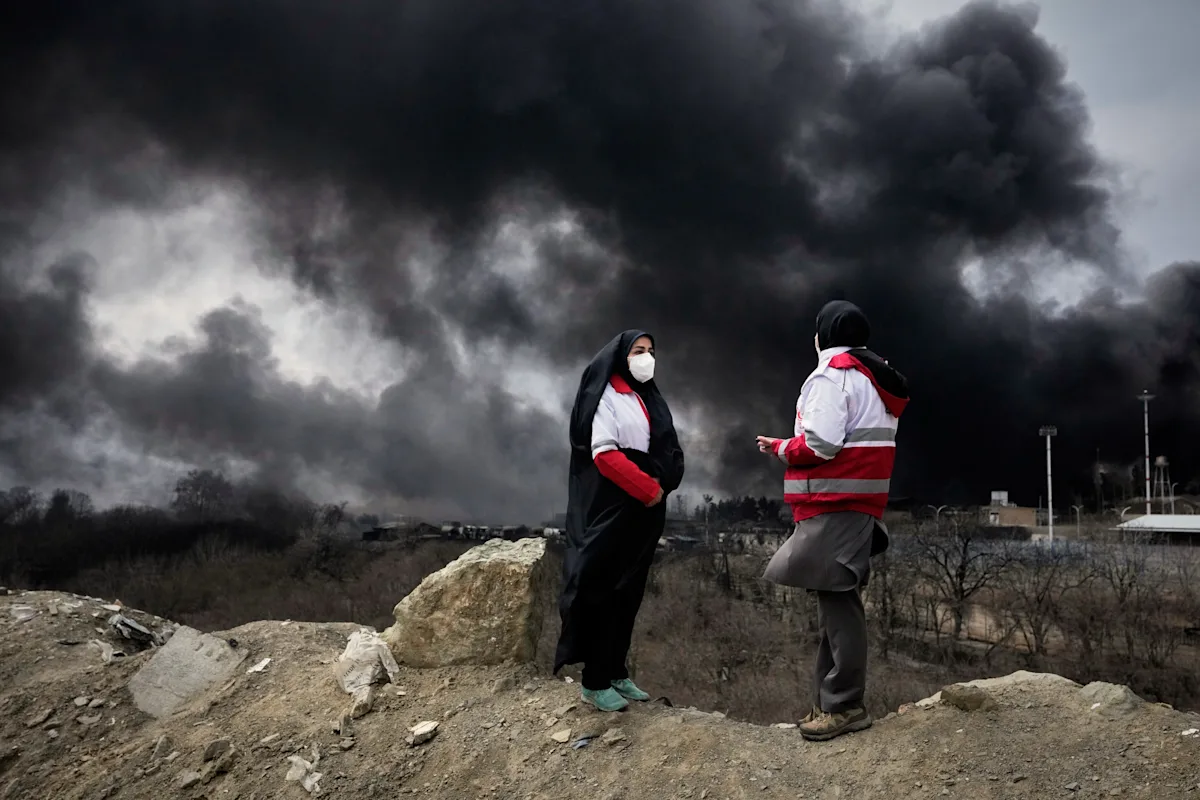
Toxic fumes released into the atmosphere by U.S. and Israeli airstrikes on Iranian oil facilities are dangerously returning to Earth in the form of “black rain,” prompting international health officials to warn the public of serious risks.
Residents in Tehran complained of burning eyes and difficulty breathing as black, oily rain fell near the Iranian capital after several fuel depots and an oil refinery were attacked last week.
The two-week war has also seen smoke rising elsewhere in the region, with Iran retaliating against U.S. and Israeli airstrikes by launching drones and missiles at its Persian Gulf neighbors’ oil and gas facilities.
Experts say rain washes dangerous chemicals out of the atmosphere in a relatively short period of time, but people exposed to black rain should take precautions to avoid short- and long-term health risks.
Here’s what you need to know:
What is black rain?
This occurs when soot, ash and toxic chemicals combine with water droplets in the atmosphere and then fall back to Earth when it rains. Commonly seen after refinery or oil field fires, it can also be caused by wildfires, volcanic eruptions and industrial pollution.
Experts say tiny soot forms in Iran when hydrocarbons in fuel are not burned completely. Peter Adams, a professor of civil and environmental engineering at Carnegie Mellon University, said burning oil also forms polycyclic aromatic hydrocarbon (PAH) compounds, as well as toxic gases such as sulfur dioxide and nitrogen oxides, which can cause acid rain.
What are the health risks of exposure?
Experts say tiny soot particles, about 40 times smaller than the width of a human hair, can lodge deep in the lungs and enter the bloodstream, causing breathing and heart problems that can lead to premature death. Exposure to PAHs increases the risk of cancer.
In Iran, the World Health Organization and the country’s health and environmental officials recommend people stay indoors and wear masks. They warned the rainfall was highly acidic and could burn skin and cause lung damage.
“We would certainly expect serious health impacts from an event like this,” said V. Faye McNeill, a professor of chemical engineering at Columbia University who specializes in atmospheric chemistry.
Even regular air pollution events can trigger health problems and lead to more hospitalizations, especially among older adults, children and people with pre-existing health problems, she said. “But this is a higher level, so health issues may now arise.”
Some Iranians worry that contaminated rainwater also contains heavy metals that could contaminate drinking water reservoirs and waterways.
How long do these chemicals stay in the atmosphere?
It usually only takes a few hours for the tank to burn out. But, as happened in Kuwait during the Gulf War 25 years ago, oil fields can burn for months, Adams said.
For fires that burn faster, much of the soot and chemicals will be carried by the wind and flushed from the atmosphere in about three to seven days, Adams said.
“So if we don’t create more problems, at least the stuff in the atmosphere will be gone,” even if the long-term health risks are not, Adams said.
“But we don’t know what will happen with future attacks, or if other tanks will be hit, or if the oil fields will be hit,” he added. “I’m not too concerned about the long-term or regional things, but it’s a real mess for people around here.”
___
AP’s climate and environment coverage receives financial support from multiple private foundations. The Associated Press is solely responsible for all content. Find AP’s criteria for working with charities, supporter lists and grant coverage at AP.org.