Scientists have announced the results of a decade-long study measuring Newton’s gravitational constant, the force that keeps our feet on the ground and planets in their orbits.
The hunt was more or less a failure. The most ambitious effort yet to determine the fundamental constant—which determines the strength of the attraction between two masses anywhere in the universe—has led to some results that are at odds with previous findings, including those from the experiments it sought to replicate.
Scientist Stephan Schlamminger painstakingly conducted the latest experiment, which began in 2016, and called it a “breathtaking” experience. “It’s really a bit like walking through a dark valley,” added Schramminger, a physicist at the National Institute of Standards and Technology in Gaithersburg, Maryland.
But he has since been able to make a positive contribution to his efforts. “Now, I’ve put it in the rearview mirror,” he said. “I think every measurement is an opportunity to learn, and every measurement brings light to the darkness.”
What is the universal gravitational constant?
Nature’s fundamental constants are key values that define the behavior of physical phenomena in the universe – they don’t change no matter where you are in time or space. They include the speed of light and Planck’s constant, which plays a key role in quantum physics.
These constants are “woven into the fabric of the universe,” Schlamminger said. “It’s very beautiful because they’re the same across generations. If you ever talked to aliens, they would have the same concept.”
For 225 years, scientists have been trying to measure the gravitational constant, nicknamed the Big G. British scientist Henry Cavendish conducted the first experiment to measure the gravitational constant in 1798, more than 100 years after Isaac Newton first discovered gravity.
However, scientists have not yet been able to achieve accuracy comparable to constants such as the speed of light (299,792,458 meters per second) or Planck’s constant (accurate to eight decimal places).
The Committee on Data of the International Council for Science (CODATA) publishes recommended values for fundamental physical constants. The recommended value for Big G is a four-digit number with a measurement uncertainty of 22 parts per million.
He said the value was “an embarrassment to active metrologists (scientists who specialize in measurements)” given that other constants in nature are known to have six or more significant figures and are thought to be precise.
“If your watch is running 22 ppm late, you’re measuring the time in a year 12 minutes late,” he added.
He noted that the field of metrology – the science of measurement – is important because it builds trust in science, economics and trade. “This science underpins so many parts of our society, but no one notices it,” he said.
“When you pay your electric bill, you want to make sure you’re paying the right amount, right? Someone knows how to measure voltage, how to measure current, and how to measure power.”

Schramminger said he hopes young researchers will not become discouraged and continue searching for the Big G. ——James R. Love
Why is measurement so difficult?
Christian Rothleitner, a physicist at the Institute of Physics and Technology of the German National Metrology Institute who was not involved in the study, said gravity is difficult to measure accurately for three reasons. First, it is a relatively weak force.
“We think of gravity as a very powerful force because we have to exert a lot of force to lift objects above the Earth,” he said via email.
In fact, he said, it is much weaker than the other three fundamental forces that hold atoms and nuclei together: the electromagnetic force, the weak nuclear force, and the strong nuclear force.
“You can see this easily if you look at a magnet, which is relatively small but still exerts a very strong force on the magnetic object.”
Another reason for the difficulty in determining the gravitational constant is that, in the laboratory, the masses used in the experiments must fit within a relatively small confined space: “And small masses in turn produce only a small gravitational pull.”
What’s more, because gravity is generated by every object, it’s “extremely challenging” to ensure that the force you measure in the lab actually comes from the expected mass.
“The problem with big-G measurements is that the values are very spread out, so the measurements don’t agree with each other,” Rothleitner said. “This leaves a lot of room for speculation as to the source of the inconsistency.”
secret envelope
Over the past four decades, there have been at least 16 attempts to measure Big G. Rather than adding new measurements to an already inconsistent data set, Schlamminger and his colleagues sought to replicate an experiment conducted by the International Bureau of Weights and Measures in Sèvres, France.
If he could independently come up with the same result, the mystery surrounding the Big G’s exact value might be solved.
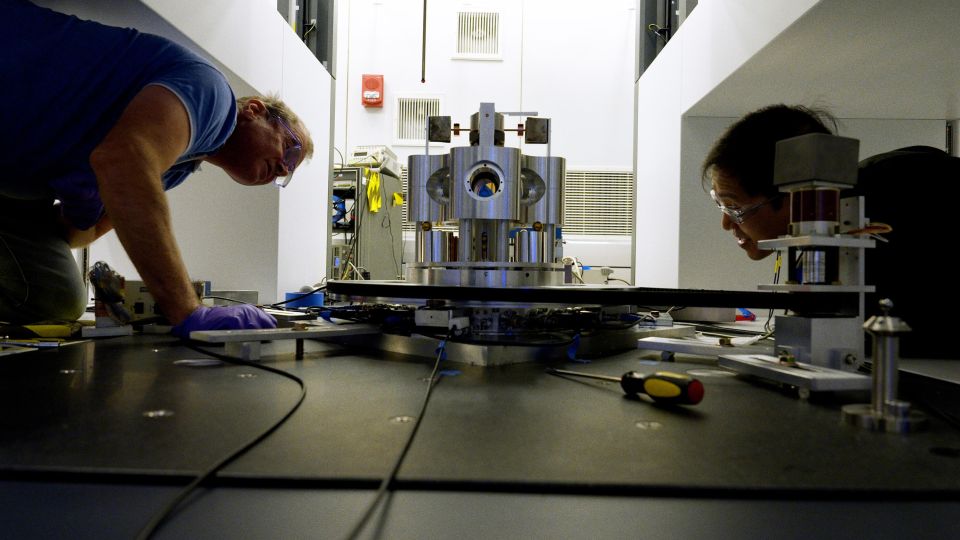
The experiment relied on a sensitive device called a torsion balance, which senses tiny forces by measuring the twist angle, or torsion, of a metal block suspended from a thin fiber, which must be operated in a vacuum. This distortion cannot be perceived with the naked eye, but can be detected with sensors that infer gravity.

Animation of a device used by the National Institute of Standards and Technology to measure the strength of gravity. -S. Kelly/NIST
During the experiment, Schramminger spent years calibrating the equipment and troubleshooting the physical effects of properties such as temperature and pressure that could confound the measurements to prove that these factors did not affect the results.
Given that the team was repeating a previous experiment, he also took another precaution to avoid any conscious or unconscious personal biases that could lead to the answers he thought the experiment should yield and prevent him from stopping the study prematurely.
A colleague not involved in the work added a random offset number to the mass so that Schramminger could not see the actual measurement he was making. The number was kept in a secret envelope and was unknown to Schramminger until the work was completed.
After the honeymoon period of research, Schramminger found the work frustrating at times. “To me, it’s like a random number generator,” he said. “I feel like I have to go to a casino and work every day.”
In July 2024, the envelope with the secret number was opened on a conference stage, and Schramminger and his team finally found the true results of their work. His initial joy – that the final value of the Big G was within the correct range – then soured, and he said he felt “a little unhappy.”
The team’s measured maximum G value is 6.67387×10⁻¹¹ Cubic meters per kilogram per second squared. This unit reflects distance, mass, and motion: how gravity works. It was 0.0235% lower than the results the researchers attempted to replicate and inconsistent with the CODATA data.
Schramminger said this is a significant difference, such as when measuring a person’s height, which can lead to an error of a millimeter or two. “In the grand scheme of things, it’s small, but when it comes to these basic concepts, it’s pretty embarrassing,” he said. On April 16, the journal Metrologia published a scientific paper detailing the work.
Ian Robinson, a researcher at the UK’s National Physical Laboratory, said Schlamminger’s efforts could provide scientists with the tools to make precise measurements in other areas involving extremely small forces. Robinson was not involved in the study, although he attended the meeting where Schlamminger’s data was released.
“Some extremely obscure problems were discovered, solved, and new results were generated,” Robinson said.
Unknown physics?
What could explain the inconsistency in big G measurements?
There may be something unknown in the universe that may prevent accurate values. While the unknown possibility is exciting, Schramminger, Robinson and Ross Leitner all said the hypothesis is far-fetched.
“It’s unlikely that some underlying physics that we don’t understand is responsible for the differences in the results,” Robinson said. “It’s more likely that an undiscovered, very small and obscure effect, or effects, is biasing some of the results.”
Schraminger believes that better engineering equipment could improve the situation, or that there may be some human error.
Still, he said he doesn’t think the past 10 years have been wasted.
“Precision metrology is not just the gathering of a number, it is the rigorous exposure of the unknown. ” his study concluded.
Schramminger’s enthusiasm for the field remains undiminished. He has the number of Planck’s constant tattooed on his forearm, which was restored in 2019 during work in which he was involved.
Schramminger said he hopes young researchers interested in the Big G won’t be discouraged from pursuing the quest. But even if he found the exact value, he would never get a big G tattoo: “This number is too picky.”
Sign up for CNN’s Miracle Theory Science newsletter. Explore the universe and get news about fascinating discoveries, scientific advancements, and more.
For more CNN news and newsletters, create an account at CNN.com