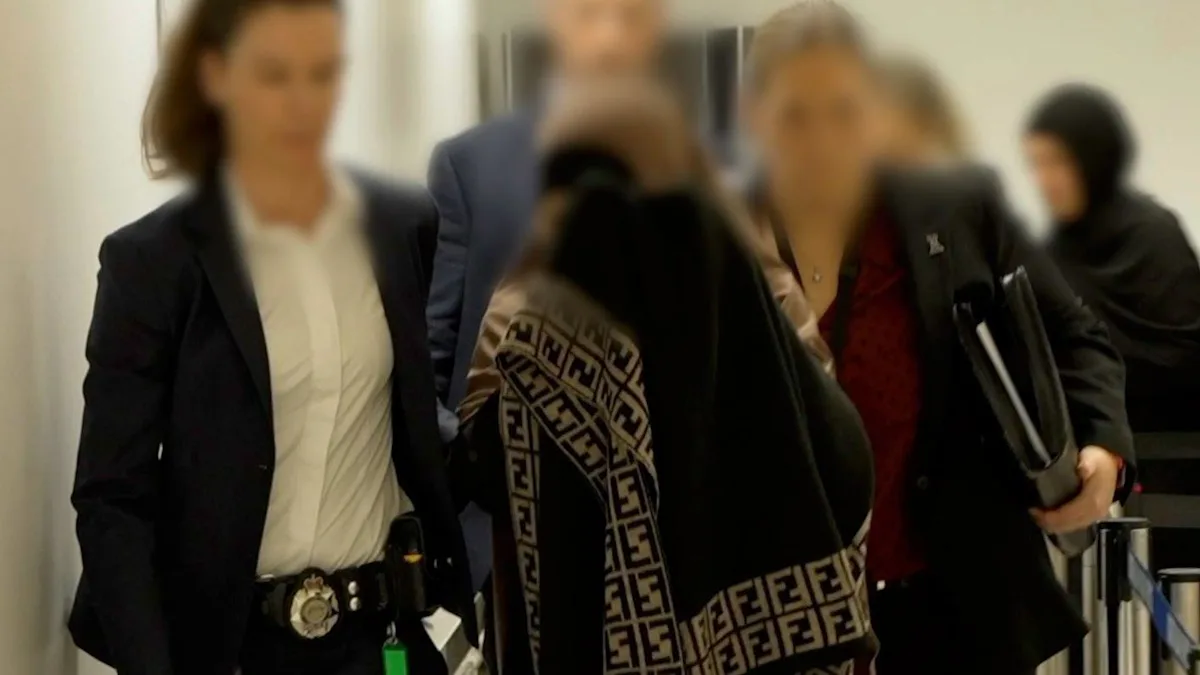
Three Australian women with links to the Islamic State (IS) group have been formally charged after returning from Syria.
Kawsar Ahmad, 53, and her daughter Zeinab Ahmad, 31, appeared in a Melbourne court on Friday, less than 24 hours after they were arrested at the airport and remanded in custody.
Kawsar Ahmad faces four charges of crimes against humanity after police accused her of traveling to Syria in 2014 and keeping a female slave in her home. Zeinab Ahmed faces two similar charges.
Janai Safar, 32, will also appear in court in Sydney on charges of entering and remaining in a declared conflict area and joining Islamic State. She was charged after arriving in Sydney with her son on Thursday.
The Australian Federal Police (AFP) allege Kawsar Ahmad traveled to Syria with her husband and children in 2014, participated in the purchase of a female slave for $10,000 “and knowingly left the woman in her home”.
Police said Zeinab Ahmad also traveled to Syria with his family in 2014 and deliberately kept a female slave in his home. The charges carry a maximum penalty of 25 years in prison.
The pair appeared in Melbourne Magistrates’ Court on Friday and were remanded in custody until Monday, when their lawyers said they would apply for bail. Neither man was asked to speak at the brief hearing.
Kawsar Ahmad’s other adult child, Zahra Ahmad, also arrived in Melbourne on Thursday but was not detained.
For Safar, police say she traveled to Syria in 2015 to reunite with her husband, who had left Australia and joined Islamic State.
She was also accused of being a member of a terrorist organization. Both offenses carry a maximum penalty of 10 years in prison.
AFP counter-terrorism assistant commissioner Stephen Nutt said police were investigating “all Australians traveling to declared conflict areas and will ensure those charged with criminal offenses are brought to court”.
“This remains an active investigation into very serious allegations,” he said.
The three women arrested on Thursday were part of four women and nine children who arrived in Australia on Thursday.
They are among 34 Australian women and children who have been living in al-Roj refugee camp in Syria since 2019.
The group left the camp in February in an attempt to return to Australia, but were turned back for “technical reasons” and the Australian government refused to provide them with any assistance.
Earlier this year, one member was banned from returning to Australia after the government issued a “temporary exclusion order” which means the person cannot return for up to two years.
There were chaotic scenes at Melbourne Airport on Thursday night as the only woman not arrested emerged from the arrivals hall.
A group of about 15 men, mostly dressed in black, gathered around her and the children, shielding the waiting media pack.