Authors: Alexander Cornwell, Trevor Hunnicutt and Asif Shahzad
TEL AVIV/WASHINGTON/ISLAMABAD, March 30 (Reuters) – U.S. President Donald Trump warned on Monday that the United States would destroy Iran's energy plants and oil wells if Tehran did not open the Strait of Hormuz, after Tehran called U.S. peace proposals “unrealistic” and launched waves of missiles at Israel.
The Israeli military said two drones from Yemen were also intercepted on Monday, two days after the Iran-allied Houthis launched missiles at Israel to join the war and Lebanon's Hezbollah fired rockets at Israel.
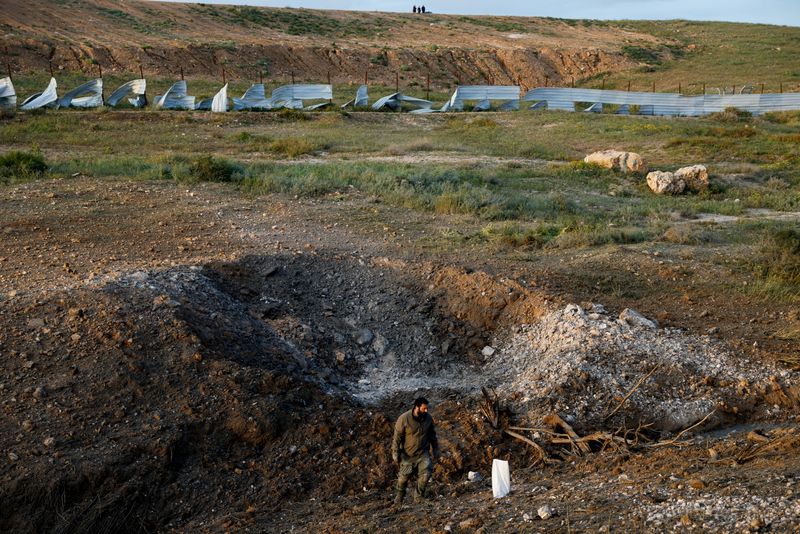
The Israeli army carried out missile attacks on Tehran's military infrastructure and infrastructure used by Iran-backed Hezbollah in Beirut, causing black smoke to hang over the Lebanese capital.
Turkey's Defense Ministry said a ballistic missile launched from Iran entered Turkish airspace and was shot down by a NATO air and missile defense system deployed in the eastern Mediterranean, the fourth such incident since the war began.
Tehran remains defiant in a month-long war that began with U.S. and Israeli attacks on Iran on February 28 and spread across the region, killing thousands, disrupting energy supplies and battering the global economy.
Most of the victims, many of them civilians, were reported in Iran and Lebanon. Iran has effectively blocked the Strait of Hormuz, the narrow waterway that normally carries about a fifth of the world's oil and liquefied natural gas supplies.
U.S. sends reinforcements while talks continue
Thousands of troops from the U.S. Army's elite 82nd Airborne Division have begun arriving in the Middle East, two U.S. officials told Reuters on Monday, part of a surge that will expand Trump's options to include deploying troops inside Iranian territory even as he pursues negotiations with Tehran.
White House press secretary Carolyn Levitt later said Trump hoped to reach a deal with Tehran before the April 6 deadline he set last week, after extending a previous deadline for Iran to open the Strait of Hormuz. Levitt said talks with Iran were making progress, adding that Tehran's public statements differed from what it told U.S. officials privately.
Iran said earlier on Monday it had received a peace proposal from the United States through an intermediary, after the foreign ministers of Pakistan, Egypt, Saudi Arabia and Türkiye held talks on Sunday.
Iranian Foreign Ministry spokesman Esmail Baghaei said the proposals were “unrealistic, illogical and excessive.”
“Our position is clear. We are suffering military aggression. Therefore, all our efforts and forces are focused on self-defence,” he told a news conference.
Shortly after Baghayi made the remarks, Trump posted on social media that the United States was negotiating with “more reasonable regimes” to end the war with Iran, but he also issued a new warning about the Strait of Hormuz.
“Great progress has been made, but if for some reason a deal is not reached soon (which it most likely will be), and if the Strait of Hormuz is not 'opened' immediately, we will end our lovely 'stay' in Iran by blowing up and completely destroying all of their power plants, oil wells, and Kharg Island,” Trump wrote.
Trump also threatened to attack Iran's desalination plants that provide clean water.
A Pakistani security official who is trying to mediate the war said direct talks between the United States and Iran this week seemed unlikely.
Baghaei also said Iran's parliament is considering the possibility of withdrawing from the Nuclear Non-Proliferation Treaty, which recognizes Iran's right to develop, research, produce and use nuclear energy as long as it does not pursue nuclear weapons.
Trump cited preventing Iran from acquiring nuclear weapons as a reason for attacking the country on February 28. Tehran denies it is seeking a nuclear arsenal.
Concerns about upgrading
The White House says Trump is considering asking Arab countries to pay for the war. “I know he has the idea, and I think you're going to hear more from him,” Levitt said in response to a reporter's question about the idea.
His administration has requested an additional $200 billion for the war, but has faced strong opposition from the U.S. Congress, which must approve the new spending.
During the conflict, Iran opened fire on Arab Gulf states and the war between Israel and Lebanese Hezbollah reignited. Three members of the United Nations peacekeeping mission in Lebanon (UNIFIL) have been killed in two separate incidents in southern Lebanon, following a bloody weekend in which Lebanese journalists and medics were killed in Israeli attacks.
Benchmark oil prices extended gains on Monday, with Brent crude futures on track for a monthly gain.
Houthi attacks on Israel make it possible for them to target and block a second important shipping route, the Bab el-Mandeb Strait.
Vandana Hari of oil market provider Vanda Insights said oil markets had almost completely underestimated the prospects of a negotiated end to the war and were “bracing for a sharp escalation in military hostilities”.
The International Monetary Fund has warned that wars in the Middle East are wreaking havoc on the economies of frontline states and dimming prospects for many economies that are just beginning to recover from previous crises.
The G7 finance ministers also said they were prepared to take “all necessary measures” to maintain energy market stability and limit the wider economic spillovers from recent volatility.
(Reporting by Reuters; Writing by Michael Perry, Stephen Coates, Timothy Heritage, Keith Weir and Simon Lewis; Editing by Gareth Jones and Matthew Lewis)