On March 31, more than a hundred Baidu Apollo Go robot taxis froze on the streets of Wuhan at the same time. Vehicles were stranded on overpasses and elevated roads, leaving passengers stranded for up to two hours.
Weeks later, Beijing suspended all new self-driving licenses across the country. The suspension prevents robotaxi companies from adding to their fleets, starting new tests or expanding to other cities, Bloomberg reported.
Meanwhile, in the United States, some self-driving cars are driving into streetlights and even crime scenes in progress. In just one month in Austin, Tesla’s robotaxis hit fixed objects head-on and in reverse, as well as trees, utility poles, buses and trucks. Waymo’s robotaxis can’t close their doors on their own, and the company has begun hiring DoorDashers to door instrument panel And close the door after passengers get off the bus. In October 2023, a Cruise AV dragged a pedestrian 20 feet.
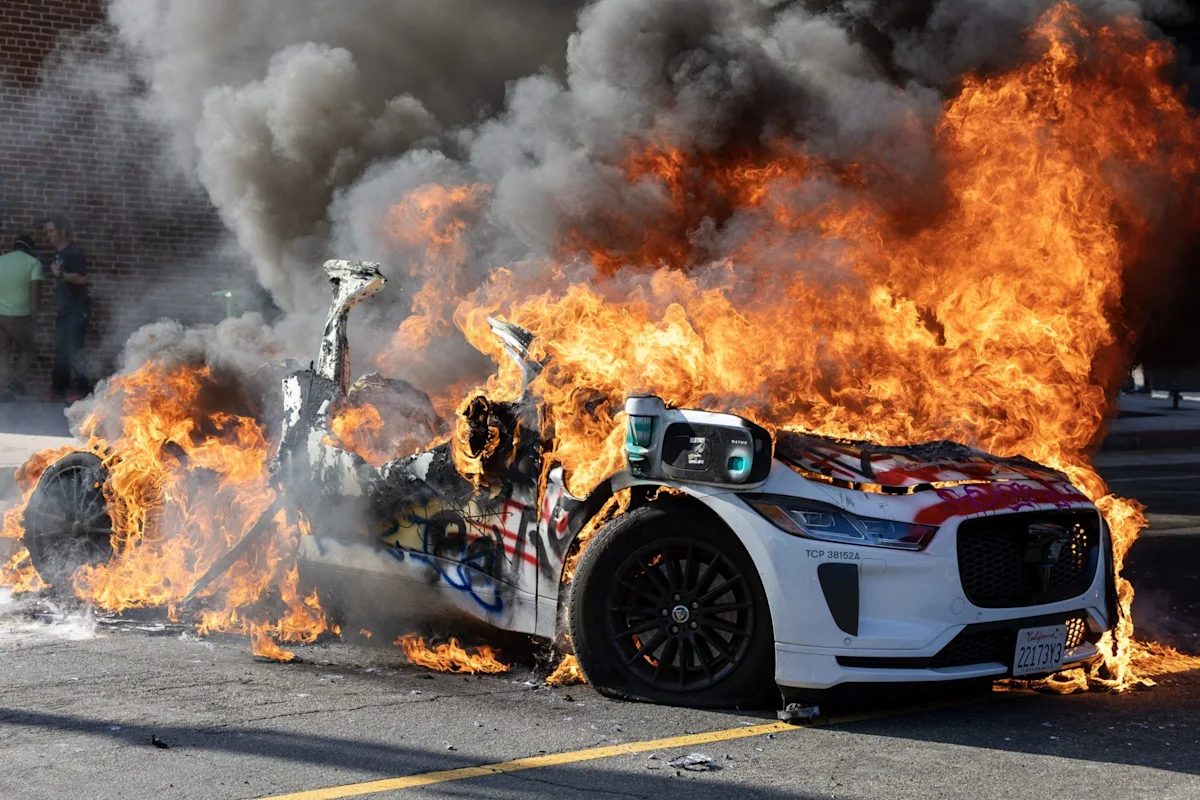
During anti-ICE protests in downtown Los Angeles in June 2025, demonstrators smashed, spray-painted, and burned at least six Waymo robotaxis. The cars reportedly honked in unison as they burned, and activists claim camera data from the cars was shared with the Los Angeles Police Department and represents a surveillance state. As a result, Waymo suspended service in the downtown area and continued to do so during subsequent protests. Despite this, federal regulations were not enacted.
In February, a Waymo plowed into a police car at an Atlanta crime scene. A month later, another person blocked an ambulance during a shooting in Austin.
In Los Angeles in December, a Waymo was spotted driving into an active crime scene; the driverless technology was unable to follow the officer’s instructions to change course and leave the scene.
That month also saw perhaps the most similar situation to what happened in Wuhan. A massive power outage knocked out traffic signals across San Francisco, causing Waymo’s fleet of 800-1,000 robotaxis to clog roads and impede emergency vehicles. During a March 2 hearing on what happened to fleets during the outages, Mary Ellen Carroll, executive director of the San Francisco Department of Emergency Management, expressed outrage.
“What has started to happen is that our public safety officers and responders have to physically move” the robotaxis, Carroll said. “In a sense, they are becoming the default roadside assistance for these vehicles, and we think that’s untenable.”
Waymo has since provided software updates for its self-driving cars, but there are still no federal regulations.
States are working to get cars off the road
There are no federal self-driving car safety laws in the United States. The SELF-DRIVE Act of 2026, a bipartisan House bill that would create the first regulations, is still in the draft stage. Earlier versions in 2017 and 2021 died without passing.
While federal regulation stalls, a separate movement is gaining traction at the state level: legislation to reduce the amount of time Americans drive. California, Minnesota, Colorado and Oregon now have laws requiring transit agencies to reduce vehicle miles driven, the Brookings Institution found. In Colorado, this has shifted $900 million from highway expansion to bus rapid transit. Maryland, New York, New Jersey and Massachusetts are considering similar bills in 2026.
Large-scale deployment of self-driving cars is widely expected to increase total driving: empty robo-taxi cruises between fares, commuters choosing to travel long distances, and freight trucks operating around the clock.
But Tony Han, founder and CEO of Chinese robotaxi startup WeRide, told the Fortune Global Forum in Riyadh that self-driving cars may never be 100% safe, but within a decade they will be 10 times safer than humans.
This story originally appeared on Fortune.com