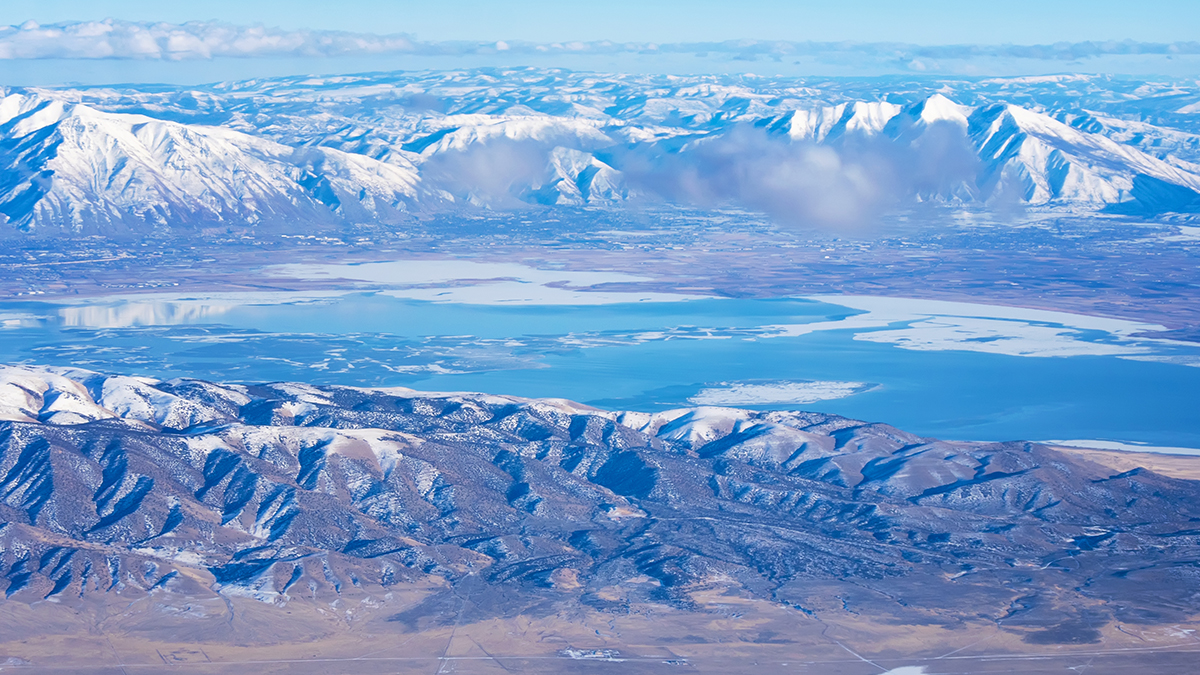
The Great Salt Lake is named for the salinity of its water, but a new study appears to have discovered a vast reservoir of salt-free freshwater hiding beneath it.
University of Utah researchers deployed a helicopter to conduct an airborne electromagnetic (AEM) survey of part of the lake, covering part of the southeastern edge of the Farmington Bay region.
AEM surveys do two things: detect electrical conductivity, which helps distinguish salt water from fresh water, and examine rock composition. This means the data has the potential to show the location of fresh water and its depth.
The team found that in the area they investigated, the depth of bedrock beneath the Great Salt Lake suddenly dropped significantly, leaving huge spaces for sand and silt to fill – the sediments appeared to be saturated with fresh water.
“We were able to answer the question of how deep this potential reservoir is and how large its spatial extent is beneath the eastern lake margin,” said geophysicist Michael Zhdanov.
“If you know how deep, how wide, how porous the space is, you can calculate the potential amount of fresh water.”

Survey helicopter and its scanning equipment. (Brian Mavley/University of Utah)
The researchers estimate that the freshwater reservoir could extend down 3 to 4 kilometers (up to nearly 2.5 miles), but that would require a comprehensive survey of the entire Great Salt Lake to determine for sure — only a small portion of which was scanned here.
There have been suspicions that fresh water might be lurking beneath the Great Salt Lake—in part because of the sudden appearance of reed-covered islands in the basin—but this is the first serious attempt by researchers to assess how large the freshwater reservoir might be.
While the presence of fresh water is not surprising, the potential reach is. An AEM survey of the reservoir revealed that the bedrock “bowl” holding the sediment extends deeper into the center of Farmington Bay Beach than expected.
Some fresh water is expected at the edge of the Great Salt Lake because it flows down from the surrounding mountains, but data suggests that there is much more fresh water within the Great Salt Lake’s roughly 2,500 square kilometers (950 square miles).
“The unexpected part is not the salt lenses we see near the surface of Playa,” Johnson explained recently on Utah radio station KPCW’s Cool Science Radio show.
“The freshwater beneath it extends all the way into the interior of the lake, and maybe even underneath the entire lake. We don’t know.”
What’s more, researchers think this water could be useful: As the Great Salt Lake’s water continues to evaporate, pollution from residual dust has become a growing problem for the health of surrounding communities.

Only a small part of the lake has been surveyed. (Zhdanov et al., science. represent.2026)
This dust often blows into Utah’s urban areas, carrying toxic metals with it. Some moistening with fresh water may help alleviate this condition.
“Before we extract more groundwater, we need to understand the beneficial effects of this groundwater,” said hydrologist Bill Johnson.

Sign up for ScienceAlert’s free fact-checking newsletter
“The first goal is to see if we can use this freshwater to moisten dust hotspots and douse them in a meaningful way without causing too much disruption to the freshwater system.”
Researchers are already scrambling to secure funding to expand the AEM survey and analyze more lakes. In particular, they hope to map the boundaries of sudden drops in bedrock water levels.
This should give us a better idea of how much fresh water can be stored here, and it will also help with water resource planning and the study of other similar lakes around the world that may hide reservoirs.
RELATED: Strange living islands appear on the Great Salt Lake, and now we know why
Similar technology could be deployed at other sites, in addition to other areas of the Great Salt Lake, combining magnetic readings to estimate rock depth and conductivity readings to estimate freshwater area.
“That’s why we need to survey the entire Great Salt Lake,” Zhdanov said. “Then we’ll know the top and the bottom.”
“We used different techniques to study the vertical extent of these freshwater-saturated sediments to determine the depth of the basement.”
The study was published in scientific report.

