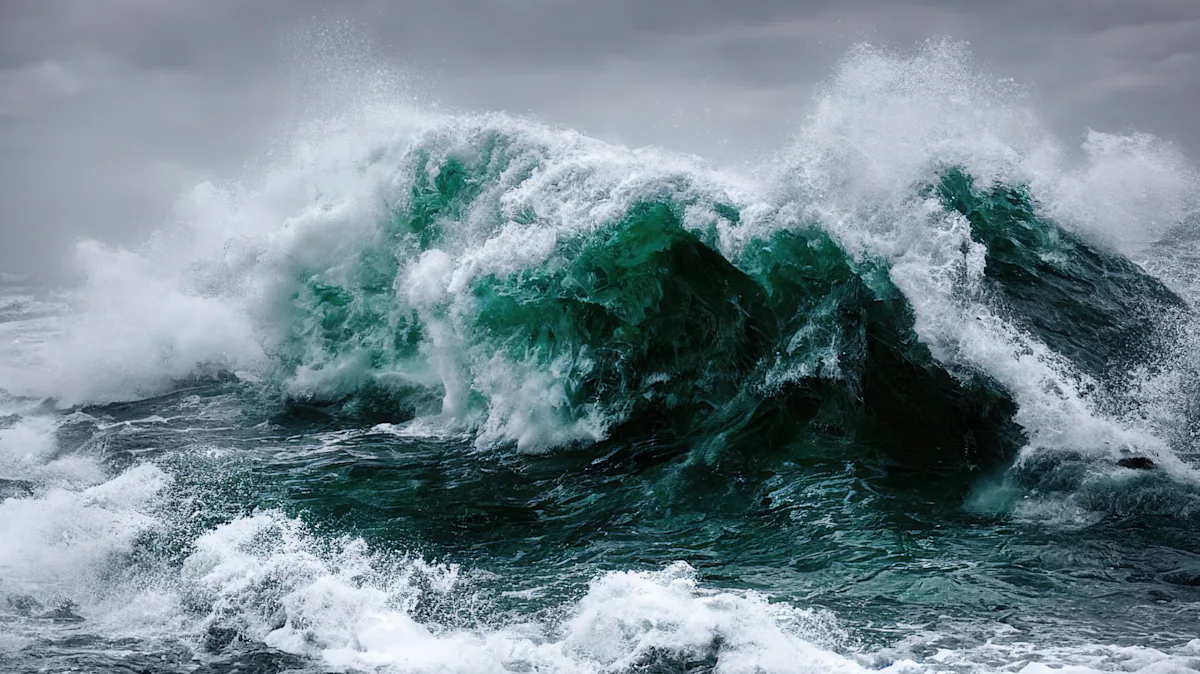
Sailors have long told stories of giant waves arriving out of nowhere in the ocean that threatened to completely destroy their ships. Despite sailors’ claims, rough waves were considered scientifically unrealistic. It is understood that wave sizes are distributed in a bell-shaped curve, with a small number of small waves, a large number of medium-sized waves and a small number of large waves. Now, satellite data has found evidence of waves at the very end of this bell curve, which may reach 100 feet high. Analysis of this data is revealing mysteries about our oceans, such as research showing that all of Earth’s oceans may have once been green.
In 2024, a storm in the Pacific Ocean may have produced waves as high as 115 feet. Data about waves is collected from satellites that monitor ocean activity. By scanning the ocean surface from space, satellites can map wave heights over large areas. This transformed the rogue wave from a post-event sailor’s story into a recorded event that could be analyzed, measured and catalogued. This wave reveals the fact that these types of waves can form even in the absence of hurricane conditions and illustrates the true unpredictability of ocean navigation.
Read more: 9 lightning myths you need to stop believing (and the truth)
Using satellites to find unusual waves

Waves in the ocean – Panmaule/Getty Images
A study aimed to understand how satellite observations and data measure unusual waves was published in Earth, Atmospheric and Planetary Sciences. This is not unlike research into understanding giant tsunamis. The study used the Surface Water and Ocean Topography (SWOT) mission, a satellite system designed to map the height of Earth’s water surfaces in detail. The study tracked the waves as they moved away from the storm, detailing how high they were and how they lowered during the voyage.
Satellite data are being used to analyze ocean storms in 2023 and 2024. One of the storms swept across the Pacific, slamming coastlines from Canada to Peru and even disrupting a big-wave surfing event in Hawaii. For this storm, satellites measured the highest waves ever recorded.
The observations reveal new insights into the behavior of the ocean’s largest waves, including unusual or giant waves. The study used the SWOT method to show how the main wave can create longer, more powerful waves away from the center of the storm, which can unexpectedly appear on ships. The study highlights that understanding these types of waves and what causes them could help keep sailors safe, improve infrastructure along dangerous coastlines, and even compare the data to the area’s seismic activity to better understand how the two mix.
Learn how unusual waves form

A shipwreck near the coast – Ronfullhd/Getty Images
This isn’t the only study aimed at expanding our understanding and approach to unusual waves. An 18-year study published in Scientific Reports analyzed high-frequency laser measurements of ocean waves collected by the Ekofisk platform in the North Sea. It breaks the data into more than 27,000 half-hour snapshots of ocean activity. This approach allowed the team to take into account local ocean conditions and better observe how unusual waves form. The team found that rogue waves are created when multiple other waves combine, unlike what other theories propose.
During this period, the ocean storms Bognion and Andrea were studied, particularly Andrea, which had unusual wave formation. The team found that the shape of the waves is a better predictor of unusual waves, rather than just the elements of severe storms that typically have large, high-energy waves. Many waves naturally develop sharper crests and shallower troughs, a shape that helps multiple waves combine and briefly form larger waves. On this basis, they developed a new statistical model to estimate the likelihood of abnormal waves.
Rough waves have always frightened sailors, who feared their ships would be lost in the ocean and in time, like those lost in Antarctica. Ocean conditions and the role they play in wave formation are now better understood. With this data, it may one day be possible to accurately predict and more thoroughly understand unusual waves.
Like this article? Sign up for BGR’s free newsletter and add us as your go-to source for the latest technology and entertainment, as well as tips and advice you’ll actually use.
Read the original article about BGR.