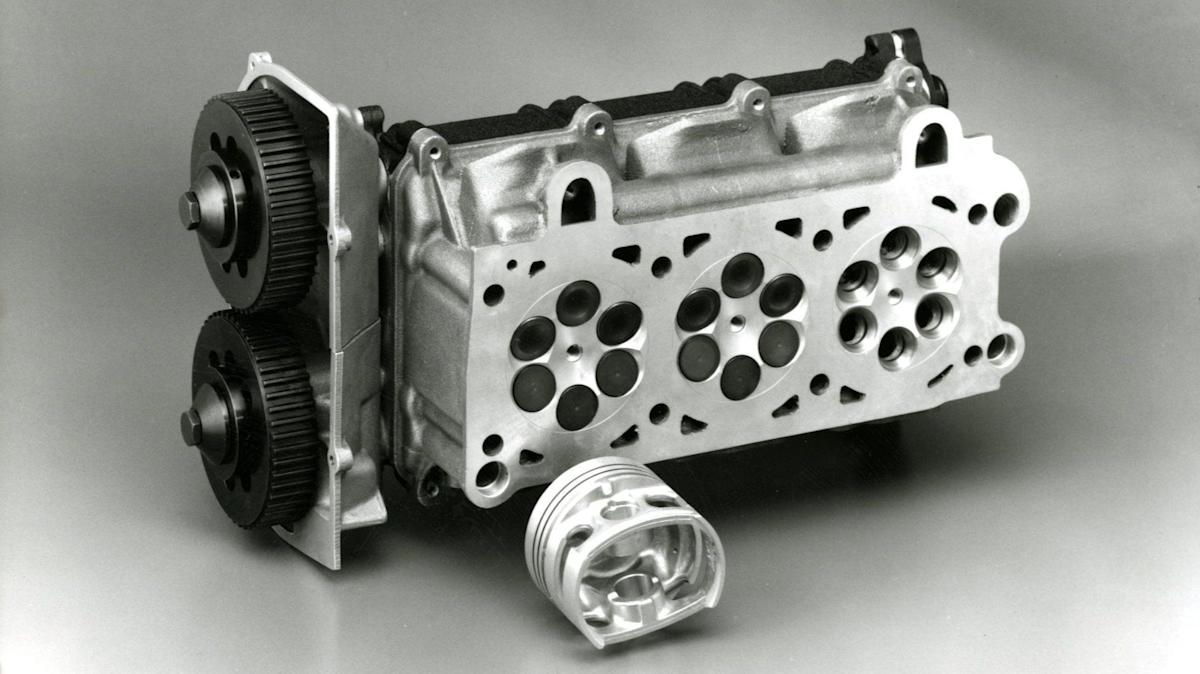
Is there anything scarier than a Maserati engine from the 1980s? A more complex one from the same timeline. Granted, we can’t really comment on its reliability because Maserati’s prototype six-valve engine never went into production, so it wouldn’t be fair to label the 2.0-liter V6 in the Biturbo as “unreliable.” That’s part of the reason the Maserati Biturbo is so cheap.
The so-called 6.36 engine was quite innovative for its time. The name 6.36 basically means a V6 engine with 36 valves, that is, 6 valves per cylinder, which is quite revolutionary for a car engine. And the amount of the claim is also huge. Maserati reckons the prototype 2.0-liter twin-turbo engine will produce 257 horsepower at 7,200 RPM, a considerable increase over the 180 horsepower produced by the earlier three-valve version.
The engine’s complexity is increased by a patented cam rocker arrangement, which means three of the six valves are operated using a single rocker and cam lobe, reducing overall engine complexity. Not only that, but unique valve settings allow the twin-turbo V6 to run an ideal air-fuel mixture. Compared with four-valve-per-cylinder engines, Maserati’s six-valve arrangement increases the gas circulation area by 34%. At least that’s what the company claims.
Despite the engine’s potential, Maserati’s enthusiasm soon faded and the 6.36 was shelved. But we can’t help but wonder, why would Maserati abandon the idea of an industry first when they managed to make it work, making decent power while claiming less complexity and better durability? Maybe Yamaha has something to do with it.
Read more: The year these Ford V10 Tritons had the most problems
More is not always better

Picture showing the cam and rocker mechanism of a Maserati six-valve-per-cylinder engine – Driving 4 Answers/YouTube
It turns out Maserati isn’t the only one considering cramming more valves into its engines. Apparently Yamaha experimented with six and seven valves per cylinder when developing the radical FZ750. In case you didn’t know, a 750cc four-cylinder engine has five valves per cylinder, three on the intake side and two on the exhaust side.
During the development of the FZ, Yamaha tested a 28-valve V4 with two spark plugs (i.e. 7 valves per cylinder) capable of revving up to 20,000 RPM. Engineers eventually realized that more was not necessarily better when it came to valves. The engine suffered from knocking problems, especially near the closely spaced exhaust valves, whereas the experimental V4 had three. Not only that, but the engine was also prohibitively expensive to develop.
Obviously, once you get beyond five valves per cylinder, you enter the area of diminishing returns. Using five rather than four valves per cylinder, volumetric efficiency can be significantly improved by increasing the intake area, as the total circumference of three intake valves (albeit smaller in diameter) is greater than a two-valve setup. However, beyond five, the total valve opening area is significantly reduced, thereby reducing the overall performance of the engine.
Five is a good compromise because in addition to broadening the torque curve, it does improve power and torque figures by 10 percent (versus four), which proves helpful with the high-revving 750cc four-cylinder engine. That’s perhaps why Ferrari uses five valves per cylinder in the 355’s stunningly beautiful engine, as did some of the engines from Mitsubishi, Audi and Volkswagen in the 1990s and early 2000s. Although the Biturbo saved Maserati, the six-valve project may have been too ambitious for the small Italian automaker.
Want more like this? Join the Jalopnik newsletter to get the latest automotive news delivered straight to your inbox and add us as your preferred search source on Google.
Read the original article on Jalopnik.