Authors: Erin Banco, Sarah Kinosian, and Matt Spetalnick
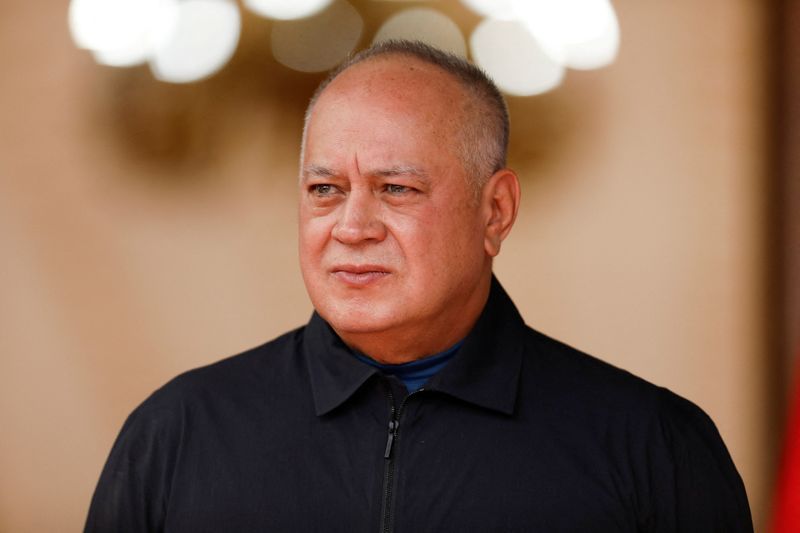
NEW YORK/MIAMI/WASHINGTON (Reuters) – Trump administration officials had discussions with Venezuela’s hardline Interior Minister Diosdado Cabello months before the U.S. moved to capture President Nicolás Maduro and have been in communication with him since, according to multiple people familiar with the matter.
Officials warned Cabello, 62, not to use the security services he oversees or radical ruling party supporters to attack the country’s opposition, four sources said. After the January 3 attack in the United States, security agencies, including intelligence services, police and armed forces, remained largely intact.
Cabello was named in a U.S. drug trafficking indictment that the Trump administration used as justification for arresting Maduro but was not considered part of the operation.
The communications with Cabello, which also involved U.S. sanctions against him and the prosecution he faces, date back to the early days of the current Trump administration and continued in the weeks before the U.S. ousted Maduro, two people familiar with the matter said. The government has also been in contact with Cabello since Maduro’s ouster, four people familiar with the matter said.
The communications, which have not been previously reported, are critical to the Trump administration’s efforts to control the situation in Venezuela. If Cabello decides to unleash the forces he controls, it could spark the chaos Trump wants to avoid and threaten interim President Delcy Rodriguez’s grip on power, according to sources familiar with U.S. concerns.
It’s unclear whether the Trump administration’s discussions with Cabello extended to questions about Venezuela’s future governance. It’s also unclear whether Cabello heeded the U.S. warning. He has publicly pledged solidarity with Rodriguez, whom Trump has so far praised.
While Rodriguez is seen by the United States as a key figure in U.S. President Donald Trump’s strategy for post-Maduro Venezuela, Cabello is widely seen as having the ability to keep those plans on track or overturn them.
Venezuelan ministers have been in contact with the Trump administration either directly or through intermediaries, a person familiar with the matter said.
All sources were granted anonymity to speak freely about sensitive internal government communications with Cabello.
The White House and the Venezuelan government did not immediately respond to requests for comment.
Cabello has been a loyal supporter of Maduro
Cabello has long been considered Venezuela’s No. 2 man. A close aide to the late former president and Maduro mentor Hugo Chavez, he became a longtime Maduro loyalist and was feared to be a key enforcer of his crackdown. Rodríguez and Cabello have operated for years at the heart of government, the legislature and the ruling Socialist Party, but have never been considered close allies of each other.
Cabello is a former military officer who exerts influence over the country’s military and civilian counterintelligence agencies, which conduct extensive domestic espionage operations. He also has close ties with pro-government militia groups, particularly the Collective, a group of armed civilians on motorcycles deployed to attack protesters.
Cabello is one of a handful of Maduro loyalists that Washington relies on as interim ruler to maintain stability while accessing the OPEC nation’s oil reserves during an unspecified transition period.
But U.S. officials are concerned that Cabello — given his record of repression and history of rivalry with Rodriguez — could rock the boat, according to a source familiar with the administration’s thinking.
Reuters interviews with Venezuelan sources show that Rodriguez has been working to consolidate his power, installing loyalists in key positions to protect himself from internal threats while satisfying U.S. demands for increased oil production.
Elliott Abrams, who served as Trump’s special representative for Venezuela during his first term, said many Venezuelans expected Cabello to be removed from office at some point if a democratic transition were to move forward.
“If he leaves, Venezuelans will know that the regime is really starting to change,” said Abrams, now a member of the Council on Foreign Relations think tank.
U.S. Sanctions and Prosecutions
Cabello has long been subject to U.S. sanctions for alleged drug trafficking.
In 2020, the United States placed a $10 million bounty on Cabello and accused him of being a key figure in the “Cartel de los Soles,” which the United States says is a Venezuelan drug trafficking network led by members of the country’s government.
The United States has since increased the prize to $25 million. Cabello has publicly denied any connection to drug trafficking.
In the hours after Maduro was ousted, some analysts and politicians in Washington questioned why the United States had not captured Cabello – the second-ranked figure in the Justice Department’s indictment against Maduro.
“I know that Diosdado is probably worse than Maduro, worse than Delci,” Republican U.S. Rep. Maria Elvira Salazar said in a Jan. 11 interview on CBS’s “Face the Nation.”
In the days that followed, Cabello denounced U.S. intervention in the country and said in a speech that “Venezuela will not surrender.”
But in recent days, media reports have become less frequent about residents being searched at checkpoints — sometimes by uniformed security forces, sometimes by plainclothes officers.
Both Trump and the Venezuelan government have said many detainees considered political prisoners by the opposition and human rights groups will be released.
The government said Cabello is overseeing the effort as interior minister. Human rights groups say the liberation process has been painfully slow and hundreds of people remain unjustly detained.
(Reporting by Erin Banco in New York, Sarah Kinosian in Miami and Matt Spetalnick in Washington. Editing by Don Durfee and Rosalba O’Brien)

