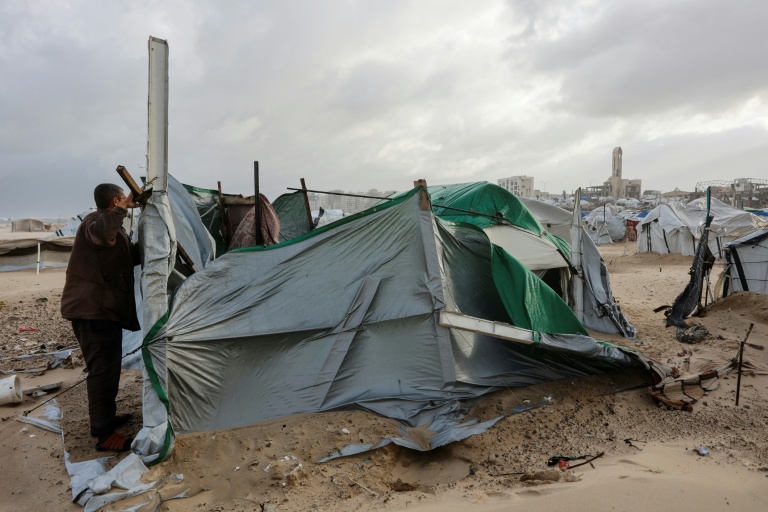
Mahmoud Abdul Al said in a tent in Gaza City that residents were frustrated and worried because nothing had changed in the Palestinian territories since the second phase of the U.S.-brokered ceasefire began.
Most Palestinians interviewed by AFP expressed anguish as buildings were blown up and makeshift camps destroyed in recent winter rains, creating an apocalyptic scene.
Although Israel’s strikes have weakened since the ceasefire between Hamas and Israel began in October 2025, bombs are still falling every day.
More than 14 people have died in the tiny coastal region after U.S. Middle East envoy Steve Witkoff announced on Wednesday the launch of the second phase of U.S. President Donald Trump’s Gaza peace plan, according to Gaza’s civil defense agency.
Israel and Hamas have repeatedly accused each other of violating the terms of the ceasefire.
“There is no difference between war and ceasefire, nor between phase one and phase two of the agreement: the strikes continue every day,” Abdul Aal said.
“Everyone is worried and frustrated because nothing has changed.”
An AFP photographer saw members of the Houli family, five of whose relatives were killed in an airstrike on their house in Deir al-Balah, central Gaza, walking among the rubble on Friday.
-“All media”-
Hamas announced the death of Mahmoud Houli, an officer of the movement, while the Israeli military said it carried out attacks on members of Hamas and Islamic Jihad’s armed factions on Thursday in response to what it considered ceasefire violations.
Ahmed Suleiman, a neighbor of the Houli family, said the announcement of the second phase of the ceasefire was “all over the media, but the reality is different”.
“There is no ceasefire, otherwise look what the ceasefire has brought,” he told AFP, pointing to destroyed buildings.
Most residents interviewed by AFP said they were skeptical of the recent announcement of a so-called “peace committee”. The Peace Council is an entity chaired by Trump that oversees reconstruction, along with a committee of Palestinian technical experts that works with it.
“No one cares about us,” said Hossam Majid, who lives in the ruins of his home in Gaza City.
“The whole world gathers in Cairo to talk about Gaza, but they can’t even get into it,” he told AFP.
“Israel will hand over the last (hostage) body as an excuse and then hand over (Hamas) weapons, and the second phase will last for several years,” he said.
Hamas has returned 47 of the 48 hostages handed over under the terms of the first phase, but has not yet committed to disarmament under the second phase plan.
-“Hope and Patience”-
According to the United Nations, daily life conditions for the vast majority of Gaza residents remain extremely unstable, with more than 80% of infrastructure destroyed.
Several humanitarian and U.N. workers told AFP that while the situation had improved in some areas since the ceasefire, the humanitarian response remained inadequate due to access restrictions imposed by Israeli authorities, claims they denied.
Water and electricity networks, as well as waste management, no longer function.
Hospitals can only operate at a minimal capacity when open, while schools exist only as sporadic or marginal initiatives. UNICEF says all children in Gaza need psychological support after more than two years of war.
“We miss real life,” said Nivine Ahmad, a 47-year-old woman who lives in a displacement camp in the Mawasi district of southern Gaza.
She said news of the formation of the technical expert committee made her imagine returning to Gaza City.
“I imagined living with my family in a manufactured home with electricity and water instead of our bombed-out home,” she said.
“Only then will I feel like the war is over,” she added.
At the same time, she urged the world to put themselves in the shoes of Gazans.
“We just have hope and patience,” she said.
Boolean/crb/mj/lba/amj