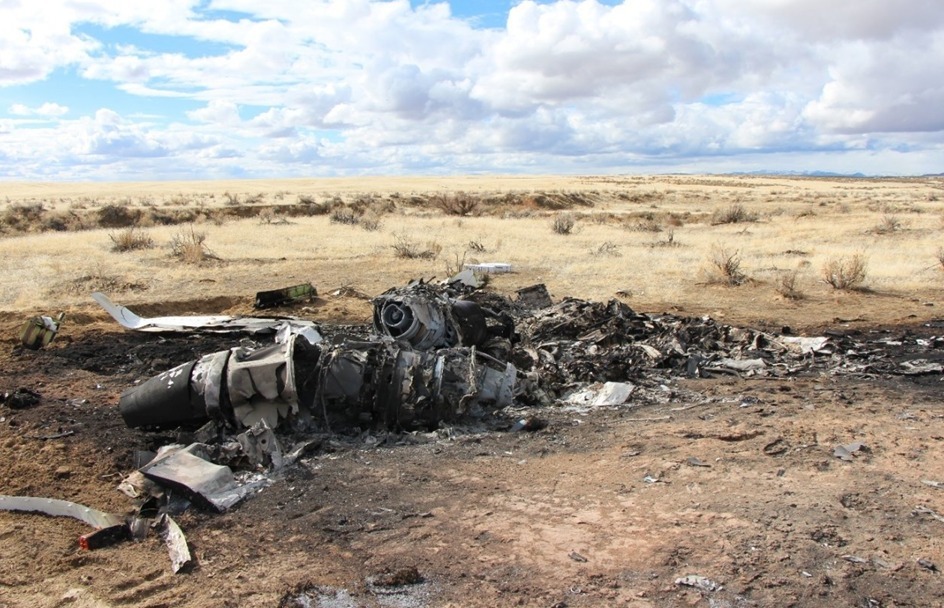
The National Transportation Safety Board’s final report on a February fatal accident involving a Hawker 900XP over Westwater, Utah, noted that the crew attempted to conduct a stall test in icing conditions despite their lack of experience conducting tests on a Hawker and were unfamiliar with stall characteristics, which resulted in a loss of control and the deaths of the pilot and co-pilot.
Two AIRMET reports, issued approximately two and a half hours before the accident flight, reportedly stated that the aircraft had moderate icing during stall tests at climb and cruise altitudes. In addition, the video shows that when taking off from the departure airport, the surroundings were dark and accompanied by precipitation.
Investigators said there was evidence the crew was aware of the sleet and winter conditions before takeoff when they interacted with maintenance personnel. According to the aircraft pilot operating manual (POM), the presence of these conditions should cause the crew to pause before performing a stall test, which requires visual meteorological conditions and the absence of icing.
detail
On February 7, 2024, the aircraft, owned by Vici Aviation and operated by Clay Lacy Aviation, was on a repositioning flight from Grand Junction Regional Airport (KGJT), Colorado, which had just undergone maintenance, to its home base at Tacoma Narrows Airport (KTIW) in Gig Harbor, Washington.
According to the NTSB, the aircraft was undergoing routine maintenance at West Star Aviation’s KGJT, which included inspection of the wing leading edges and TKS panels for cracks and corrosion.
The wing leading edges and de-icing panels had recently been removed, inspected and reinstalled as part of routine maintenance, and a crew consisting of the pilot-in-command (PIC) and first officer (SIC) were conducting stall tests on the aircraft.
The plane took off from KGJT and turned northeast. Two AIRMET reports were issued approximately two and a half hours before the accident flight, indicating moderate icing during the climb and cruise altitudes of the stall test. In addition, video from the Hawker’s departure airport during takeoff showed the field was surrounded by cover and precipitation, and the crew was aware of the presence of sleet and “stormy” conditions when interacting with maintenance personnel before departure.
Required stall test conditions for the POM include an empty belly tank, an operational stall identification system, and the autopilot off.
The aircraft took off normally and climbed to an altitude of 20,000 feet, whereupon the crew began a stall test. According to the flight data recorder and cockpit voice recorder, the pilot did not follow the recommended cloud clearance and altitude limits specified in the stall test procedures in the POM.
The crew deliberately chose to conduct the stall test above clouds, which caused them to fly 2,000 feet above the specified maximum altitude. The NTSB report also noted that there was no evidence that the crew attempted to verify that the outer surface was free of ice after flying through icing conditions, even though the aircraft was equipped with an ice-detection spotlight system that could be used to illuminate the wing fairings. Notably, the aircraft is also equipped with an ice detector, which must be manually activated by the crew as it is not directly connected to the airframe anti-icing system.
“The occurrence of these conditions should cause the crew to pause before performing a stall test, which, according to the Aircraft Pilot Operating Manual (POM), requires visual meteorological conditions and the absence of icing,” the NTSB report states.
Flight data showed no anomalies in the flight controls or engines, as flight control surface movements were consistent with flight control inputs and engine performance matched power lever movements.
The aircraft slowed and the pitch attitude increased, consistent with the crew preparing to perform a post-maintenance stall warning and identification system check.
“The airspeed then slowed further and the flaps were retracted for the first system check,” the report states. “Performance calculations indicate that the rocker was activated approximately 117.5 [knots]1 knot lower than the activation speed of the stick shaker when the flaps are zero. The pusher then activates at 113.5 [knots]3 [knots] Higher than pusher activation speed. “
“Both the rocker and pushrods were activated at appropriate speeds considering the weight and load factor of the aircraft; however, the aircraft entered a stall at the same time as the rocker was activated, which did not provide any warning to the crew.”
According to the NTSB, the correct stall warning sequence should be “stick, push stick, and then, if the pilot does not attempt a stall recovery, enter a stall.”
The report continues: “After the aircraft entered a stall, the crew attempted to break the stall by inputting full left wing lower aileron when the aircraft banked suddenly to the right and used full power and full aft control stick, which exacerbated the aerodynamic stall/spin.”
The crew’s erroneous response suggested they had not received adequate flight training, and the POM’s brief guidance did not provide clear instructions on the possible consequences of “unacceptable stall characteristics,” i.e., warning instructions or appropriate recovery.
The stall section of the POM states, “The pilot conducting the stall check should have prior experience performing stalls in a Hawker and must be prepared for unacceptable stall behavior occurring at any time prior to and throughout the maneuver.”
A review of the crew’s training records revealed that they participated in simulator training for initial SIC training and recurrent PIC training at a commercial facility last year. The courses cover the operation of the Stall Warning and Identification System, which consists of shakers and thrusters. The training focuses on recognizing and avoiding stalls, as the simulator is not designed to teach a full stall and does not prepare the crew for uncommanded rolls, despite POM warnings about this.
It is worth noting that PIC participated in stall test flights as early as four years ago, but SIC did not participate in stall test flights. The NTSB noted that given this information, “the flight crew’s simulator training on the Stall Warning and Identification System and the pilot’s prior participation in stall test flights are unlikely to adequately prepare them to safely conduct stall flight tests or address any unacceptable stall behavior.”
Investigators stated that the stall warning sequence of the accident flight (the stall occurred simultaneously with the activation of the stick control) was likely caused by wing contamination (icing or recent maintenance of the aircraft) that worsened the relationship between lift and angle of attack (AOA).
Depending on the weather conditions at the time of the accident and the altitude the aircraft had to climb from 5,000 feet to 16,700 feet through clouds and precipitation, the Hawker may have accumulated as much as 1 millimeter of ice on its wings during the climb.
As pilots learn in private ground schools, even a thin layer of ice can reduce lift by up to 40 percent.
The aircraft entered a flat spin but failed to recover. It hit the ground and shattered, then burst into flames. This prevented a complete and thorough wreckage inspection of the airframe and engines.
timeline
10:36:41: SIC reports to PIC that the anti-icing function was turned off while the aircraft was on the ground before takeoff.
10:37: ADS-B and flight data recorder (FDR) data show the aircraft took off from KGJT and began climbing southeast.
10:38:45: The crew requests a blocking altitude for “approximately 10 minutes” from ATC, and the SIC reports “anti-ice is off”.
10:39:54: PIC tells SIC, “Once above VMC-C, we will request altitude.” The aircraft turns northwest and continues climbing.
10:42:25: SIC requires Denver Center to provide height blocks from FL 180 to FL 200. The center approved the height block. Hawker climbed and leveled off at 20,000 feet mean sea level.
10:44:00: The FDR shows that the airspeed begins to decrease from 219 knots as the aircraft’s pitch attitude and AOA (angle of attack) begin to increase.
10:44:41: The crew starts discussing the stall test, and then the SIC asks, “So we’re getting instructions, right?” The PIC responds, “Ah, yes, instructions are given. We’re looking for the shaker, the pusher. If you can’t see it for some reason, I’m going to call pusher Mark.”
10:45:01: Autopilot has been disconnected.
10:45:51: A sound consistent with a landing gear warning horn is heard, followed by a confirmation signal from the captain.
10:46:33: The cockpit area microphone records a sound consistent with a rocker, as the aircraft’s pitch attitude continues to increase while the airspeed simultaneously decreases, the SIC reports “one nineteen”.
10:46:37: When decelerating from 118 knots, the left and right angles of attack are 0.91% and 0.93% respectively, the left and right pitch attitudes are both 15.12 degrees, and stall valve A is open. The CVR records the rattle that accompanies the sound of the rocker.
1046:47: Flight trajectory data shows the aircraft begins a rapid descent in a pattern similar to a corkscrew shape. The aircraft made several circular spins before ending at 10:47:44.
The National Transportation Safety Board found that the probable cause of the accident was the crew’s decision to conduct a post-maintenance stall test in icing conditions, which resulted in contamination of the wings that severely reduced the aircraft’s critical angle of attack.
The full NTSB final report is below:
Report_WPR24FA083_193761_12_30_2025 4_19_20 PM download