Future and its affiliate partners may earn a commission when you purchase through links on our articles.

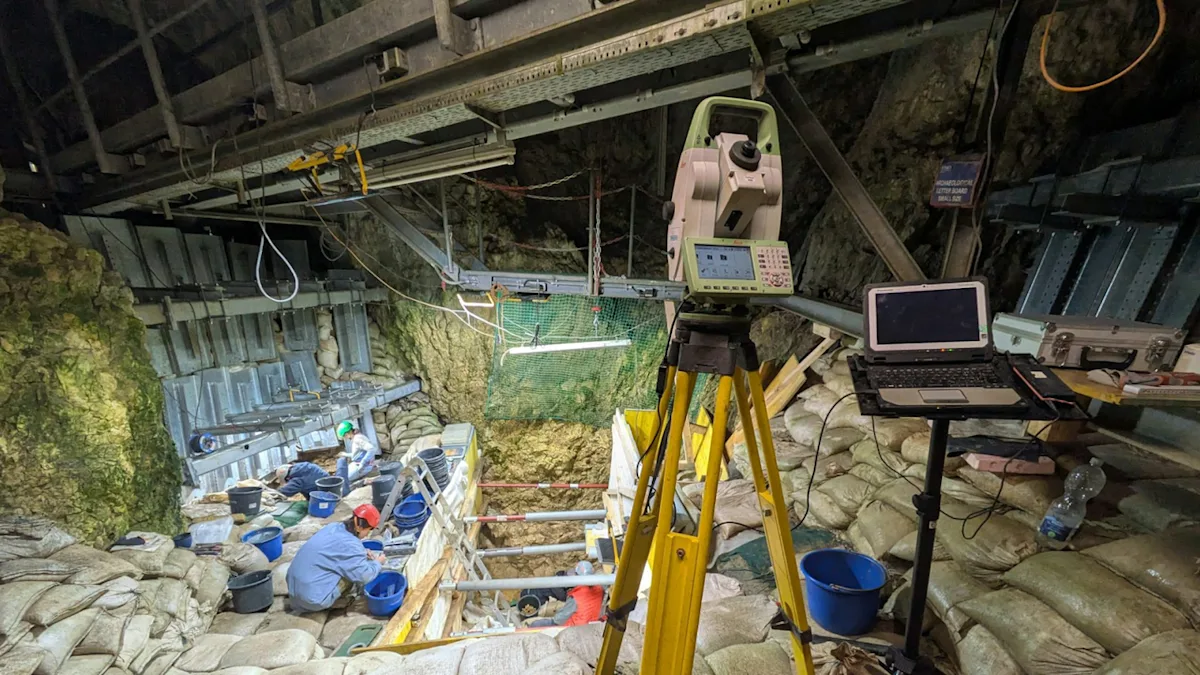
The team at GACT has been analyzing sediments from the Hohlefels Cave in Germany. . |Image source: GACT
The past two decades have witnessed a revolution in scientists’ ability to reconstruct the past. This is made possible through technological advancements DNA Extracted from ancient bones and analyzed.
These developments indicate Neanderthals interbred with modern humans ——Things that I didn’t think would happen before. It allows researchers to tease apart the various migrations that shaped modern humans. It also allowed the team to sequence the genomes of extinct animals, such as mammoths, and extinct disease vectors, such as extinct strains of plague.
While much of this work is done by analyzing human or animal physical remains, there is another way to obtain ancient DNA from the environment. Instead of relying on bones, researchers can now extract DNA directly from cave sediments and sequence it (determine the order of the “letters” in the molecule). This is changing the field known as paleogenetics.
Caves can preserve tens of thousands of years of genetic history, providing ideal archives for studying humans’ long-term interactions with ecosystems. The sediments beneath our feet become biological time capsules.
This is something we are exploring at the Geogenomic Archaeology Campus (GACT) in Tübingen, Germany. Analyzing DNA from cave sediments allows us to reconstruct who lived in Ice Age Europe, how ecosystems changed and what role humans played. For example, did modern humans and Neanderthals overlap in the same cave? Genetic material can also be obtained from feces left in caves. We are currently analyzing DNA from the feces of cave hyenas that lived in Europe about 40,000 years ago.
this The oldest sediment DNA The fossils discovered so far are from Greenland and are 2 million years old.
Paleogenetics has come a long way since the first genome of the extinct quagga, a close relative of the modern zebra, was sequenced in 1984. Over the past two decades, next-generation genetic sequencing machines, laboratory robots, and bioinformatics (the ability to analyze large, complex biological data sets) have transformed ancient DNA from a fragile curiosity into a high-throughput scientific tool.

Sediment samples from Hohlefels were divided into different analytical methods. Some go to clean rooms, and some go to geochemistry laboratories. |Image source: GACT
Today, sequencers can decode 100 million times more DNA than earlier sequencers. The first human genome took more than a decade to complete, but modern laboratories can now sequence hundreds of complete human genomes in a day.
2022, Nobel Prize in Physiology or Medicine The winner is Svante Pääbo, a leader in the field. It emphasizes the global significance of this study. Ancient DNA is regularly making headlines these days, from attempts to recreate mammoth-like elephants to tracing humans’ presence around the world over hundreds of thousands of years. Crucially, advances in robotics and computing allow us to recover DNA from sediments and bones.
GACT is a growing research network based in Tübingen, Germany, in which three institutions collaborate across disciplines to build new methods for finding DNA in sediments. Archaeologists, geoscientists, bioinformaticians, microbiologists, and ancient DNA experts combine their expertise to reveal insights that no single field can achieve alone—a collaboration that makes the whole truly greater than the sum of its parts.
The network extends far beyond Germany. International partners support fieldwork at archaeological cave sites and natural caves around the world. This summer, for example, the team investigated cave sites in Serbia, collecting hundreds of sediment samples for ancient DNA and related ecological analyses. Future work is planned in South Africa and the western United States to test the limits of ancient DNA preservation in sediments from different environments and time periods.

Work is underway at a cave site in Serbia. |Image source: GACT
Finding a needle in a haystack
Recovering DNA from sediment sounds simple: scoop up, extract, sequence. In fact, the situation is much more complex. These molecules are scarce, degraded and fragmented, and mixed with modern contamination from cave visitors and wildlife. Detecting real Ice Age molecules relies on subtle patterns of chemical damage in the DNA itself, ultra-clean laboratories, robotic extraction and specialized bioinformatics. Every positive identification is a small victory, revealing patterns invisible to traditional archaeology.
Much of GACT’s work takes place in the caves of the Swabian Jura, a UNESCO World Heritage Site, such as Hohle Fels, home to some of the world’s oldest musical instruments and figurative art. Neanderthals and Homo sapiens left behind stone artifacts, bones, tusks and sediments accumulated over thousands of years. Caves are natural DNA archives, with stable conditions preserving fragile biomolecules, allowing researchers to build the genetic history of Europe’s Ice Age.
One of the most exciting aspects of sediment DNA research is its ability to detect long-lost species, even if no bones or artifacts remain. Of particular concern are humans: who lived in the caves and when? How do modern humans interact with neanderthal Using caves, as mentioned earlier, do they exist simultaneously? Do cave bears and humans compete for shelter and resources? What might the microorganisms that live alongside them reveal about human impacts on past ecosystems?
Related stories
— New research suggests ‘hobbits’ may have gone extinct when drought forced them to compete with modern humans
——”Extreme human genetic variation”: Ancient humans have been isolated from the world in southern Africa for nearly 100,000 years, and their genetic differences are astonishing
——Modern humans arrived in Australia 60,000 years ago and may have interbred with ancient humans such as “hobbits”
Sediment DNA can also trace life outside caves. Predators drag their prey into hidden chambers, and humans leave waste behind. By tracking changes in human, animal and microbial DNA over time, researchers can study ancient extinctions and ecosystem changes, providing insights relevant to today’s biodiversity crisis.
The work is ambitious: using sedimentary DNA to reconstruct Ice Age ecosystems and understand the ecological consequences of human presence. GACT is only two years old, and each data set generates new questions. Each level of the cave adds another twist to the story.
Hundreds of samples are currently being processed, and major discoveries are coming. Researchers expect to soon discover the first cave bear genome, the earliest traces of humans, and the complex communities of microorganisms that once thrived in the dark. Will the sediments reveal all their secrets? Time will tell – but the prospects are exciting.
This edited article is reprinted from dialogue Licensed under Creative Commons. read Original article.

