A powerful solar eruption is expected to hit Earth soon, according to the National Oceanic and Atmospheric Administration’s Space Weather Prediction Center.
A coronal mass ejection — a massive eruption of solar material and magnetic fields from the sun’s outer atmosphere — is expected to reach Earth early to noon on Tuesday, according to the National Oceanic and Atmospheric Administration. Coronal mass ejections are related to the M8.1 solar flare, which may lead to enhanced geomagnetic activity and may trigger G3 storms (the third level of the space weather scale).
Geomagnetic storms of this magnitude are considered “severe” and have the potential to cause some minor impacts to technology, such as satellite outages and radio communications problems.
Solar activity may also cause stronger-than-usual auroras, making the northern lights visible in more areas of the United States than usual, including many northern states and some from the Midwest down to Oregon, according to the National Oceanic and Atmospheric Administration.
These U.S. states are expected to see the Northern Lights for the second night in a row
What is space weather?
Weather is generally thought of as external conditions, ranging from rain and snow to clear skies. But beyond Earth’s atmosphere, there’s another type of weather that has just as much influence.
Space weather is primarily affected by the sun, which produces energy through nuclear fusion. According to NASA, it refers to the conditions of the space environment and how those conditions affect objects throughout the solar system, including Earth and the thousands of satellites that orbit it.

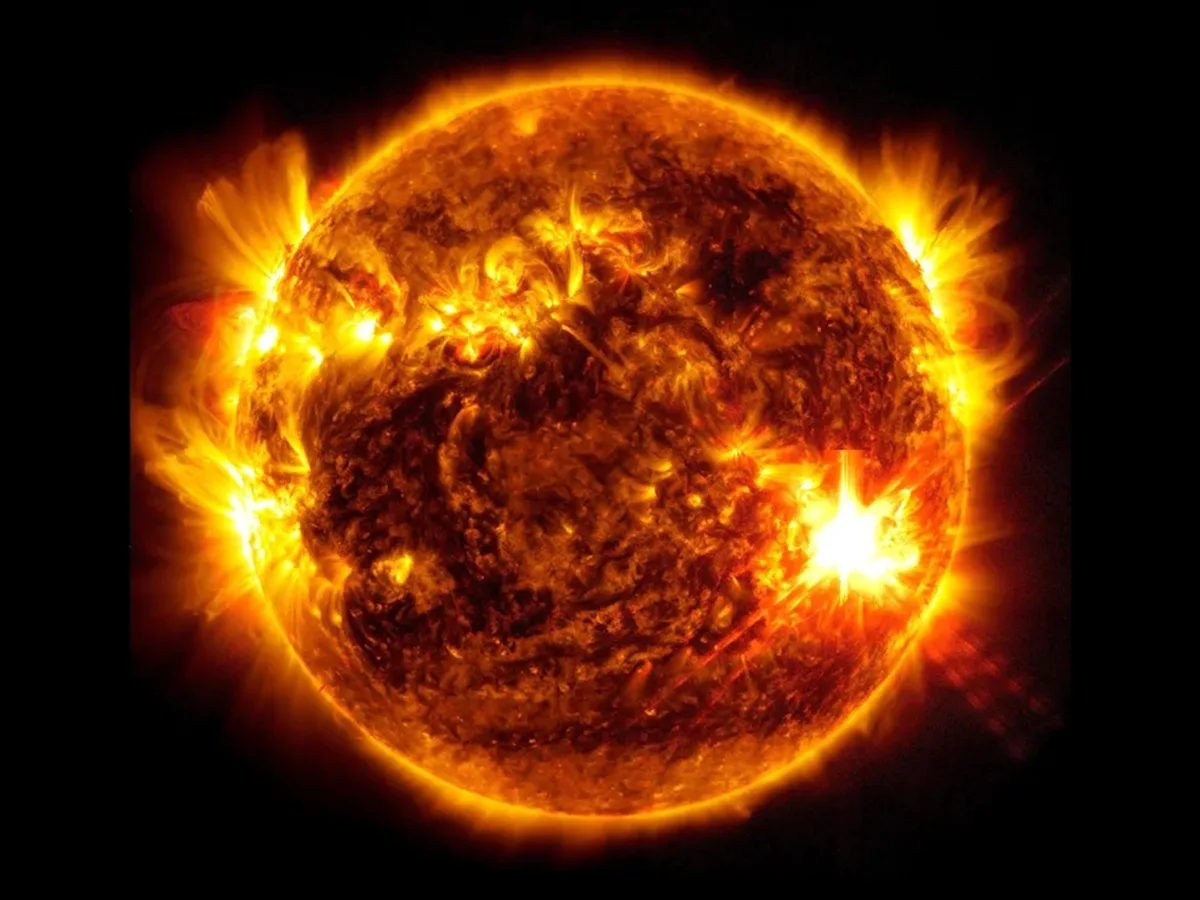
NASA – Photo: NASA’s Solar Dynamics Observatory (SDO) captured this image of the X5.8 solar flare that peaked at 9:23 PM ET on May 10, 2024.
The Sun continuously emits high-energy charged particles, plasma eruptions, and bursts of radiation that disrupt conditions in space when they reach Earth. Fortunately, our planet’s magnetic field and atmosphere protect us from the most dangerous impacts. But that doesn’t stop everything.
One of the most famous interactions of the solar wind as it collides with Earth’s magnetosphere and thin upper atmosphere occurs in the form of auroras, resulting in the beautiful Northern Lights.
However, many effects of solar activity can be harmful, affecting a wide range of technologies from communications systems to GPS to power grids, according to the National Oceanic and Atmospheric Administration (NOAA).
Northern lights appear across eastern US amid ‘severe’ solar storm
Why you should care about space weather
The sun has been very busy lately. In October 2024, the sun’s magnetic field reaches its solar maximum in its 11-year cycle, during which the number of solar flares is greatest. But even as this cycle continues, activity continues, bringing several geomagnetic storms and aurora shows to Earth.
In late November, Airbus announced that solar storms could “corrupt data critical to flight control functions” and quickly rolled out a software fix to address the issue. In November, powerful solar flares create brilliant auroras around the world, including parts of the United States as far south as Florida. As December begins, NOAA’s Space Weather Prediction Center releases geomagnetic storm observations.
NASA will launch two new satellites to help predict solar storms
How is space weather monitored and measured?
Both NASA and NOAA monitor space weather. However, NOAA’s Space Weather Prediction Center is dedicated to monitoring and predicting events in the space environment that could impact technology and life on Earth.
The Space Weather Prediction Center tracks a variety of space weather events, including geomagnetic storms, solar radiation storms, solar flares and sunspots.

CJ Yushta Photography via Reuters – Photo: The Northern Lights, also known as the Aurora Borealis, light up the sky in Sturgis, South Dakota, on November 12, 2025.
The agency uses the NOAA Space Weather Scale to communicate current and predicted space weather conditions for the three most impactful events: geomagnetic storms, solar radiation storms and radio outages, quantifying their potential impact on humans and infrastructure.
To convey the severity of these events, the NOAA space weather scale uses numbered levels (1-5), similar to how earthquakes, hurricanes, and tornadoes are measured. Each level outlines the potential impact, measures the intensity of the phenomenon and estimates the frequency of such events.
How to increase your chances of seeing the Northern Lights during the peak of the current solar cycle
What are the effects of geomagnetic storms?
Geomagnetic storms tend to get the most attention because of their potential to disrupt communications systems, GPS and power grids.
Severe geomagnetic storms are often caused by coronal mass ejections from the Sun, which are massive bursts of charged particles embedded in the magnetic field that interact with Earth’s magnetic field, temporarily disrupting the planet and releasing large amounts of energy, according to the National Oceanic and Atmospheric Administration.
Geomagnetic storm intensity is ranked by G for current and forecast conditions, with G1 storms considered “mild” and G5 storms considered “extreme.”

NASA – Photo: In February 2022, a coronal mass ejection resulted in the loss of 38 commercial satellites. Solar plasma produced by geomagnetic storms heats the atmosphere, causing denser gas to expand into satellite orbits.
The G scale measures geomagnetic storms based on the planet’s K index (called Kp, which ranges from 0 to 9). The index is calculated by observing fluctuations in the Earth’s magnetic field. G1 and G2 storms are fairly common and occur frequently throughout the year. In contrast, G5 storms are extremely rare and have the most significant impacts.
Significant technical disruptions and widespread auroras typically occur when geomagnetic storms reach G3 (strong), becoming more severe at G4 (severe). G3 and G4 storms are not uncommon and occur several times each year, depending on the solar cycle.
When the latest forecast indicates that a geomagnetic storm is possible or imminent, the Space Weather Prediction Center issues geomagnetic storm watches and warnings that provide information on expected intensity, timing, and potential impacts. The agency has also released guidance on where to see the aurora during the ongoing event.
Northern lights fill the sky: slideshow
Notable space weather events
The strongest geomagnetic storm in more than two decades arrives in May 2024. According to NASA, G5 storms bring stunning displays of the Northern Lights, which can be seen in many areas of the world, including places where auroras are rare.
The incident also caused problems on the ground, including tripped high-voltage lines, overheating transformers and GPS steering tractors off course, disrupting planting plans in the U.S. Midwest. Additionally, some transatlantic flights were forced to reroute due to concerns about potential communications and navigation failures.

Brian Owens via Reuters – Photo: The Northern Lights, also known as the Aurora Borealis, light up the night sky in Johnstown, Iowa, on November 11, 2025.
One of the worst solar outbursts in recent history occurred in late October 2003, when a series of massive solar storms struck the Earth. The National Oceanic and Atmospheric Administration said the global impact was widespread, affecting power grids, airline flights and spacecraft operations. These extreme and persistent geomagnetic storms, some of which reached G5 intensity, brought widespread aurora sightings on October 29 and 30, with auroras visible as far south as Texas and Florida.
Just early Monday morning, a powerful solar flare, classified by NOAA as an R3 (Strong) radio outage event, affected Australia and parts of Southeast Asia. This powerful flare caused severe radio blackouts on the sunlit side of the Earth. An R3 rating indicates a widespread loss of high-frequency radio communications, lasting approximately one hour. Such events could disrupt satellite operations, degrade GPS signals and interfere with radio communications used by aviation, maritime operations and other critical services.
ABC News’ Julia Jacobs contributed to this report.