


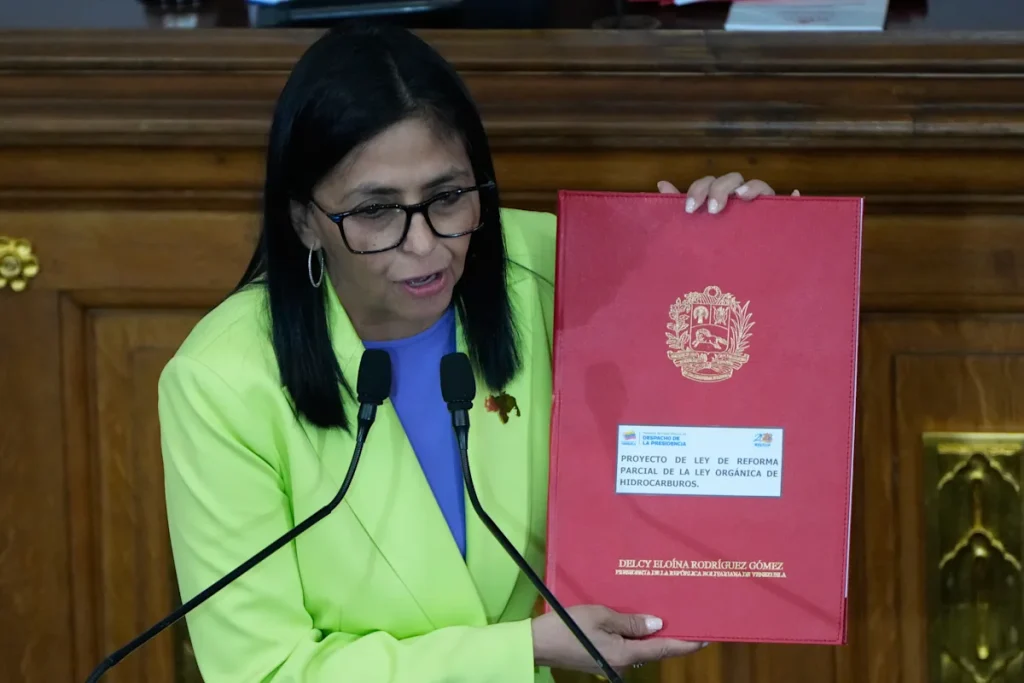
CARACAS, Venezuela (AP) — Venezuela’s acting President Delcy Rodriguez delivered her first State of the Union address Thursday, advocating for opening the critical state oil industry to more foreign investment, following the Trump administration’s pledge to rein in Venezuelan crude sales.
Rodriguez laid out for the first time a vision of Venezuela’s new political reality – one that challenges the Venezuelan government’s most deeply held beliefs less than two weeks after the United States captured and toppled former President Nicolás Maduro.
Under U.S. pressure to cooperate with plans to reshape Venezuela’s sanctioned oil industry, Maduro’s former vice president announced that “Venezuela is developing a new policy.”
She urged foreign diplomats at the meeting to inform overseas investors of the changes and called on lawmakers to approve oil sector reforms to ensure foreign companies have access to Venezuela’s vast reserves.
“Venezuela has free trade relations with the world and can sell the products of its energy industry,” she said.
The Trump administration has said it plans to control future oil export revenues to ensure they benefit the Venezuelan people.
In that vein, Rodriguez described the flow of cash from oil sales into two sovereign wealth funds, one used to support crisis-stricken health services and the other used to strengthen public infrastructure, much of which was built under Maduro’s predecessor Hugo Chávez but has since deteriorated.
Today, the country’s hospitals are so poorly equipped that patients are asked to provide supplies needed for their care, from syringes to surgical screws.
While Rodriguez criticized the United States for capturing Maduro and cited “a stain on our relationship,” she also pushed for a return to diplomacy between the two historical rivals. Her terse 44-minute speech and conciliatory tone were in stark contrast to her predecessors’ fiery rants against U.S. imperialism, which often lasted for hours.
“Let us not be afraid of diplomacy,” Rodriguez said. “I ask that politics not change and not start with hatred and intolerance.”
The day before, she gave a four-minute briefing to the media and said her government would continue to release prisoners detained under Maduro’s harsh rule. But human rights groups have confirmed only a fraction of her alleged release.
Rodriguez seems to be threading the needle.
As she spoke, portraits of Maduro and his wife, Celia Flores, were displayed next to her. She called on the U.S. government to “respect the dignity” of Maduro, who is being held in a Brooklyn jail after pleading not guilty to drug trafficking charges. She has portrayed herself as a defender of Venezuela’s sovereignty despite the dizzying speed of the country’s overtures to the United States.
“If one day, as acting president, I have to go to Washington, I will walk standing up and not be dragged along,” she said. “I will stand tall…and never crawl.”
Rodriguez spoke as Venezuelan Nobel laureate and opposition leader Maria Corina Machado met with President Donald Trump in Washington.
Trump has banned Machado from discussions about the country’s political fate since Maduro’s ouster, while embracing Rodriguez, praising her as a “terrific person” after the first known phone call with Maduro on Wednesday.
Machado’s party is believed to have won the chaotic 2024 presidential election, despite Maduro’s claims of victory. She said she awarded Trump the Nobel Peace Medal in a closed-door conversation.
Later, emerging from the White House, she greeted dozens of cheering supporters. “We can count on President Trump,” she told them, without elaborating.
Her role in Venezuelan politics remains uncertain, as Rodriguez’s government is effectively out of trouble holding elections for the foreseeable future.
Machado’s meeting with Trump was not reported in Venezuela.
The country’s state-run television has continued to broadcast a steady stream of pro-government footage, including statements from Iranian and Russian officials denouncing “American aggression” and sweeping coverage of state-orchestrated rallies calling for Maduro’s return.
Groups of teachers marched through the streets of Venezuela’s capital, Caracas, on Thursday, holding posters denouncing the U.S. “kidnapping” Maduro and chanting slogans in support of the government. National police in riot gear were everywhere. The city walls are covered with pro-government graffiti that reads: “Suspicion is betrayal.”
“They still have the same anti-imperialist rhetoric, but it’s more moderate,” said David Smilde, a Venezuela expert at Tulane University who has studied Venezuela for 30 years. “The idea is to give Trump everything he wants economically, but hold the line politically.”
On the streets of central Caracas, most Venezuelans refused to be interviewed for their views, fearing government retaliation if Maduro’s security apparatus remains intact. Others simply don’t know what to say about their country’s strange new reality, in which the United States claims to be calling the shots.
“It’s a complete sea of uncertainty, and the only one with the power to make decisions right now is the U.S. government,” said Pablo Rojas, a 28-year-old music producer.
He said he was paying close attention to Trump’s meeting with Machado “to see if she has a leadership role and if they think she’s ready to lead the country or be a candidate.” He shook his head in confusion. “It’s impossible to know what will happen.”
___
Associated Press writers Isabel Debray in Buenos Aires, Argentina and Megan Janetski in Mexico City contributed to this report.
___
Follow AP’s coverage of Latin America and the Caribbean: https://apnews.com/hub/latin-america