


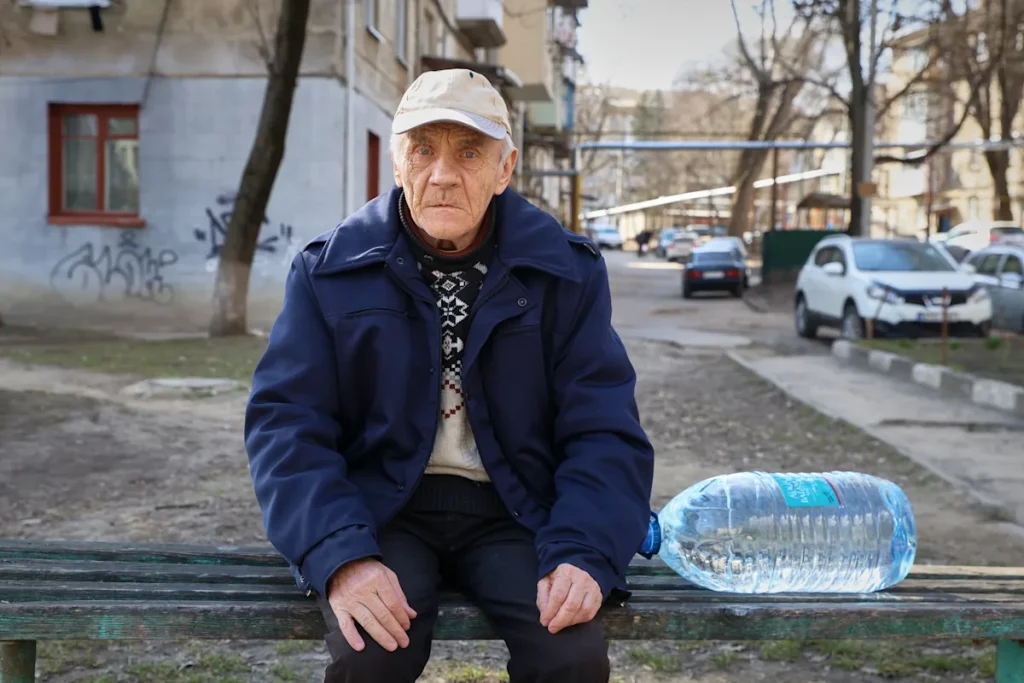
BALTI, Moldova (AP) — A Russian attack on a hydroelectric plant in neighboring Ukraine has contaminated a major river that flows between the two countries with oil and left tens of thousands of Moldovans without water.
After the March 7 attack on the Novnistrovsk hydropower station in Ukraine, Moldovan President Maia Sandu blamed Russia for pollution of the Transnistria River, saying it “threatens Moldova’s water supply.”
The Ukrainian plant is located about 15 kilometers (9 miles) upstream of Moldova’s northern border with Ukraine and supplies water to about 80 percent of Moldova’s population of about 2.5 million people. Since launching a full-scale invasion of Ukraine in 2022, Moscow has repeatedly targeted Ukrainian civilian infrastructure such as dams and river ports.
“Russia bears full responsibility,” Sandhu posted on X on Sunday.
Moldova declares environmental alert
Moldova’s Environment Ministry on Sunday declared a 15-day state of environmental alert, providing authorities with legal mechanisms to step up technical intervention and impose temporary restrictions on water supplies.
“We have taken this decision to ensure that we prevent any risk to people’s health,” the statement said. “Because the wave of contamination from petroleum products continues, the risk of contamination spreading is high and pollution levels in the northern Transnistria region exceed legal limits.”
While the presence of oil contaminants in the river was confirmed following the strike, the exact source of the contamination is unknown.
The situation forced authorities to cut off water supplies in several areas, including Balti, Moldova’s second-largest city with a population of about 90,000. In addition to humanitarian aid from neighboring Romania, the Moldovan military also stepped in this week to distribute drinking water in northern cities via a 10-ton tanker.
Water shortage affects residents
“It’s very difficult, very difficult,” said Liuba Istrati, 84, a Balti resident who has been carrying buckets of water to her apartment. “We live on the fifth floor, just the two of us, old people, and my husband is sick in bed.”
Water shortages have also forced some schools to close and move learning online.
“The situation is complicated and I have to come every day to collect water,” said Irina Mutluc, a teacher who lives in Balti. “Even as a human, you need to consume a lot of water, going to the toilet and so on, so it’s really complicated.”
Authorities are now stepping up efforts to clean up the pollution and analyze and monitor the river water. Neighboring Romania, which has close ties to Moldova, has sent teams and equipment, such as absorbent material for dams, to assist with cleanup efforts.
Tests show improvement in water quality
“The latest samples collected show improved water quality indicators, confirming the effectiveness of filters and barriers in capturing and disposing of pollutants,” the environment ministry said on Wednesday.
The ministry added that authorities were “accelerating” the restoration of water supplies, “but this decision will be taken solely on the basis of at least two sets of consecutive analyzes carried out on different dates… Protecting the health of citizens remains an absolute priority.”
Moldovan Environment Minister Georgi Hajdel told a news conference on Wednesday that oil pollution at three key monitoring points on the river “has reached acceptable limits” for the first time since the crisis began.
He added that if the analysis showed the same results or improvement in the next 48 hours, authorities would consider reopening a pumping station in the northeast on the border with Ukraine that supplies water to several regions and Balti.
“There is clear evidence that upstream oil diversions have been significantly mitigated and suction dams have also played a role,” he said.
The Transnistria River originates in southwestern Ukraine and is more than 1,300 kilometers (846 miles) long, continuing downstream through Moldova and back to southern Ukraine, where it empties into the Black Sea.
“Although values may temporarily return to acceptable ranges at some point, matter continues to appear in waves, making accurate predictions of evolution difficult,” the environment ministry said.
Moldova plans to file criminal charges
The Moldovan Prosecutor General’s Office said on Tuesday it would open a case to investigate the matter, and the Moldovan Foreign Ministry summoned Russia’s ambassador to Chisinau Oleg Ozerov and presented him with a bottle of brown water.
The Russian embassy in Moldova argued in an online statement on Wednesday that Moldovan authorities had not provided any evidence of Russian collusion, except for “a container of unknown turbid liquid without any markings as to where and when it was obtained” and “by definition cannot prove anything.”
The Moldovan authorities “publicly claimed to lack accurate information on the nature, type and amount of contaminants involved in the incident” and put forward “conflicting theories,” the statement said.
Ilya Trombitsky, a biologist at Eco-TIRAS, a Moldovan and Ukrainian NGO, said that while it was still difficult to determine the short- or long-term consequences of the pollution, “the loss of water to some cities is a clear social harm.”
“It depends on the nature of the contamination… We still don’t know the source or the substance of the contamination,” he told The Associated Press. “Obviously, it’s not healthy for birds, wetland birds. It’s clear that some invertebrates are being killed, especially upstream…crustaceans, but small crustaceans, (which) can serve as food for fish.”
“Moldova has no experience with such leaks,” he added.
___
McGrath reported from Leamington Spa, England.