


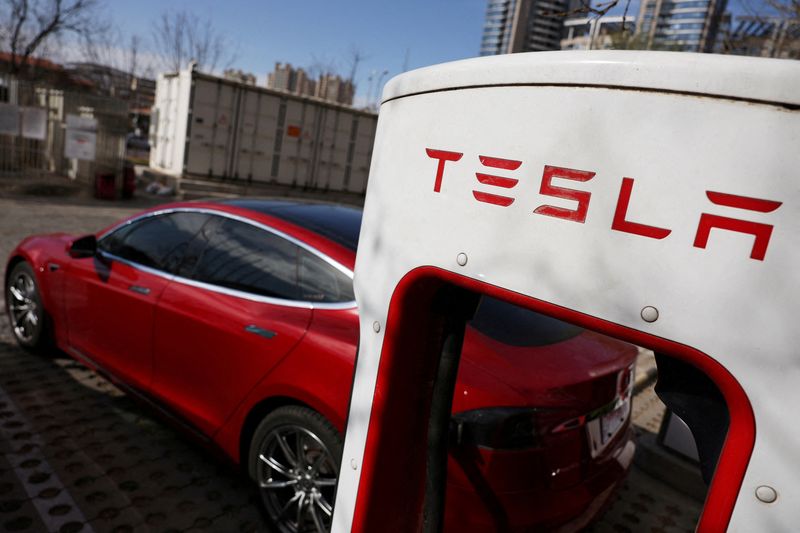
BEIJING/SHANGHAI, Jan 19 (Reuters) – Tesla is expected to be one of the first automakers to benefit from Canada’s move to lift 100% tariffs on Chinese-made electric vehicles, experts say, thanks to the company’s early efforts to ship cars from its Shanghai factory and its established Canadian sales network.
Under the deal announced on Friday, Canada will allow imports of up to 49,000 vehicles per year from China and impose a 6.1% tariff on most-favored-nation terms. Canadian Prime Minister Mark Carney said the quota could increase to 70,000 vehicles within five years.
However, under a clause in the agreement, half of the quota will be reserved for vehicles costing less than C$35,000 (US$25,189). Tesla models are priced higher than this figure.
While many Chinese automakers are eager to seize the opportunity to expand exports, Tesla has an advantage because it has equipped its Shanghai factory, the world’s largest and most cost-effective factory, in 2023 to produce and export a Canadian-only version of the Model Y.
That same year, the U.S. automaker began shipping cars from Shanghai to Canada, boosting Canadian vehicle imports from China to its largest port, Vancouver, by 460% year-on-year to 44,356 units in 2023.
But the company was forced to cease operations in 2024 and switch to shipping from its U.S. and Berlin factories after Ottawa imposed 100 per cent tariffs, citing a desire to counter what they said was China’s deliberate state-directed overcapacity policy.
The company now ships Model Ys produced in Berlin to Canada, but more models, such as the cheaper Model 3, are mostly made in China.
“This new deal could revive those exports very quickly,” said Sam Fiorani, vice president at research firm AutoForecast Solutions.
Tesla currently has a network of 39 stores in Canada, while Chinese rivals such as BYD and NIO have yet to set up sales in Canada, and it may also speed up its marketing plans because it only has four core models, far fewer than its Chinese rivals.
“Tesla does have an advantage because it offers fewer models, versions, and simpler production lines, so it can flexibly sell cars produced in any country to any market, thereby achieving optimal cost efficiency,” said Zhang Yele, managing director of Shanghai-based consulting firm AutoForesight.
Tesla did not immediately respond to Reuters’ request for comment.
Before the tariffs were imposed, other brands exporting Chinese-made vehicles to Canada included Volvo and Polestar, both owned by Chinese automaker Geely.
Volvo and Polestar did not immediately respond to requests for comment.
Opportunities for Chinese EV brands
However, price terms may give Chinese brands some breathing room.
“The beneficiaries are likely to be Chinese automakers and Canadian customers looking for entry-level vehicles,” Fiorani said.
John Zeng, head of China market forecasting at London-based consultancy GlobalData, said the quotas could also provide Chinese automakers with an opportunity to test the waters in Canada, which has a large ethnic Chinese population.
Canada hopes to consider joint ventures and investments with Chinese companies within the next three years to build a Canadian electric vehicle with Chinese knowledge, Canadian broadcaster CBC quoted senior Canadian officials as saying.
BYD, China’s largest electric car maker, currently has an electric bus assembly plant in Ontario, Canada.
Trump administration officials criticized Canada’s decision. The former Biden administration also quadrupled tariffs on Chinese electric vehicles to 100% in 2024, all but halting exports of such products to the United States.
(1 USD = 1.3895 Canadian dollars)
(Reporting by Ju-min Park, Qiaoyi Li and Zhang Yan; Editing by Brenda Goh and Raju Gopalakrishnan)