


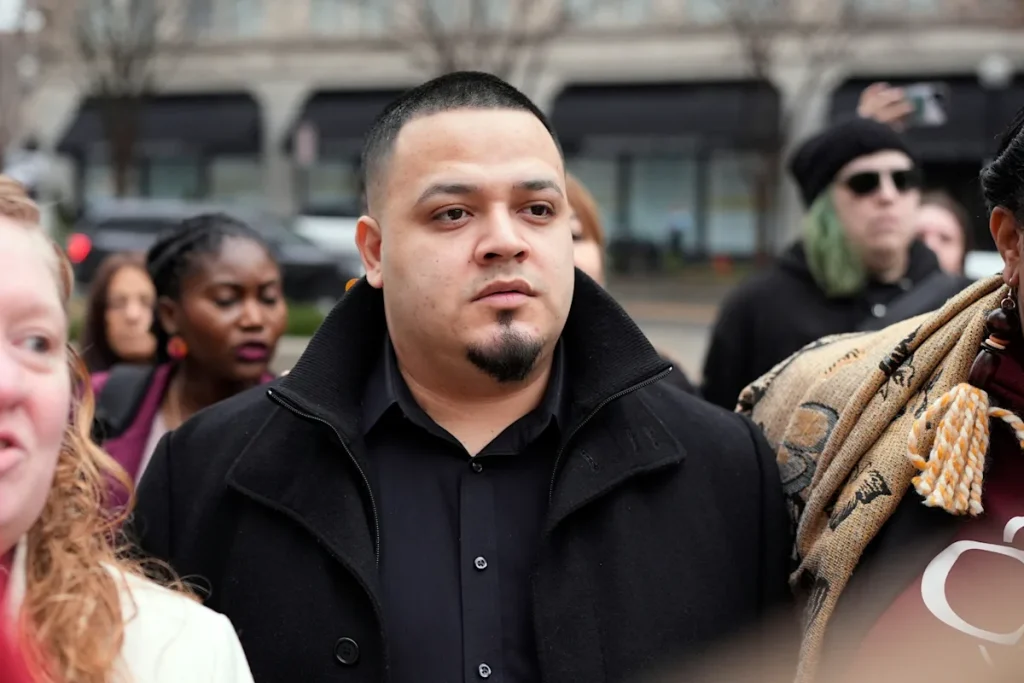
NASHVILLE, Tenn. (AP) — A representative from the U.S. Attorney’s Office testified in federal court Thursday that the human smuggling case against Guilma Abrego Garcia was justified, while acknowledging that the charges filed two years after the traffic stop in question were “extraordinary.”
Abrego Garcia, whose wrongful deportation has inflamed both sides of the immigration debate, claims the criminal prosecution is retaliatory and was pushed by officials in President Donald Trump’s administration to punish him after he was forced to bring him back to the United States. He wants the charges dropped.
Although Abrego Garcia is a citizen of El Salvador, a 2019 court order prevents him from being deported to the country. That’s because an immigration judge determined he faced danger in El Salvador from a gang that threatened his family. Abrego Garcia, 30, immigrated to the United States illegally as a teenager but has an American wife and children. He lived and worked in Maryland for many years under the supervision of U.S. Immigration and Customs Enforcement.
After he was deported to El Salvador last year, the U.S. Supreme Court ruled that the Trump administration must work to bring him back. He was eventually returned to the United States but faces criminal human smuggling charges stemming from a 2022 traffic stop in Tennessee. He pleads not guilty.
Tennessee Highway Patrol body camera footage shows a calm conversation with Abrego Garcia after he was pulled over for speeding. There were nine passengers in the car, and the police officers discussed with each other whether they were suspected of smuggling. However, Abrego Garcia was eventually allowed to continue driving with only a warning.
Rob McGuire, the first assistant U.S. attorney for the Middle District of Tennessee who served as acting U.S. attorney in April 2025, testified that it was his decision to charge Abrego Garcia and that he did so based on the evidence.
“I have prosecuted several human smuggling cases before,” McGuire testified. When he saw the video of the traffic stop, “I was immediately struck by how similar what was depicted in the body cameras was to those investigations.”
McGuire said Abrego Garcia’s car was carrying nine people and no luggage, belonged to someone with a “human smuggling background” and took a suspicious route.
He said he was in close contact with the deputy attorney general’s office on the progress of the investigation, but said it was common in high-profile cases.
In cross-examination, McGuire admitted the timing of the charges, more than two years after a traffic disruption, was “extraordinary”. McGuire said he was unaware of the stop.
Rana Saoud, the Homeland Security Investigations special agent in charge of the Nashville district when Abrego Garcia was deported, testified Thursday that she first heard about the 2022 traffic jam in April 2025, when someone forwarded her a news article from the conservative online publication The Tennessee Star. Saoud said she was aware of the publicity surrounding Abrego Garcia while he was still in El Salvador.
Saud testified that she launched the investigation without pressure from above.
“If the facts don’t add up, we stop moving forward,” she said. “The case is getting stronger and stronger.”
Under cross-examination, Saud agreed that the case was unnoticeable not because of the nature of the criminal charges but because of who the defendant was. “Mr. Abrego was in the news all the time,” she said.
Defense attorney David Patton said another HSI office in Baltimore knew about the traffic stop two years ago but never charged Abrego Garcia and closed the investigation after he was deported in March 2025. A month after the Supreme Court’s decision on Abrego Garcia’s deportation, the case was reopened in Baltimore. By the time McGuire became aware of the traffic stop, federal agents from the Baltimore field office had interviewed the owner of the car driven by Abrego Garcia.
McGuire said Jose Hernandez Reyes, who was incarcerated at the time, told agents that he worked with Abrego Garcia in the smuggling operation and served as his driver. The same day McGuire learned about the traffic stop from Saud, Deputy Attorney General Akash Singh emailed him asking to meet with him regarding Hernandez Reyes’ testimony.
McGuire regularly emailed Singer with updates on the progress of the prosecution. He said he did not know whether Singer shared those updates with Deputy Attorney General Todd Branch or Attorney General Pam Bondi.
“I can tell you, they never came back and said, ‘Put this in there,’ or ‘Say this,’ or ‘Don’t say that,'” he testified.
Asked whether he might feel pressure to prosecute the case, McGuire said: “I’m not going to do something that I think is wrong just to keep my job.”
U.S. District Judge Waverly Crenshaw previously found evidence that the prosecution of Abrego Garcia “may have been motivated by retaliation.” Garcia arrived at the courthouse Thursday morning with his wife. The judge said many of the comments made by Trump administration officials were “troubling.” He cited a statement from Branch that appeared to indicate the Justice Department charged Abrego Garcia because he won a wrongful deportation case.
Abrego Garcia’s attorneys have been arguing with prosecutors for months over whether officials such as Branch need to testify at Thursday’s hearing and what emails Justice Department officials must turn over to them. McGuire argued that he alone made the decision to prosecute, so the motives of other officers were irrelevant.
Crenshaw reviewed many controversial documents. In the order unsealed in late December, he wrote, “Some documents indicate that not only was McGuire not the sole decision-maker, but that he in fact reported to others at the Department of Justice that the decision to prosecute Abrego may have been a joint decision.”