


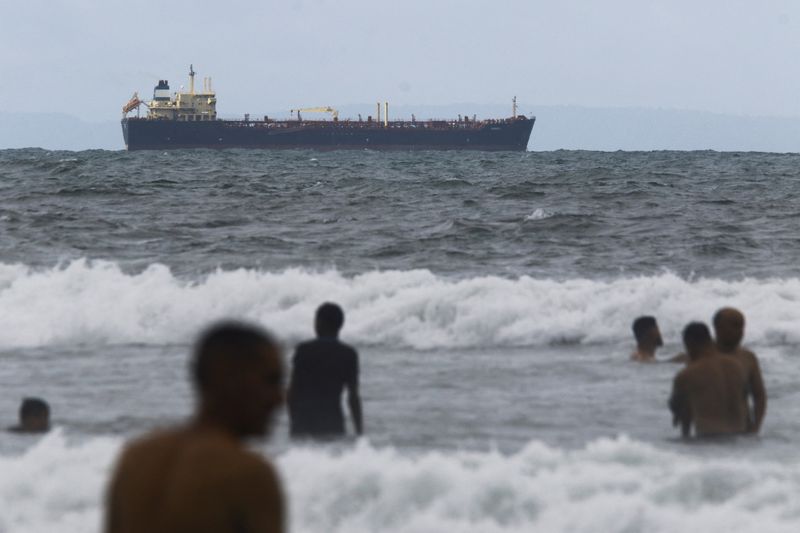
Jan 5 (Reuters) – About a dozen tankers laden with Venezuelan crude and fuel have left the country’s waters since the start of the year, documents seen by industry sources including Reuters and monitoring service TankerTrackers.com show, in an apparent defiance of a U.S. government export blockade.
U.S. troops dramatically captured Venezuelan President Nicolas Maduro early Saturday morning after U.S. President Donald Trump imposed a blockade on all sanctioned oil tankers bound for Venezuela in mid-December. Trump said on Saturday that the oil embargo would remain in full effect after Maduro’s withdrawal.
Shipping data shows that all identified vessels departing are subject to sanctions and most are currently sailing on the high seas without any known flags or existing ship security documents. Half of them are supertankers that typically carry Venezuelan crude to China, according to shipping documents from TankerTrackers.com and PDVSA.
It is unclear whether the United States approved or allowed the shipment. Trump also said on Saturday that Venezuela’s biggest customers, including China, would continue to receive oil.
A U.S. official told Reuters on Monday that the ship “quarantine” was actually focused on sanctioned tankers, but did not elaborate on the vessels leaving port.
The White House, the U.S. State Department, Venezuela’s state oil company PDVSA and Venezuela’s oil ministry did not respond to requests for comment.
The vessels were carrying an estimated 12 million barrels of Venezuelan heavy crude and fuel oil, according to the deal negotiated with PDVSA and satellite images analyzed by TankerTrackers.com.
It was unclear where the ships were heading. When they are shipped in December, most are destined for Asia. The ships have been stuck in Venezuelan waters due to the U.S. blockade.
A separate group of three smaller empty vessels, also subject to sanctions, left the country after completing domestic trips or offloading imported cargo including Russian naphtha.
At least four departing tankers left Venezuelan waters on Saturday via a route north of Margarita Island after briefly stopping near the country’s maritime border, TankerTrackers.com said.
Venezuelan authorities have approved the departure of at least four supertankers in dark mode, three sources with knowledge of the departure documents told Reuters. That means the ships sailed without their satellite tracking devices turned on, a common tactic among tankers in the global fleet carrying sanctioned oil from Venezuela, Iran and Russia.
“We managed to get some supplies out,” a PDVSA source said. “Despite the risk, the shipment was approved, but we don’t think we can continue to use this route.”
The PDVSA board is expected to receive instructions and make export-related decisions at a planned meeting with Venezuela’s interim president and oil minister Delcy Rodriguez later on Monday, the person added.
Chevron resumes exports
Separately, U.S. oil giant Chevron Corp. recalled employees to Venezuela after the holidays and resumed Venezuelan oil exports to the United States on Monday after a four-day suspension, shipping data and sources said.
Chevron is the only company authorized by Washington to export Venezuelan crude oil, exempt from embargoes and sanctions. An oil tanker chartered by the company is currently transporting about 300,000 barrels of Venezuelan heavy crude oil to the U.S. Gulf Coast.
Chevron has become a major joint venture partner of Venezuela’s state-owned oil company Petroleos de Venezuela in recent years amid severe political turmoil in Venezuela, with the liquidity of its operations in stark contrast to the state-run company’s situation.
PDVSA’s exports came to a standstill last week due to the lockdown, forcing it to start cutting production over the weekend. After filling up onshore storage facilities and loading crude oil onto ships, the company has few places to store the oil.
According to TankerTrackers.com, more than 20 million barrels of oil destined for export are stuck on ships ahead of these departures.
Oil exports are Venezuela’s main source of income. The government, now led by Oil Minister and Vice President Delcy Rodriguez, needs export cash to fund state spending and stabilize the country.
Venezuela’s National Assembly reappointed Jorge Rodriguez as president on Monday, with his sister Delsi officially sworn in as interim president following Maduro’s detention.
Trump told reporters on Sunday that he may order another military strike against Venezuela if authorities do not cooperate with U.S. efforts to open up its oil industry and stop drug trafficking.
(Reporting by Reuters; Editing by Simon Weber, David Goodman and Nia Williams)