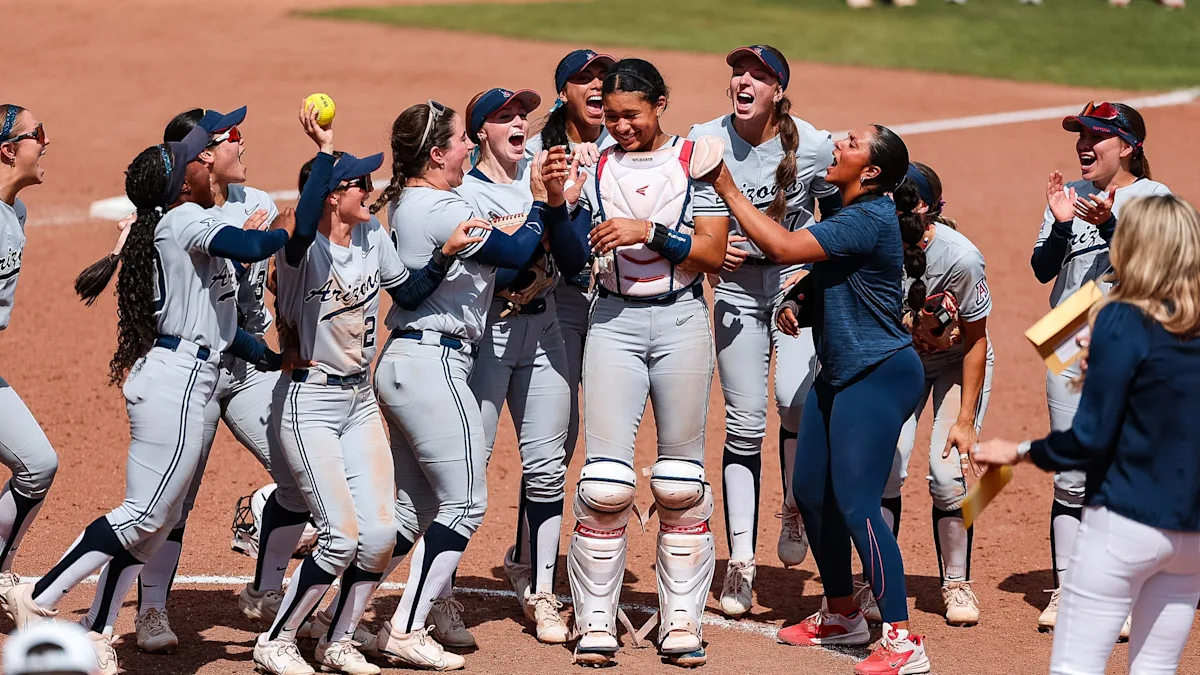
It says a lot about the Arizona Wildcats softball program that getting to regional finals is enough for fans to want several coaches fired. That’s what comes with being an eight-time national champion, even if the last title was 19 years ago.
“Pressure is a privilege,” as retired head coach Mike Candrea regularly reminded both his players and the media.
Advertisement
Arizona hasn’t been a true threat to win a national title since 2017, and that year ended in a devastating loss in the Tucson Super Regional. It has only had two years in the past 39 when it was a question whether it would make the NCAA postseason. In one of those years, it made an improbable run to the Women’s College World Series.
This year required a lot of new pieces to come together quickly. Arizona officially lost 10 to the transfer portal, although several of those players were seldom if ever used. One never suited up for the Wildcats.
Its biggest losses were the corner outfielders. Dakota Kennedy, who will be playing in the Fayetteville Super Regional where the Wildcats would have traveled if they’d advanced on Sunday, was by far the biggest loss. Reports indicated she had been contacted by third parties on behalf of Texas Tech last April. It may not have lured her to Lubbock, but if those reports were accurate, it certainly told her there was a substantial market for her.
While not as devastating, the loss of Kaiah Altmeyer was also significant. Altmeyer was the least heralded of Arizona’s three outfielders, but she was a steady hand in the box. She was more likely to hit a double to the gaps than hit one out of the park, but that’s a useful skill, too. She’s with the defending national champions in Austin.
Advertisement
Arizona brought in the power of Grace Jenkins to replace Altmeyer. In truth, her power was needed more by this edition of the Wildcats after Devyn Netz and Miranda Stoddard graduated along with their 39 combined home runs. Jenkins’ power put Arizona in the winners’ bracket of regionals when Big 12 Player of the Year Sydney Stewart seemed to let the pressure get to her in the postseason.
The Wildcats could have used even more power this year, especially after the season-ending injury to Anyssa Wild. That turn of fate made the transfer of Emily Schepp after 2025 a bigger issue than it might otherwise have been.
Arizona remade the pitching staff that was also dominated by Netz and Stoddard in 2025. All but one pitcher left via graduation or transfer. Beyond Netz, Stoddard, and perhaps fellow senior Saya Swain, none were huge impact players. They certainly were not going to take the Wildcats back to the glory days.
Jalen Adams brought in her workhorse mentality from three years at Iowa. Her numbers weren’t as good at Arizona as they were for the Hawkeyes, but she faced a much tougher slate of opponents as a Wildcat. She was the undisputed ace for UA. It would have been in dire straits without her.
Advertisement
Freshman Rylie Holder got a late start to the season because she “wasn’t quite ready” when February rolled around according to head coach Caitlin Lowe. She had the ups and downs expected from all but the most elite freshmen pitchers.
Sophomore transfer Jenae Berry was the other pitcher who got significant time for the Wildcats. Like the other two primary pitchers, she had her ups and downs. Her best stretch came during the postseason
No one on this year’s staff rose to the level of Netz, Stoddard, or Swain. Netz ended 2025 with an ERA of 2.25 and a WHIP of 0.94. Stoddard had an ERA of 1.73 and a WHIP of 1.11. Swain was at 2.66 and 1.19 when her senior year came to a close. The 2025 staff had an ERA of 2.60 and a WHIP of 1.15 because of those three. No other pitcher came close to those numbers in 2025 or 2026.
The 2026 staff was led by Adams with a 3.60 ERA and 1.42 WHIP. The only other pitcher with enough innings to qualify for NCAA statistics was Holder, who wrapped up her rookie season with a 4.79 ERA and 1.80 WHIP. Berry improved her numbers late in the year, but they still ended at 7.30 and 2.01.
Advertisement
There’s a question that hangs over the season. Would it have mattered if the four pitchers who left had stuck around? Would more have stayed if the innings had been spread around in 2025? The answer to the latter question is unknown. Based on what they did last year in Tucson and for their new teams in 2026, the answer to the former is, “Probably not.”
Only Brooke Mannon and Sidney Somerndike improved their ERA this year, and Somerndike was bound to just by having a few more innings under her belt. She had a 21.00 ERA in 0.2 IP in 2025.
Mannon threw 59.2 innings for Indiana after throwing 11.1 for Arizona. Her ERA went from 3.71 to 3.40. Her WHIP dropped from 1.50 to 1.21.
Those numbers would have been helpful assuming Mannon could maintain them against a considerably more difficult schedule. As of Selection Sunday, the Big Ten was the No. 4 conference according to RPI. The Big 12 was second. Arizona had the No. 16 strength of schedule. Indiana had No. 90.
Advertisement
Aissa Silva had a 3.77 ERA and 1.31 WHIP in 26 IP for Arizona in 2025. At ASU in 2026, she threw 95.2 innings. Her ERA rose moderately to 3.95 and her WHIP went up considerably to 1.73. Both numbers were better than Holder but worse than Adams. Like Mannon, Silva might have been useful, but even as a senior she wasn’t going to be the elite pitcher Arizona needed and she would have blocked the Wildcats’ freshman arm from getting as many innings.
Arizona’s bullpen was probably as good as it would have been if the transfers had returned, but there was a precipitous drop in advanced pitching stats. Those regressions were due to the loss of three very good seniors who threw most of the innings in 2025.
The Synergy pitching rankings on D1 Softball’s website sort based on xFIP. This version of fielding-independent pitching attempts to compensate for the effects of park factors on home runs. Otherwise, xFIP considers the same things as FIP. That is, the things within the pitcher’s control: home runs, strikeouts, walks, and hits-by-pitches. Arizona’s staff struggled in all of those areas.
Arizona’s two most-used pitchers started the year doing a fairly good job at keeping the ball in the park. That tendency evaporated by the end of the season. Despite the reputation Netz had for giving up home runs, all three of Arizona’s primary pitchers from 2026 eclipsed her on a per-inning basis.
Advertisement
Adams ended up surrendering 26 home runs in 159.1 IP compared to Netz with 19 in 152.1 IP. Netz gave up 0.12 home runs for every inning of work. Adams gave up 0.16.
No. 2 pitcher Holder gave up 18 home runs in 98 IP. That works out to 0.18 per inning of work.
Berry struggled even more. She matched the 19 home runs of Netz but did it in just 53.2 innings. That works out to 0.35 every inning.
None of Arizona’s staff could be called strikeout pitchers. Both Holder and Berry walked more batters than they struck out. Adams barely got onto the positive side with 62 strikeouts and 59 walks.
The hits-by-pitches were also a significant issue, especially for Adams. She hit 28 batters this season. The entire Wildcats’ pitching staff hit 46 batters, the most in at least a decade. Adams’ 28 hit batters were more than the entire staff in 2017, 2018, or 2019.
Advertisement
The combination of home runs,, lack of strikeouts, and free passes caused Arizona’s xFIP to drop from No. 34 in the nation to No. 224.
In addition to the decline in the circle, the Wildcats also had a steep decline on offense in 2026. Several players performed better than they had in the past, but there simply weren’t as many players capable of the kind of offense they produced in 2025.
The team’s wRC+ took a huge drop. The stat attempts to account for every offensive outcome, adjusts it based on plate appearances and other factors, and compares it against the average team or player. Every point above 100 is a percentage point better than the average, so a team wRC+ of 110 is 10 percent better than the average D1 team.
In 2025, Arizona had a wRC+ of 156. That ranked 12th in DI according to Synergy. In 2026, the Wildcats dropped to 32nd with a wRC+ of 134. While that’s still a solid ranking, it wasn’t enough.
Advertisement
Every advanced metric was worse in 2026. The team’s K rate increased. It’s BB rate decreased. It’s K:BB rate of 0.84 in 2025 became 1.10 in 2026. Team ISO, which accounts for power, dropped from .222 to .206.
The departures
Arizona honored Tayler Biehl, Stewart, Adams, Jenkins, Kiki Escobar, and Camila Zepeda on senior day. Biehl, Stewart, Adams, and Jenkins had huge roles for the team both on the field and off. Escobar was a plug-and-play contributor at multiple positions and a primary pinch runner.
Arizona is losing almost all of its current power with the departures of Stewart and Jenkins. It is losing a Pac-12 Defensive Player of the Year anchoring the infield in Biehl. It’s losing its experienced ace in the circle.
Advertisement
As for what happens with the portal, it’s difficult to know. The departure of Kennedy was a shock last season. Altmeyer perhaps not as much, but it’s always at least a bit of a surprise when a starter who has been in the program for three years leaves.
The biggest risk for transfers out are always those who didn’t play as much as they might have expected, but there are lots of reasons for transferring. Will Sina Talataina stick around with old high school teammate Sereniti Trice, or will the freshman first baseman who got just 26 at-bats decide she’ll try her hand elsewhere? Will Sarah Wright decide that after a total of 23.1 IP with an 8.40 ERA in two years, she might have better luck at a mid-major? Could someone like Emma Kavanagh be dissatisfied with her dwindling role later in the season and become the third sophomore catcher in three years to move on? Is there any possibility that Rylie Holder becomes the next Madi Elish, who got a lot of opportunities her freshman year but ultimately decided she wanted to be close to home?
Any and all of that is speculation, but this time of year has become stressful for coaches, fans, and players precisely because of all the unknowns. Lack of playing time, positional logjams, money, home sickness, team dynamics, coaches’ nudging, and numerous other factors can cause a player to move on. Will any of those reasons appeal to members of this year’s team?
Top returners
A list of top returners could become obsolete a day after it’s published. Although the NCAA moved the portal windows back for every sport to try to keep players from entering while the postseason is still unfolding, it hasn’t had the desired effect. Players simply announce that they will be leaving as soon as the portal opens. So, Arizona players could start announcing at any time then go into the portal on June 8.
Advertisement
Still, there are some players who seem likely to return.
At the top of that list is Regan Shockey. Along with Biehl and Stewart, Shockey was one of the leaders of this year’s team. When her fellow outfielders left last year, she didn’t follow them. She stayed to fight as a Wildcat. Seeing her run into a wall trying to keep her team’s season alive only reinforced her reputation as a player completely committed to this program.
Jenna Sniffen has been a starter since she came to Arizona. She seems settled and secure. While Arizona has several players with third base skills in the incoming freshman class, the Wildcats also need Sniffen. She has been a strong defender both years as a Wildcat.
Trice seems to have found what she is looking for at Arizona. Her one-two punch with Shockey at the top of the lineup will be a building block for next year’s offense. She just transferred last season, so it seems less likely that she would move again.
Advertisement
While Kavanagh might not have gotten all of the at-bats she wanted this year, there is a huge opening for her on next year’s squad. She will be the only returner whose primary position is catcher. She was the NFCA Catcher of the Year her senior year in high school. She’s spent two years biding her time and her summers honing her skills in summer ball. Arizona will need her next year.
Holder will be the returning pitcher with the most innings. She got a lot of experience in her first season and there is plenty of potential for growth. She needs to reduce the number of free passes she hands out. She also needs to work on hitting her spots to avoid the home runs, but she is young enough to develop those skills.
The newcomers
According to D1 Softball and Softball America, Arizona signed either the No. 1 or No. 2 class in the Big 12. There are additions across the diamond.
Advertisement
Given Arizona’s specific struggles this season, the biggest signee is pitcher Lilly Hauser. She has the potential to be the next Netz or Stoddard. When she signed, pitching coach Christian Conrad noted her “elite velocity and movement,” while also talking about her strong bat.
Arizona has at least one significant need on the infield. Shortstop will be a critical position next year. There’s the possibility of moving Kez Lucas there, but the Wildcats also signed infielders Violet Mitchell and Natalie Keith who play shortstop at least part of the time. The positions of shortstop and first base will be up for grabs.
Arizona also needs to add quality depth in the outfield. Madi Babasa and Gabriela Navarez both provide that in the freshman class. On paper, Babasa is the most likely to challenge for a starting position, but Arizona needs to look for transfer help, as well.
That’s not the only need from the portal. The biggest is a pitcher who can miss bats. It’s something that the elite pitchers in the game can do, and elite teams have at least one elite pitcher. Arizona may maintain its position as a top 25 team, but it’s not going to consistently be a top 10 team who battles for the WCWS without one.
Advertisement
Assuming that at least two of Arizona’s pitchers return next season, the Wildcats probably need to add a total of two arms. At least one needs to be experienced.
Arizona could use a proven shortstop. Biehl has been a cornerstone of the defense for four years.
The team also needs to add power. It lost both players who hit 10+ home runs this year. Wild and Kavanagh should be able to contribute if they get more at-bats, but they’re unlikely to be able to make up for everything Stewart and Jenkins accomplished. Sniffen and Lucas will have to become more consistent at the plate to be true power threats.
Despite its top 25 ranking by both D1 Softball and Softball America, the recruiting class does not include a single player ranked above No. 69. All but Hauser are unranked or outside the top 100 according to Softball America. The portal is critical.
Advertisement
The coaching staff
The demands on those who coach Arizona softball are tough. Just getting to the postseason isn’t enough for a significant portion of the fan base. When the Wildcats don’t advance, calls for firing start. Will that happen?
It’s unlikely that Lowe will be out of a job this year. She signed a one-year extension after last year. It runs until after the 2027 season. Whether she gets another extension this year or not, all signs point to her being Arizona’s head coach in 2027.
The fact is that Lowe is affordable for an administration that doesn’t like to spend on coaches for women’s sports. In 2025, Front Office Sports reported the top 20 softball coaching salaries. Lowe was not on the list. As of last year, athletic departments from the likes of UC Santa Barbara and Oregon State paid their softball coaches more than Arizona. It’s unknown whether or how much any of those salaries increased this season, but Lowe made $250,000 in 2025-26.
Advertisement
On top of being affordable, she’s a model employee and coach from a public relations standpoint. She has done that while having her team ranked and in the postseason four out of five years, as well as getting to the Women’s College World Series once.
Whether there are other changes on the staff probably depends on what kind of pressure is brought to bear. Sometimes loud voices can force a change on the staff whether it’s likely to improve the situation or not.
Taryne Mowatt-McKinney took the brunt of Arizona failing to get to the postseason in 2023, and pitching coach is where most of the current dissatisfaction is focused. The decision to move on from a decorated Wildcat didn’t pay off for Arizona. The Wildcats still have lingering pitching issues. She’s very successful as the pitching coach of Mississippi State, though.
Sometimes change just for the sake of change isn’t the best way forward.

