


It’s easy to think that nothing noteworthy happens on Mars, but there’s a lot of interesting stuff happening on this dusty, rusty planet.
Most of them have to do with rocks. Mars has a lot of rocks. In fact, there’s a lot of rock on Mars that has gone through various kinds of weathering over eons, and if you squint hard enough, it occasionally produces something that looks a bit like man-made or biological structures.
It’s a bit like a monkey and a typewriter. We may not see Shakespeare, but every once in a while, we might see some rocks that look suspiciously like bugs enough to fool entomologists.
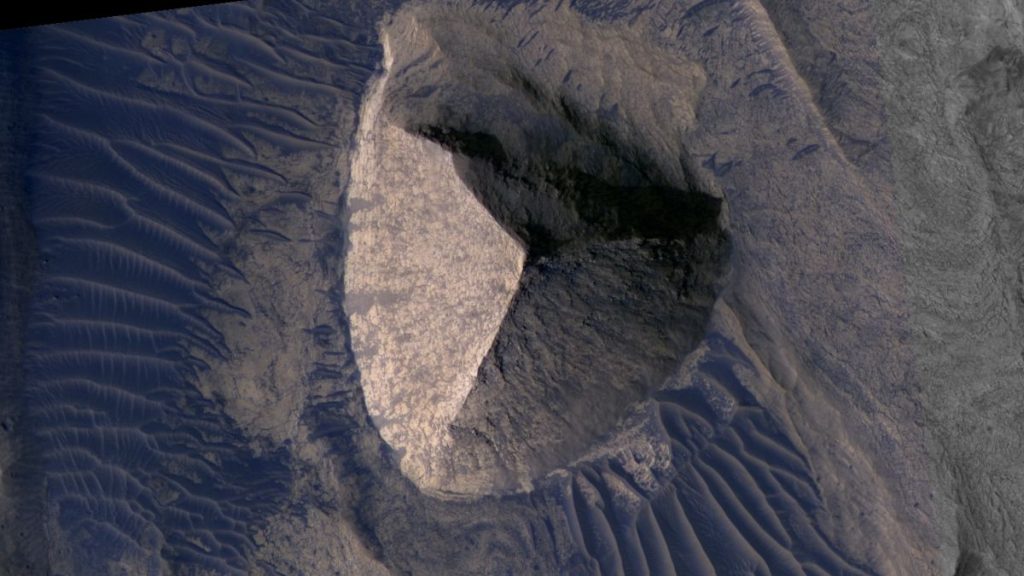
The latest of these mesmerizing Martian hallucinations to hit the tabloids is a striking structure, first discovered in 2002, that resembles a three-sided pyramid and sits in a wind-carved valley called Candor Chasma.
The claim appears to have gained traction after being shared on X by filmmaker Brian Cory Dobbs, who has previously promoted the idea that NASA images contain evidence of man-made structures on Mars.
The post quickly went viral, with cropped images of the formation circulating on social media and tabloid websites.
The images themselves are actual NASA data from the orbiter that first photographed the area in 2001.
The earliest records of pyramid-like structures date back to 2002, when independent researcher Wilmer Faust highlighted a strange feature he discovered in the Mars Global Surveyor (MGS) image E06-00269.
Over time, later accounts of the early discovery seemed inconsistent, but one thing was firm: the so-called Frank Tetrahedron was indeed interesting.
Since the discovery, other orbiters have imaged the area, notably the HiRISE camera on NASA’s Mars Reconnaissance Orbiter.
HiRISE’s high-resolution images are stunning, but when you zoom out and look at the landscape surrounding the tetrahedron, it starts to look less strange and more like what it is: a slightly jagged mountain carved by the same erosive forces as the cracks that surround it.
Candor Canyon is one of the largest canyons on Mars, shaped by water, landslides, wind, and possibly even billions of years of tectonic activity.
It’s also dotted with geological formations that scientists call “positive relief knobs.” These are previously buried rock structures that are more durable than the bedrock that once surrounded them; when erosion washed away the surrounding bedrock, the knobs were left in place.
These knobs are not small: up to a kilometer (3,280 feet) in diameter and tens of meters tall. The Candor tetrahedron is approximately 290 meters in diameter, a bit taller than the typical 145-meter-tall knob, but it still fits into this wider landscape of layered rock carved into solitary mountains.
It is also not unlike the natural pyramids on Earth. There is a mountain called Cerro Tusa in Colombia, with an altitude of 457 meters and a foothills of 1.8 kilometers. Guizhou Province in China is famous for its pyramid-shaped mountains.


Sign up for ScienceAlert’s free fact-checking newsletter
If you look closely at the image of the pyramid, you’ll see that it sits amid ripple beds—rippled ridges carved by Martian winds, suggesting ongoing erosion.
You can also see that the ridges on the mountain are not as perfect as you would imagine a man-made structure to be, but rather jagged, uneven, and different sizes on three sides.
RELATED: Curiosity cracks a rock on Mars and reveals a huge surprise
Human pattern recognition is a powerful thing; we can’t help but find meaning in meaningless data. We particularly like anything that looks like another person or a face, but geometric shapes and structures also capture our attention.
However, Mars doesn’t need to be laced with fantasy to be interesting. Its geology and weather create landscapes that are both familiar and completely different from what we see on Earth.
And, with technology like the Mars Reconnaissance Orbiter, we can explore these landscapes in fine detail, imagining what it would be like to stand among the towering cliffs and rugged terrain of Mars, where for billions of years only the wind has howled.