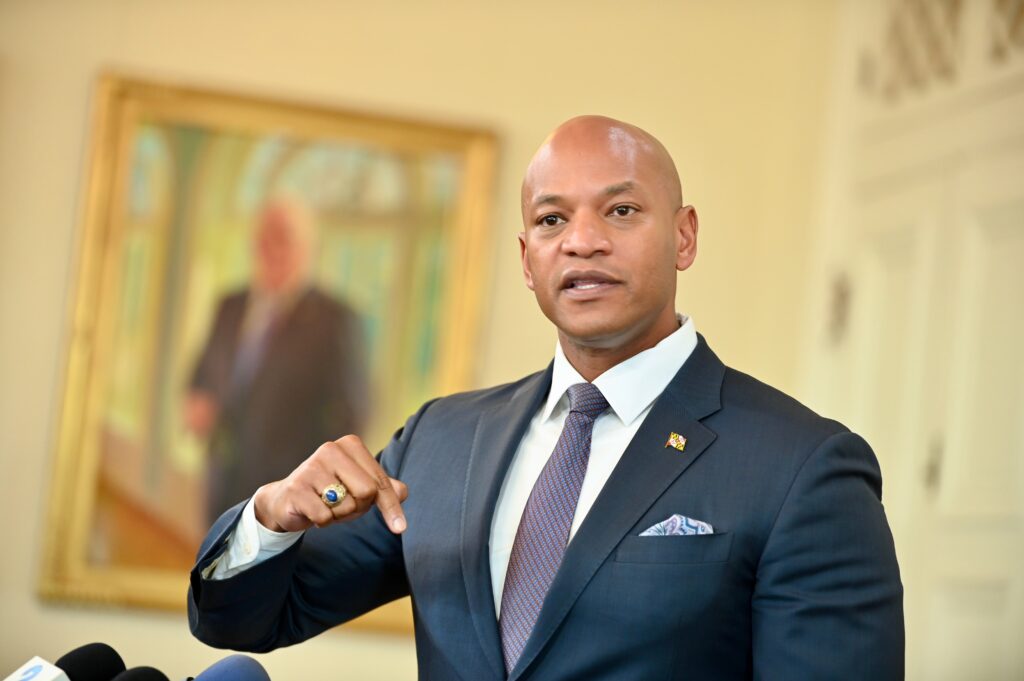
Gov. Wes Moore (D) speaks to reporters in November. A new poll shows the governor remains popular, but his approval ratings continue to decline. (Photo: Bryan P. Sears/Maryland Matters)
About half of Maryland voters say they will vote to re-elect Gov. Wes Moore, even as the first-term Democrat’s job approval rating continues to trend downward.
A poll released Tuesday by Annapolis-based Gonzalez Research & Media had mixed results for the governor.
“If the election were today, Moore would be re-elected, but the election is not today,” said veteran state pollster Patrick Gonzalez. “We’re still 10 months away. I suspect, for the governor, our conference is going to be a pretty big deal. Where we are six months from now, where we are on Labor Day, that’s going to be important. That’s how I see it.”
The poll was conducted between Dec. 21 and Jan. 6 among 808 registered Maryland voters who said they were likely to vote in 2026. The margin of error is plus or minus 3.5%.
Gonzalez also asked who voters would support if the 2026 election were held today.
Moore led the general Republican and third-party candidates with 49.9% of the vote. That number was driven by nearly 76% of Democrats saying they would give Moore a second term.
In Maryland, Democrats beat Republicans by a 2-to-1 registration advantage, accounting for just over 50% of all registered voters in the state.
As expected, 81% of Republicans said they would support the Republican candidate. Independent voters were evenly split, with 35% saying they would vote for Moore and 32% backing the unnamed Republican.
Gonzalez pointed to polling data showing voter dissatisfaction on economic issues: affordability, the economy and taxes. Nearly six in 10 voters surveyed said they believed they paid too much in taxes.
“They’re paying too much for their electricity,” he said. “They pay too much tax and people [angry]”.
All of these are precursors to a potential election, he said.

Since taking office, Gov. Wes Moore has seen a narrowing gap between voters who support his job performance and those who oppose it. (Gonzales Research and Media Services)
Gonzalez noted that among those who say they pay too much in taxes, “a hypothetical Republican candidate leads Moore by 13 points, 47 percent to 34 percent.”
Another 41% said they believed they paid the “correct amount” of tax. Only 1% said they thought they should pay more.
Last year, Moore and the General Assembly projected a $1.6 billion tax increase as part of a plan to eliminate a projected $3.3 billion structural budget deficit.
Tax increases combined with one-time funding transfers and some cuts are expected to fill the spending gap and leave $300 million for the fiscal 2028 budget year.
Those expectations were dashed. The state is expected to face a $1.5 billion structural deficit in the next budget year. Officials point to federal actions, including the loss of 25,000 federal jobs since President Donald Trump took office.
In recent history, surges in support for Republican candidates late in election years have been linked to one or more so-called wallet problems. In 1994, Ellen Sauerbrey lost to Parris Glendening by just 6,000 voters. In 2002, Robert Ehrlich became the first Republican elected governor in nearly four decades. In 2014, Larry Hogan won the first of two consecutive elections. He was the first Republican since Theodore McKeldin to do so.
Job approval rates are on a downward trend
Moore takes office in 2023 with the support of about 6 in 10 Marylanders. He peaked in Gonzales’ September 2024 poll, when 64% of respondents approved of his efforts. In that poll, the gap between supporters and opponents was 35 points.
Since then, it has been on a downward trend. In March last year, the gap between the two sides reached 19 points. In Tuesday’s poll, 52% said they approved of the job Moore is doing, compared with 41% who said they disapproved, three points lower than Gonzalez’s March 2025 survey. The governor has fared similarly in other surveys, including one by the University of Maryland Baltimore County Institute of Politics.
Beneath these top numbers from the Gonzales poll, surveys show a continued trend of voters changing their minds about Moore’s efforts.
Current polls show an 11-point gap between supporters and opponents. For the first time since Gonzalez asked Moore about his job performance, more people expressed strong disapproval than strong approval.
About a third of voters said they strongly disapproved of Moore’s job performance in the final session of the term — a 7-point change from March.
Support: You make our work possible
Moore lost support among Democrats, Republicans and independent voters. While 73% of Democrats approve of Moore’s performance, that’s down from 83% in March 2025. Meanwhile, disapproval increased by 5 percentage points to 18%.
In March, one in five independent voters declined to comment on Moore’s job performance. Now, just 10 percent refuse to answer: 41 percent of independent voters approve of the governor’s performance, up 7 points from March, but 49 percent disapprove, also up 7 points.
democratic optimism
Moore’s job approval comes despite a Gonzales poll showing an increase in overall sentiment about the direction of the country.
Of those surveyed, 47% said the state is moving in the right direction, while 44% said it is on the wrong track.
The results were an improvement from last March, when 50% said the state was on the wrong track and 41% said things were moving in the right direction.
The results are not directly tied to Moore’s job approval numbers.
“It’s not just about whether people think taxes are too high,” Gonzalez said. “There are other factors that contribute to the seeming contradiction in the polls. I wouldn’t make a fuss about that.”
Instead, Gonzalez said national politics and the upcoming midterm elections — a referendum on Trump — could play a role. Democrats nationwide are eyeing the possibility of regaining a majority in the U.S. House of Representatives in November.
“When we polled in March, Trump had just taken office and Democrats were a little demoralized,” Gonzalez said. “Now, their Tiger Eye, Rocky and Apollo Creed running on the beach mentality is back, and 70 percent of Democrats think things are moving in the right direction for them.”