


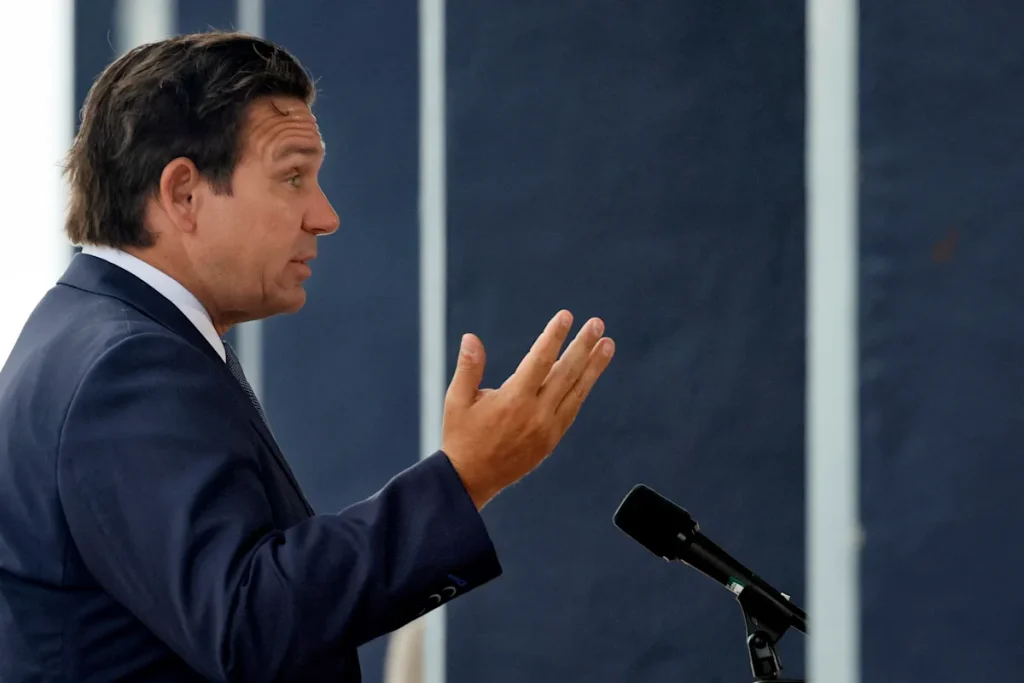
FORT LAUDERDALE, Fla. — Since taking office, Gov. Ron DeSantis has taken two different approaches when members of Congress or the Florida Legislature resign or die.
At times, he has moved quickly to call special elections to fill vacancies and find replacements quickly, especially in districts where voters were likely to elect a Republican.
In other cases, he slowly waits weeks to schedule an election with an election date far in the future, more often when the vacancy is in a Democratic district.
State law leaves the timing — when special elections are called and when special primaries and general elections are held — up to DeSantis. BROWARD – Sen. Tina Polsky, D-Palm Beach County, and state Rep. Michael Gottlieb, D-Broward, are sponsoring legislation that would require the governor to act more quickly and establish timelines for various scenarios.
Florida’s governor can fill many vacancies himself, including members of the Florida Cabinet, county commissioners and school boards. But he does not have the power to pick his replacement in the legislative branch.
For federal offices, the governor may appoint a replacement senator until the next election. (That’s how Ashley Moody became the appointed senator when U.S. Senator Marco Rubio resigned to become secretary of state.) U.S. House vacancies must be filled by voters.
DeSantis’ unexplained delays have lasted far longer than those of previous Republican governors, sometimes meaning residents of vacated congressional districts went without representation for months.
“The scary thing is that we can’t count on having a special election in time,” said state Sen. Tina Polsky, a Broward-Palm Beach County Democrat. The result, she said, is sometimes “some people don’t have representation.”
There is a general perception that these decisions are political. “It shouldn’t come down to politics or what the seats look like,” Polsky said.
The governor’s office did not respond to a request for comment on the Polsky-Gottlieb legislation or how DeSantis decides when to hold a special election.
In 2021, in response to questions about delays in setting an election date and suggestions that his actions were aimed at keeping Democratic seats open, his then-press secretary simply said that he had “fulfilled his constitutional and statutory duties.”
no representation
DeSantis’ delay in setting a special election date means the Palm Beach County district in Tallahassee’s state House of Representatives will be without representation for the entire 2026 legislative session.
An unusual feature of the current example is that it involves the Republican-leaning 87th District, which has 115,600 active registered voters and includes the state’s most prominent Republican, President Donald Trump, whose official residence is his Mar-a-Lago club in Palm Beach.
This vacancy is not surprising. That’s because DeSantis appointed former representatives to new positions. DeSantis appointed former state Rep. Mike Caruso as circuit court clerk and Palm Beach County comptroller after he resigned Aug. 18 from his 87th District seat.
DeSantis has scheduled a special primary for District 87 for Jan. 13 and a special general election to determine who gets the seat for March 24, 11 days after the Legislature plans to adjourn for the 2026 session.
Although the vacancy occurred on August 18, DeSantis did not announce the primary and general election dates to succeed Caruso until October 24, 70 days after Caruso resigned to accept the gubernatorial appointment.
DeSantis will move quickly to schedule a special election when he chooses. On July 21, Bryce Ingoglia resigned from the Florida Senate after DeSantis named him the state’s new chief financial officer.
On July 22, the day after Ingoglia resigned to take the new position, DeSantis set dates for a special primary and general election to fill the vacancy.
The same day, DeSantis set a date for a special primary and general election in another Palm Beach County district following the July 18 death of state Rep. Joe Casello.
The quick setting of the special election date is notable because Caselo is a Democrat and represents a predominantly Democratic district. In a Dec. 9 special election, voters chose Democrat Rob Long to fill the remainder of Caselo’s term.
democratic constituency
Typically, he waits longer to call special elections in Democratic districts than in Republican ones.
When longtime Democratic U.S. Rep. Alcee Hastings died on April 6, 2021, DeSantis waited 30 days to set an election date. He then set the special primary for November 2 and the general election for January 11.
As a result, the seat remained empty for more than nine months after Hastings’ death.
The district is very Democratic and voters are almost certain to elect a Democrat.
Postponing the special election for the Hastings vacancy meant Democrats lost one seat in Washington, D.C., making it harder for then-House Speaker Nancy Pelosi, D-Calif., to pass Democratic priorities in the chamber.
By contrast, when President-elect Donald Trump announced in November his promotion of then-U.S. Reps. Matt Gaetz and Mike Walz to senior administration positions, DeSantis set what the state said would be the fastest possible election date. (Gates’ nomination was ultimately withdrawn, but he made no attempt to undo his resignation.)
DeSantis is scheduled to hold a special primary on January 28 and the general election on April 1.
Waltz was without a representative for 10 weeks and Gates was without a representative for 20 weeks. Quick special elections in districts where Republicans are almost guaranteed to win make it easier for House Speaker Mike Johnson, R-Louisiana, to pass the Republican agenda.
DeSantis has frequently delayed special elections in Democratic state legislative districts.
Unlike a closely divided Congress, Republicans hold overwhelming majorities over Democrats in state legislatures, so vacancies are unlikely to affect the outcome of major issues. No representation means no one to advocate for funding for projects in the region.
break with the past
Data collected in 2021 by the Harvard Election Law Clinic shows that DeSantis has kept his office open far longer than his three predecessors, all of whom were Republican governors. The clinic filed a lawsuit that year in an attempt to force him to set an election date.
Since 1999, DeSantis and previous governors have held 69 special elections to fill vacancies. Rick Scott, Charlie Crist and Jeb Bush generally have their dates set sooner. The elections themselves were also held more quickly.
No other governor in the past 20 years has waited this long to schedule an election or schedule an election after a vacancy occurred.
After Hastings’ death, DeSantis left the seat vacant for 280 days. Research from the Harvard Election Law Clinic shows that the previous five congressional special elections were held an average of 154 days after a vacancy occurred. On average, this was shortened by more than four months.
In another example, on October 27, 2021, DeSantis set primary and general election special election dates for three Broward and Palm Beach County seats in the state Legislature. Those seats were already vacant when the lawmakers holding those positions all submitted their irrevocable resignations in July, making them eligible to become candidates to fill the vacancy created by Hastings’ death.
DeSantis waited 91 days to schedule two special elections and 92 days for another.
According to his timetable, the general election is held a few months later: 223 or 224 days after the vacancy occurs.
litigation
There is another mode. When DeSantis delayed scheduling special elections, he was repeatedly sued by Democratic candidates or their supporters, asking judges to order the governor to fulfill his election-scheduling duties.
When these lawsuits are filed, DeSantis often moves quickly to set an election date to avoid a court ordering him to take action.
— At the state Capitol District 87 in Palm Beach County, Democratic candidate Emily Gregory announced an election date 17 days after her campaign filed a lawsuit seeking a court order forcing him to take action.
— in the congressional district Hastings represents, and he took action five days after the lawsuit was filed.
— In a 2021 case brought by the Harvard Election Law Clinic on behalf of plaintiffs in state Senate and House districts in Broward and Palm Beach counties, DeSantis acted 12 days after the case was filed.
legislation
Polsky’s Senate Bill 460 and Gottlieb’s House Bill 597 would require, rather than simply authorize, governors to call special primaries and general elections. The measures, which would take effect July 1, also require the governor in most cases to set primary and election dates within 14 days of a vacancy occurring.
If the governor fails to act, voters can ask a circuit judge to set an election date.
It does not impose the same time limit on each vacancy. For example, if a state Legislature vacancy occurs in December and the legislative session is scheduled to run from January 13 to March 13, the seat could remain open until the regular primary in August and the general election in November, Polsky said.
The process would be expedited if there was enough time before the legislative session to hold an election.
Similar legislation in 2022 has not moved forward. Even if the 2026 version can pass the House and Senate, it faces significant obstacles. It would then go to DeSantis, who can veto it.
“It’s going to be difficult to enact this bill, especially because the people who have to sign it are the same people who are causing these problems,” Polsky said.
————-