Lakeland officials are staring at a lengthy list of more than $69 million for necessary stormwater drainage and water quality improvements without any funds to pay for it.
The proposed solution: Increased stormwater utility rates that would nearly double the cost to residents and double the cost to businesses over the next five years.
On Dec. 11, Lakeland commissioners can vote to increase the city’s stormwater utility rate from $9.72 per month (or $116.64 per year) for the average homeowner to $17.47 (or $209.64 per year).
This will be the city’s first stormwater rate increase since 2021.
Lakeland Lakes and Stormwater Department Manager Laurie Smith said the city’s existing stormwater fees bring in about $9.3 million annually. Smith said $8.6 million of that amount covers daily operating expenses for city staff, equipment and materials. That leaves about $700,000 a year to pay for all of the city’s drainage and water quality improvements.
“You have a math problem,” she said. “To our knowledge, we are not generating enough revenue to address the current $69 million problem. That’s just the way it is.”
The city currently has more than $69.4 million in unfunded stormwater and water quality improvement projects. About $43 million of that amount is for stormwater conveyance and drainage system projects, Smith said.
“We learned a lot during last year’s hurricane season, including that we actually have more problems than we previously realized,” she said.

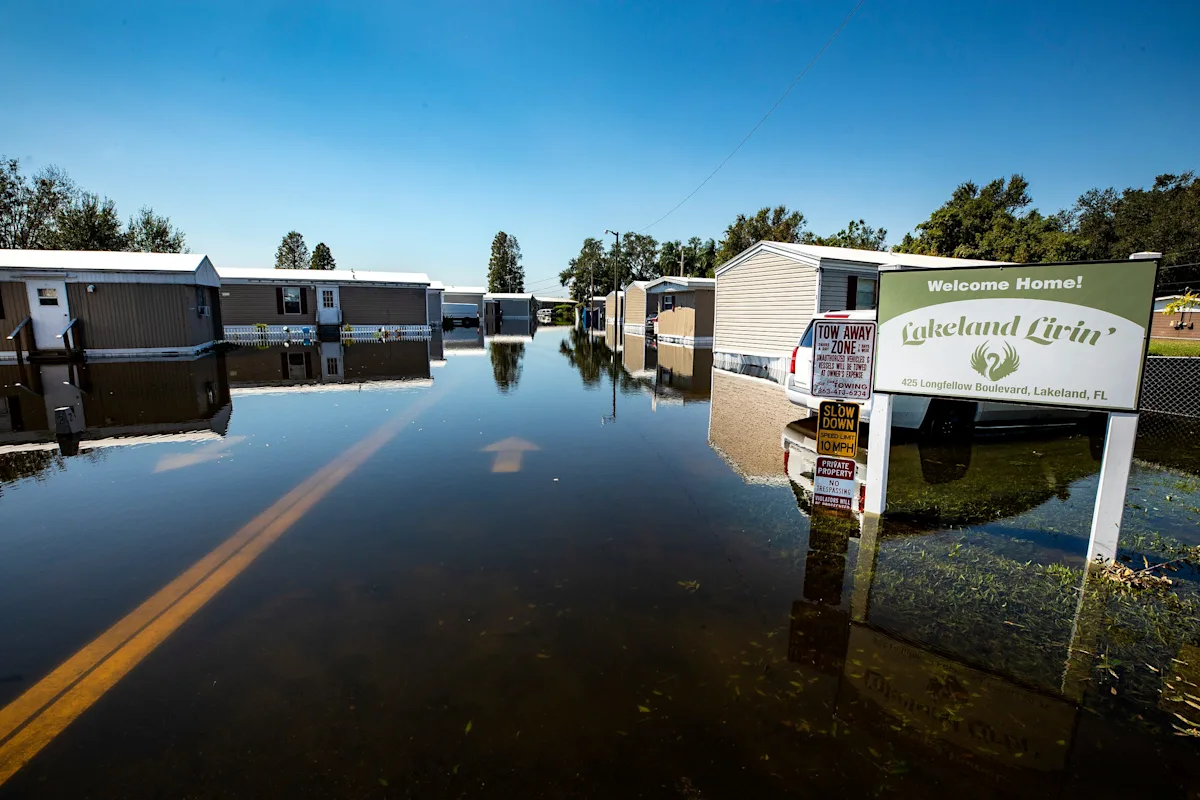
Homes in a mobile home park near Bonney Lake in Lakeland were flooded after heavy rains from Hurricane Milton in 2024. The Bonney Lake watershed is one of Lakeland’s major stormwater projects in need of funding.
Some of the unfunded stormwater improvement projects she submitted to city commissioners have received preliminary designs and estimates, including:
-
Stabilizing San Gully Road to prevent erosion and potential flooding in the adjacent 55+ senior mobile home community.
-
Drainage improvements in Highland Hills are causing erosion between Westover Street and Cleveland Heights Avenue.
-
Watershed Management Plan for Lake Bonney following the Milton Flood.
-
Drainage improvements on the south side of Lake Hollingsworth Boulevard.
-
Repairs to storm drains along Wayman Street.
Smith said there are several other known problem areas, including Dixieland, the Mass Market area, Mirror Lake, Lake Morton and downtown that require stormwater drainage improvements. She singled out Ingraham Avenue at Osceola Street, the ditch at South Lincoln Avenue and Webster Avenue as also being prioritized.
“As we continue to rebuild, we really need to evaluate stormwater drainage improvements as much as possible,” Smith said.
Lakeland also faces the burden of about $25 million in unfunded surface water restoration projects, Smith said. In 2016, the number of lakes in the city on the Florida Department of Environmental Protection’s impaired list increased from four to nine.
These include Bonnie Lake, Bonnet Lake, Crystal Lake, Gibson Lake, Hollingsworth, Hunter Lake, Mirror Lake, Morton Lake and Lake Parker, the largest of which covers more than 2,200 acres.

The St. Trench Road Ditch is one of the major stormwater projects Lakeland is prioritizing. More than 55 neighboring communities regularly flood during heavy rains.
“There has been an increase in state regulatory requirements for stormwater system monitoring and maintenance,” she said. “We will be required to comply with state standards for stormwater treatment. This is a new mandate and is also unfunded, but there are additional inspection requirements.”
Smith estimated that if commissioners agree to implement scheduled stormwater utility rate increases, it would provide the funding needed to address these issues over the next 10 to 15 years.
“This is not a five-year solution,” she warned the committee. “This cost increase assumes we will be undertaking these projects over the next 10 to 15 years.”
Changes in interest rate structure raise concerns among businesses
Lakeland is considering changes to how its stormwater utility rates are calculated, and if rate increases are added in, businesses could face a 133% increase.
The city’s stormwater fees are calculated based on how much impervious surface a building has, or the area of coverage that prevents rainwater and rainwater from seeping into the ground.
Currently, any homeowner or business with less than 5,000 square feet of paved or built surface pays a flat rate of $9.72 per month per equivalent dwelling unit (commonly referred to as an ERU). Commercial or industrial businesses with buildings and pavement in excess of 5,000 square feet will be charged a prorated fee.
Finance Director Mike Brossart said Lakeland’s subsidy of 5,000 square feet for one ERU is generous compared to other cities in the state. The average in other cities is closer to 2,400 square feet.
The city is considering reducing the size of ERUs from 5,000 square feet to 3,850 square feet, a size that would still cover an average home.
However, it could mean a significant increase for businesses, which would be prorated based on every 3,850 square feet of impervious surface (rather than 5,000 square feet), combined with a rate hike, for an increase of around 133% over five years.
Commissioner Stephanie Madden asked whether the city’s stormwater utility rate calculations were fair, given that many commercial developments must install stormwater drainage systems and ponds. Madden said many residents don’t, but she expects they will get the most benefit from capital improvement projects that clean the lake and are less likely to see their homes flood.
Commissioner Guy LaLonde said many newer residential developments are required to install storm drain systems and cisterns under building codes. LaLonde said a development of 300 to 500 homes would pay 300 to 500 ERU, which could be more than an industrial warehouse on a similar-sized property.
LEDC opposes rate hike proposal
Steve Scruggs, chairman of the Lakeland Economic Development Council, said the group does not support the city’s proposal to increase stormwater utility rates and recalculate them.
Scruggs said the city’s stormwater rate study, conducted by Geosyntec Consultants Inc. and its subcontractor Anser Advisory, was flawed. It compared Lakeland’s stormwater fees to several cities that look nothing like Lakeland, with significantly different populations, sizes or geographic locations (such as being on the coast).
“The city of Lakeland and its consultants should consider Lakeland’s competitors rather than picking the top jurisdiction,” Scruggs said.
Scruggs said Lakeland’s proposed stormwater fee would look very different if it were compared to more similar cities.
“Lakeland will be one of the highest stormwater utilization areas in Florida, the highest compared to our peers,” he said. “The highest monthly rates will be compounded by the change in unit area.”
Scruggs offered help to LEDC, working with city staff and officials to have them go back to consultants in Lakeland and tweak the study to offer several options for modifying the unit sizes used to calculate rates, which he said would spread capital improvement costs more evenly among businesses and residents.
What to do next?
Commissioners are scheduled to vote on the stormwater utility fee increase at their next meeting on Dec. 15 at 9 a.m. at City Hall, 228 S. Massachusetts Avenue. The committee will hold an agenda study on December 12, at which time the proposal can be revised or submitted to a future date.
This article originally appeared on The Ledger: With too many critical stormwater projects, Lakeland wants to raise fees