


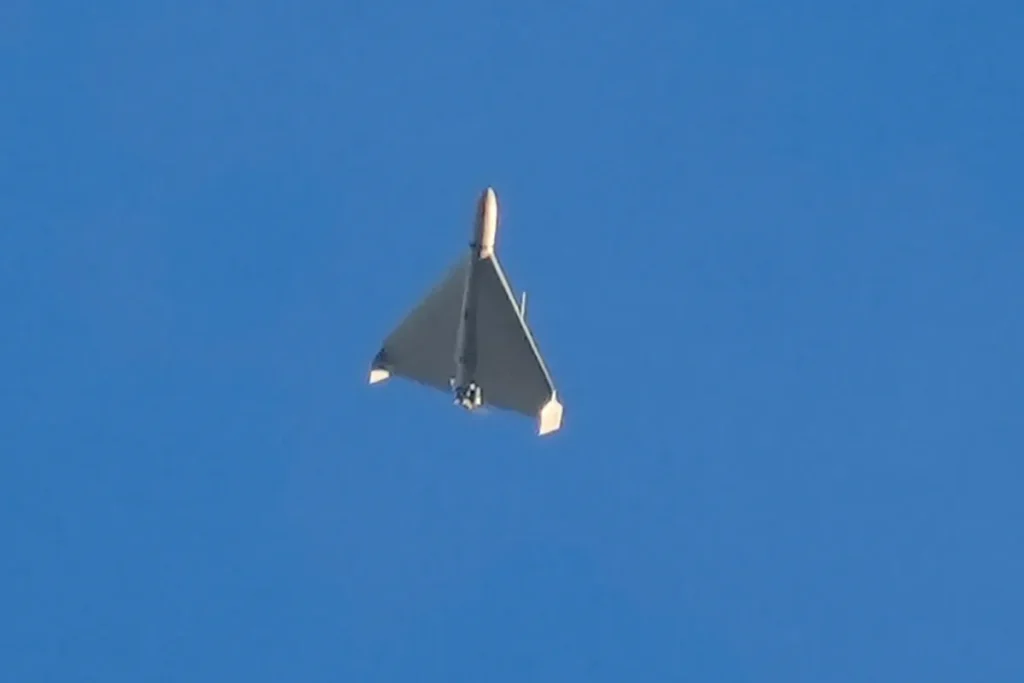
The distinctive drone of Iranian-designed drones has become a familiar sound in Ukraine over the past four years. Now, after the United States and Israel attacked Iran, Tehran struck back with cheap but effective weapons, a voice increasingly heard across the Persian Gulf.
The Shahid drones have had a transformative impact on modern warfare, with Russia firing a slew of deadly weapons into the skies over Ukraine during nighttime missions.
While ballistic and cruise missiles fly faster and are more powerful, they cost millions of dollars and are available in limited quantities. The cost of a Shahed drone is tens of thousands of dollars—a fraction of that of a ballistic missile.
Drones used in large numbers have demonstrated their ability to oversaturate air defense systems and cause painful damage at very low cost.
Debut in Ukraine
In February 2022, Russia launched a full-scale invasion of Ukraine using tanks, troops and missiles in an attempt to capture the Ukrainian capital. After a failed attempt, the battle has transformed into a war of attrition increasingly dominated by drones.
While swarms of small drones play a decisive role on the battlefield, Russia and Ukraine are also increasingly relying on long-range drones to carry out attacks deep into each other’s territory.
After striking a deal with Tehran early in the war to import Shahd drones (Shahed is “witness” in Persian), Russia localized its production. Russian engineers increased its flight altitude, improved its ability to resist jamming, and equipped it with a more powerful warhead.
The Russian replica of Shahed – called “Geran” or “Geranium” – has gone into production at a factory in Russia’s Tatarstan province, with output increasing exponentially. Russia has since struck Ukraine with hundreds of drones overnight – more than it will use in an entire month of 2024.
By using large numbers of missiles in a single attack, Moscow’s strategists are trying to overwhelm Ukraine’s air defenses and distract them from striking high-value targets with the more expensive cruise and ballistic missiles Moscow often uses along with drones.
Although it flies at a slow speed of 180 km/h (just over 110 mph), it has a range of up to 2,000 km (1,240 miles) and can carry 40 kg (88 lb) of explosives. Ukrainians call them “mopeds” because of their distinctive buzzing sound.
Ukraine relies on mobile units armed with machine guns as a low-cost response to drones to avoid using more expensive Western-supplied anti-aircraft missiles. It has also developed interceptor drones and is working to expand production, but a steady increase in Russian attacks has strained its defense capabilities.
Attacks in the Gulf and Beyond
Iran has attacked Israel and launched hundreds of missiles and drones at multiple targets in Saudi Arabia, Bahrain, Kuwait, Qatar and the United Arab Emirates, following weekend attacks by the United States and Israel.
These include U.S. bases, ports, airports, oil facilities and tankers, as well as some high-rise buildings.
Officials in Dubai, United Arab Emirates, said on Sunday that air defense systems shot down 165 ballistic missiles, two cruise missiles and more than 540 Iranian drones in two days. Although officials said they intercepted all airstrikes on Saturday, fragments of downed weapons sparked fires at some of Dubai’s most iconic locations.
Some Iranian drones have flown as far as British military bases in Cyprus. The runway at the Royal Air Force Base in Akrotiri was hit by an Iranian drone on Sunday and two more drones flying towards the base were intercepted on Monday, raising the alarm again, British officials said.
The most advanced U.S. and Israeli air defense assets have proven effective in intercepting most ballistic missiles launched by Iran toward Israel. But attacks using large numbers of cheap drones hit softer targets that lacked the same level of protection.
Drones have already transformed warfare, thanks to a combination of “continuous surveillance and high-precision strike” as well as improved targeting systems and artificial intelligence, said Patrick Burry, professor of security at the University of Bath.
Shahed drones can be easily concealed behind trucks, he noted.
Burry told The Associated Press that “what is surprising … is the ferocity and scale of Iran’s retaliation this time” compared with Iran’s response to the U.S. and Israeli attacks in June 2025. “I think what the United States and Israel hope and calculate is that they can weaken it enough to take away some of the momentum.”
Many observers point out that the United States and its allies could learn from the experience gained by Ukraine in responding to Russian drone attacks.
“Our military must do more and soon to institutionalize Ukraine’s defense lessons,” Carnegie Endowment senior fellow Darla Massicot posted on X.
___
Jill Lawless in London contributed.