MEXICO CITY (AP) — Mexican troops scored a major victory Sunday by killing the country’s most powerful drug cartel leader and one of America’s most wanted fugitives, as cartel members unleashed a wave of violence across the country.
Jalisco New Generation drug cartel leader Nemesio Oseguera Cervantes has been killed while trying to capture him in Jalisco state, the most high-profile blow to the cartel since the capture of former Sinaloa cartel leader Joaquín Guzman a decade ago.
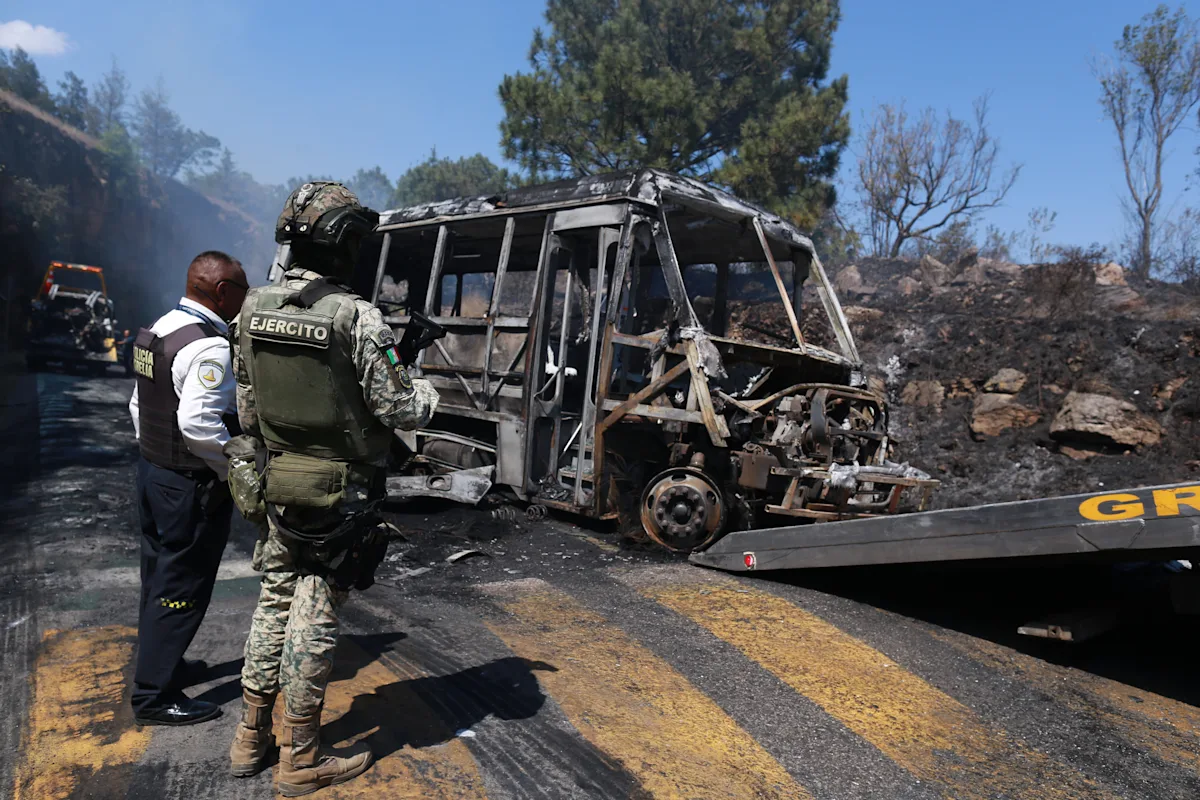
After Oseguera Cervantes’ death, gunmen unleashed violence across the country. Burnt cars by cartel members clogged roads in 20 Mexican states, sending thick smoke billowing into the air. In Guadalajara, Mexico’s second-largest city and the capital of Jalisco state, people locked themselves in their homes, schools were closed in several states on Monday and security forces were on alert across the country. Even Guatemala has stepped up security on its border with Mexico.
The killing could give the Mexican government an advantage in dealing with the Trump administration in the United States. The Trump administration has been threatening to impose tariffs or take unilateral military action if Mexico does not achieve results against drug cartels.
But the long-term impact on Mexico’s security situation remains unclear.
Here’s what you need to know:
‘El Mencho’ is the leader of a fast-growing crime syndicate
Oseguera Cervantes, better known as “El Mencho,” is 59 years old from the western state of Michoacán. His links to organized crime go back at least three decades.
In 1994, he was tried in the United States for heroin trafficking and sentenced to three years in prison. After returning to Mexico, he quickly rose through the ranks of Mexico’s drug-trafficking underworld.
Around 2009, he founded the Jalisco New Generation Cartel, which became Mexico’s fastest-growing criminal organization, moving cocaine, methamphetamine, fentanyl and immigrants into the United States and innovating with violence through the use of drones and improvised explosive devices.
The drug cartel is known for brazen attacks on Mexican security forces, including shooting down a military helicopter in Jalisco state in 2015 and a spectacular but unsuccessful assassination attempt on Mexico City police chief Omar Garcia Harfuch, now Mexico’s federal security minister.
It actively recruited people, experimented with new online ways to reach potential members, and generated revenue through activities such as fuel theft, extortion and timeshare fraud.
Ocegra Cervantes was killed fighting the troops sent to capture him
Oseguera Cervantes was killed during an attempt to capture him as his followers tried to repel the Mexican army.
The Mexican Defense Ministry said in a statement that the Army launched an operation to capture Oseguera Cervantes in the southern state of Jalisco, involving the Mexican Air Force and special forces.
The drug cartel fought back, and in the ensuing confrontation, federal troops killed four members of the criminal group and wounded three others, including its leader, who later died during an airlift to Mexico City, the statement said.
Three soldiers were injured during the operation and two were detained. Rocket launchers capable of shooting down aircraft and destroying armored vehicles were seized at the scene.
Mexico eager to show Trump results in crackdown on cartels
Oseguera Cervantes will help the Mexican government demonstrate results to the United States, which is pressuring its neighbor to pursue drug cartels more aggressively. Both countries said intelligence cooperation led to Sunday’s operation.
Oseguera Cervantes faces multiple indictments in the United States, and the U.S. State Department is offering a $15 million reward for information leading to his arrest. A year ago, the Trump administration designated his cartel and other terrorist groups as foreign terrorist organizations.
U.S. Deputy Secretary of State Christopher Landau, who served as U.S. ambassador to Mexico during Trump’s first administration, praised X’s action, writing: “The good guys are stronger than the bad guys. Congratulations to the great nation of Mexico for its force of law and order.”
Mike Vigil, the former chief of international operations for the U.S. Drug Enforcement Administration, said Mexico “sends a strong message to the Donald Trump administration that they are aggressively and effectively targeting” the most powerful drug cartels. He added, “Much of the information came from the Mexican Armed Forces, and all credit goes to Mexico.”
Cartel leader’s death leaves power vacuum
It’s unclear who will replace Oseguera Cervantes, or if anyone can.
The Jalisco drug cartel operates in at least 21 of Mexico’s 32 states and is active in nearly the entire United States, according to the U.S. Drug Enforcement Administration. But it is also a global organization, and the loss of its leader has repercussions far beyond Mexico.
“El Mancho controlled everything, he was like a dictator of the country,” Vigil said.
His absence could slow the cartel’s rapid growth and expansion and weaken it in its initial confrontation with the Sinaloa Cartel or its proxies on several fronts. However, Sinaloa is locked in an internal power struggle between El Chapo’s sons and factions loyal to Ismael “El Mayo” Zambada, who is in U.S. custody.
Vergeire said Mexico should seize the moment and launch an “effective frontal attack based on intelligence.”
“If Mexico and the United States work together, this is a huge opportunity for them,” he said.
Security analyst David Saucedo said Sunday’s violence could continue if relatives of Oseguera Cervantes took control of the drug cartel. If someone else were in charge, they might be more willing to turn over a new leaf and continue operations.
The biggest fear is that the cartels will turn to indiscriminate violence. They may decide to “launch a narco-terrorist attack… and create a scenario similar to what happened in Colombia in the 1990s” with an all-out attack on the government, “car bombs, assassinations and plane attacks.”