


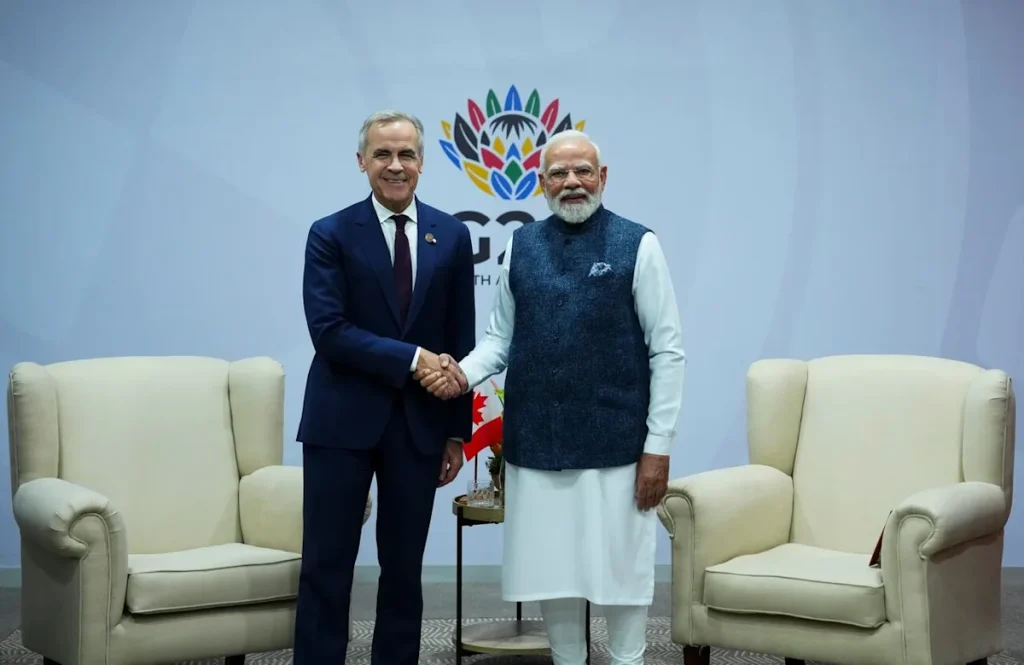
India wants to buy whatever energy products it can from Canada, and its officials are urging the federal government to streamline approvals for various projects so that it can tap new supplies to meet the needs of a fast-growing country with relatively few natural resources.
That was the message from Indian High Commissioner to Canada Dinesh Patnaik in an interview with CBC News ahead of Canadian Prime Minister Mark Carney’s five-day visit to the country.
The trip will focus on striking new business deals and ongoing free trade agreement negotiations as part of a push to diversify the U.S. market.
“On the energy front, even Canada cannot meet our needs and we are willing to buy whatever crude oil, LPG, LNG Canada has to offer,” Patnaik said of oil and gas products.
Patnaik said strengthening trade ties would help the two countries end years of bilateral discord.


Indian High Commissioner Dinesh Patnaik said increased trade would help improve Canada-India relations. (Spencer Colby/Canadian Press)
Relations between the two countries have been frosty since former Prime Minister Justin Trudeau accused unnamed Indian agents of involvement in the 2023 killing of a Canadian Sikh separatist. India denies any involvement.
But things have improved significantly since Carney invited Indian Prime Minister Narendra Modi to the G7 meeting in Alberta last year.
It was there that the two leaders agreed to pursue a comprehensive economic deal, which is expected to take several steps towards reality in the coming days as the two leaders face each other again in Delhi.
“It’s all going to come together so that the energy can completely redefine our relationship. So far, what we’ve done is just a drop in the bucket,” Patnaik said.
The message was echoed by Saskatchewan Premier Scott Moe, who has long advocated closer trade ties with the Indo-Pacific economic powerhouse, given how much energy and agricultural products India wants to buy from the province.
“Politics aside, the bottom line is that we had some challenges in those relationships for much of the last decade under the previous prime minister,” Moi said.
“We now have a prime minister who is focused on advancing these trading relationships.”
To this end, Patnaik said India is interested in acquiring more Canadian uranium, especially to power its growing nuclear sector.
India operates 25 reactors and has eight more under construction. Patnaik said the Canadian government aims to increase nuclear power capacity to 100 GW by 2047 from about 8.7 GW currently, and Canada, as the world’s second-largest uranium producer, has a large number of proven high-grade deposits in Saskatchewan that can help achieve this goal.
“We are willing to take all measures,” the high commissioner said, adding that Indian companies were open to taking ownership of Canadian uranium mines and buying more of the country’s world-leading nuclear technology.
“Nuclear energy is a huge area that we want to work together on.”

India’s Madras Atomic Power Station was seen last year. (R. Patiban/Associated Press)
Moi hopes Carney can reach a uranium supply deal with India – a senior government official told CBC News that could happen while Carney and Modi consider a series of memorandums of understanding.
According to Forbes, a 10-year deal worth about $3 billion is under consideration. A deal would be a huge boon for the prairie province and Cameco, its largest uranium supplier.
Less than an hour after arriving in Mumbai on Friday, Moi met India’s atomic energy ministry to lay out the case for the uranium deal. He told reporters the discussions were going well.
“As Canadians, we have a responsibility to provide and replace some of the dirtier forms of energy,” Moe said.
Patnaik said India does not want to become a captive customer, dependent on a few energy suppliers.
Until recently, India purchased large quantities of oil from Russia despite the ongoing war in Ukraine – infuriating US President Donald Trump.
Trump imposed huge tariffs on India – 25% on top of other “reciprocal” tariffs he already imposed on Indian products – and lifted them earlier this month after Modi apparently agreed to stop relying on the Russian oil industry.
In exchange for tariff relief, Trump said India agreed to buy U.S. oil and U.S.-controlled Venezuelan exports.
But with broader U.S. trade talks on hold, Patnaik said India also wanted Canadian oil to replenish its supplies.
“Given what’s happening in global geopolitics, we want to diversify our supply base,” he said. “The quantities that we need and the quantities that the world needs, no one country can provide all of that.”
The problem, Patnaik said, is that currently most of Canada’s oil is shipped to a single customer: the U.S.
About 93% of Canada’s total crude oil exports will be shipped to the United States by 2024, according to the Canadian Energy Regulator. That puts Canadian oil companies and governments that rely on taxes and royalties from the industry at a disadvantage because they sell their products at higher global prices.
Patnaik applauded Carney for supporting the construction of a new oil pipeline to the Pacific Ocean, a project that, if completed, would help break that dependence and move more Canadian crude to other markets, mainly in Asia.
British Columbia’s export terminal will be closer to India than the U.S. Gulf Coast, from which India now imports most of its Canadian crude — a quirk of the North American market that, given domestic pipeline constraints, means that much Canadian oil, even oil shipped overseas, flows through the United States.
“You are an energy superpower but you supply only one country,” Patnaik said.
“We will be your largest customer – I think that is possible in the near future. The perception in India is that Canada is a difficult country, a more bureaucratic, over-regulated country,” he said.
Now that Carney is at the helm, “I think people believe he can do more,” he said.


Canada has the world’s third-largest oil reserves and is the world’s fourth-largest producer. (Jeff McIntosh/Canadian Press)
India also wants to increase the share of natural gas in its energy mix to 15% by 2030 from the current 6.2% as part of efforts to build a clean energy system and reduce dependence on coal.
India, already the world’s fourth-largest buyer of LNG, is seeking more supplies to meet these ambitious transition goals.
With seven LNG export projects in various stages of development (two of which Carney has submitted to the Major Projects Office for accelerated approval), Canada could become a preferred supplier to India and its population of more than 1.4 billion.
When asked about India’s need for greater access to Canadian energy, Natural Resources Minister Tim Hodgson said that as middle powers, Canada and India need to get closer in the face of “hegemons” such as the United States that are weaponizing economic integration, part of which includes selling the country more of the products it needs.
“The prime minister has said he wants us to double our trade with India by the end of the century. I think India is willing to do that as well.
“Frankly, when I went to India a few weeks ago, I was shocked by the positive reception we received,” he said.


Carney and Modi exchanged greetings in Alberta last June, when the two leaders announced they would resume senior diplomatic posts in each other’s countries. (Daryl Dyke/The Canadian Press)
Senator Peter Bohm, a former senior diplomat who now chairs the Senate Foreign Affairs and International Trade Committee, said Carney’s trip has the potential to bring huge opportunities to the Canadian economy, given that the relationship has moved from the “crisis management” phase.
“India needs a lot of energy. There’s a lot – a lot – of potential there,” Boehm said.
“About 98% of our energy goes to the United States, but continuity is uncertain at the moment – outward expansion is the way to go.”