


Naval history has always been a story of innovation and ambition. From massive battleships that symbolize national pride to stealth submarines and nuclear-powered aircraft carriers that quietly transform warfare, engineering talent often determines who has the upper hand at sea.
These ships are floating experiments in design, technology and human ingenuity. Some ruled their times, while others became symbols of lessons learned. Taken together, they form a fascinating journey through time, showing how each generation of naval architects sought to surpass the last in size, power, and vision.
Bismarck (Germany, 1940)


Image credit: Bundesarchiv – CC-BY-SA 3.0/Wiki Commons.
The Bismarck became the battleship everyone was talking about in the Atlantic, not only because of its guns, but also because of how it incorporated engineering into a balanced package. Its designers combined high speed, heavy protection and long range into a hull capable of handling rough seas.
The ship’s compartment division and damage control layout reflected careful German planning. Even its fire control system, while not revolutionary, works seamlessly with the rest of the design.
Project highlights:
• Balance speed, armor and range in one hull.
• Advanced zoning for improved survivability.
• Shows how a single ship can change global strategy.
Yamato (Japan, 1941)

Image credit: Hasuya Hirohata – Public Domain/Wikimedia Commons.
The Yamato is bringing bold engineering to sea, showing that its size and survivability still reign supreme. Its designers followed the philosophy of “bigger solves everything” and then found ways to bring action and combat to scale.
Onboard systems, armor distribution and impact protection pushed the limits of wartime metallurgy. The ship’s massive power plant was built to sail across the Pacific with confidence. However, just as naval airpower was rewriting the rules, Yamato appeared. Its fate highlights how even the best engineering can be overtaken by changes in doctrine. Nonetheless, the boat demonstrates incredible craftsmanship in terms of structural strength and cabin layout.
Project highlights:
• The largest battleship ever built, with a record number of guns.
• Redefining metallurgy for armor and structural strength.
• A symbol of unparalleled scale and ambition.
USS Essex (CV-9, United States, 1942)

Image credit: PHCS Jackman – Public Domain/Wikimedia Commons.
Essex won the naval battle through ingenious design. The class’s standardized features make the carrier easier to build, repair and upgrade in the heat of battle. Its efficient elevator layout and hangar workflow make aerial work faster and safer.
Essex proves that engineering brilliance can sometimes look like efficiency rather than spectacle. The ships can continue to fly even after battle damage because the systems are laid out with redundancy and repair in mind. Commanders trust them, aircrews love them, and shipyards can reliably produce them. Essex Airways can accommodate new aircraft and new electronics without a fundamental redesign. This flexibility extended their utility into the Cold War.
Project highlights:
• Simplified wartime mass production.
• Deck edge lift speeds up flight operations.
• Flexible design extends service life for decades.
USS Missouri (BB-63, United States, 1944)

Image source: Official U.S. Navy Photo – U.S. National Archives, Public Access Online/Wikimedia Commons.
The “Mighty Mo” represented the pinnacle of the American fast battleship spirit. Engineers balanced armor, speed and long-range firepower with radar-guided fire control that was ahead of its time.
Missouri can rush, take hits and keep shooting in rough seas. The ship’s electrical systems and internal protection reflected the hard lessons learned in the early days of the war. It served in Korea and later conflicts, becoming a technological platform that remained relevant beyond the battleship era. The design can accommodate new electronics and upgraded defense systems without losing its core strengths.
Project highlights:
• Improved the concept of fast battleships.
• Advanced long-range artillery with radar fire control.
• Remained relevant in post-World War II combat.
USS Midway (CV-41, United States, 1945)

Image credit: U.S. Navy – Public Domain/Wikimedia Commons.
Midway transcended generations by combining rigorous protection with the flexibility operators required. Its structural strength and flight deck design were heavier than those of earlier U.S. aircraft carriers, in anticipation of larger and faster postwar aircraft. Engineers created room to grow, which turned out to be the smartest decision.
During a service life that spanned the jet age, Midway absorbed sloping decks, new arresting gear, and modern sensors. The ship became a test bed for how to modernize without starting from scratch. Its powerplant and hull shape make it durable and seaworthy for global operations. Workers can reconfigure space to support new tasks without causing downtime.
Project highlights:
• Designed to handle the transition to jet aircraft.
• Easily adapts to sloped decks and modern systems.
• The service life is approximately 47 years due to the foresight of the design.
USS Nautilus (SSN-571, United States, 1954)

Image credit: John Kristoffersen – Public Domain/Wikimedia Commons.
The Nautilus transformed the submarine from a tracker of limited endurance into a true ocean rover. Nuclear propulsion frees the ship from snorkeling and battery cycling.
This single change requires a rethinking of hull strength, thermal management and crew safety. Engineers built shielding, redundancy and controls to establish a safety culture for the nuclear navy. The Nautilus can sprint long distances underwater, turning the vast ocean into a tactical space. From silencing measures to navigation, system integration is as important as the reactor. The hull and interior layout were adapted to suit the new type of sustained high-speed underwater life.
Project highlights:
• First nuclear powered submarine.
• Unlimited underwater endurance revolutionizes tactics.
• Develop safety and design standards for future nuclear fleets.
USS Enterprise (CVN-65, United States, 1961)

Image credit: Pilot Rob Gaston – Public Domain/Wikimedia Commons.
The USS Enterprise was the world’s first nuclear-powered aircraft carrier, extending the Nautilus idea into a floating air base. Eight reactors provide the ship with exceptional durability and electrical headroom for evolving wings and sensors.
This strength also requires an engineering culture that can handle complexity without losing reliability. The Enterprise pioneered logistics, training and procedures that the United States still uses on nuclear aircraft carriers today. Its massive deck operations benefit from the ship’s speed and stability in rough seas. Over the decades, the ship adapted to new aircraft, new missions and new defense systems. It becomes a platform where innovation feels normal rather than special.
Project highlights:
• First nuclear-powered aircraft carrier with eight reactors.
• Adapt to changing aircraft and missions over decades.
• Developed a blueprint for nuclear aircraft carrier operations.
Kirov-class (Russia, 1980)

Image credit: JOHN KRISTOFFERSEN – Public Domain/Wikimedia Commons.
Kirov proved that another superpower could uniquely deploy nuclear power to its surface fleet. Instead of building a floating airfield, the Soviets built a guided-missile battlecruiser with a surprisingly deep magazine.
This class combines nuclear and steam power to power a very large, very fast hull. Engineers are focused on developing long-range anti-ship and anti-aircraft missiles that integrate powerful sensors. This is an air-rejection concept embodied in the fields of steel and electronics. The ship’s dimensions allow for heavy armor in important spaces and redundant layers.
Project highlights:
• Hybrid nuclear/steam propulsion speed and range.
• Designed as a “missile battleship” with heavy firepower.
• A bold alternative to Western carrier-centric doctrine.
USS Ohio (SSBN/SSGN-726, United States, 1981)

Image credit: Destiny Dempsey/U.S. Navy – Public Domain/Wikimedia Commons.
Ohio took a submarine-based nuclear deterrent and made it quieter and more sustainable. The design emphasizes reliability, habitability and patrol endurance as well as raw stealth.
Engineers build systems that reduce noise, make maintenance predictable, and allow crews to work for months at a time. Navigation, propulsion and assistance systems are arranged for everyday excellence rather than spectacle. Later conversion to missile role showed the adaptability of the hull. The ability to change tasks without changing identity is engineering maturity.
Project highlights:
• Designed for long, quiet nuclear deterrent patrols.
• Prioritize crew habitability and reliability.
• Flexible enough to adapt to new tasks.
USS Arleigh Burke (DDG-51, United States, 1991)

Image credit: U.S. Navy – Public Domain/Wikimedia Commons.
It’s no accident that Arleigh Burke is the “Swiss Army Knife” of modern surface warfare. Designers prioritized survivability, steel hulls, careful separation and damage control from day one.
The ship’s Aegis combat system and vertical launch unit make it a flexible missile truck. Just as important, the hull, power and cooling margins support decades of continuous upgrades. Engineers built a ship that could continually absorb new radars, weapons, and computing systems without damage. The multiple “flights” of this class attest to the architecture’s staying power.
Project highlights:
• Designed for survivability and resilience.
• Aegis System + VLS provides unparalleled flexibility.
• Architecture that is still upgradeable after more than 30 years.
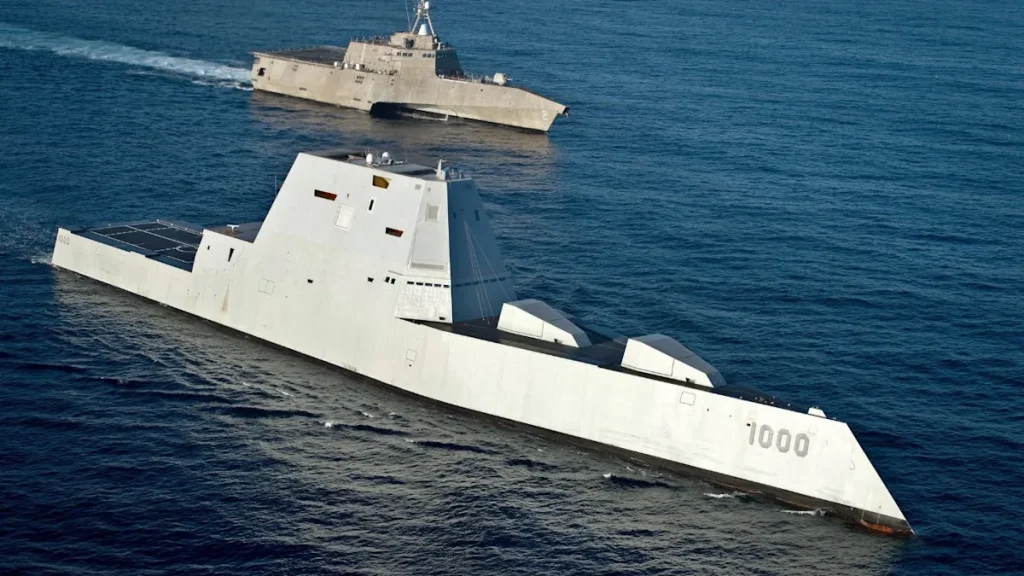
USS Zumwalt (DDG-1000, United States, 2016)

Image credit: National Museum of the United States Navy – Public Domain/Wikimedia Commons.
Zumwalt is an adventurous laboratory hidden in the silhouette of a stealth destroyer. Its tumbling hull reduced radar signature and forced new thinking about stability and control.
The integrated power system turns the entire ship into a power plant, supporting demanding sensors and future weapons. Advanced automation can reduce headcount and enable tighter system management. Some original ideas, like the gun system, didn’t work out as planned, and that’s part of the innovation.
Project highlights:
• Focus on stealthy hulls to reduce radar signature.
• Integrated power plants for future weapons.
• Serves as a floating prototype for next-generation naval designs.
USS Gerald R. Ford (CVN-78, United States, 2017)

Image credit: Jackson Adkins – Public Domain/Wikimedia Commons.
Ford takes the supercarrier concept into the 21st century and provides backup power. Its electromagnetic catapult and advanced arresting gear are more than just flashy acronyms. They reduce stress on the aircraft and ensure faster turnaround.
The redesigned flight deck simplifies the organization of aircraft movement, refueling and arming. Elevators and magazine libraries were rethought for safety and pace. These reactors provide huge power capacity for sensors and future systems that have not yet been deployed. Yes, like any first class, the ship experienced early reliability woes.
Project highlights:
• Electromagnetic launch and recovery system.
• Redesigned cockpit enables faster jet operations.
• Designed for future surplus power adaptability.
Where wave meets innovation

Image credit: PH1 Harold Gerwien – Public Domain/Wikimedia Commons.
From steel giants that rock the oceans to submarines that patrol in obscurity, these ships tell the story of how human ambition continues to push the boundaries of technology. Each ship represents a moment when naval engineering took a bold step forward, often changing the future of warfare in the process. While the details of their careers vary, from legendary to tragic, the common thread is innovation.
Looking ahead, the ocean will undoubtedly see more radical designs, from autonomous warships to hybrid vessels powered by future energy systems. But as we plot this route, it’s worth remembering the glorious lineage that brought us here.