


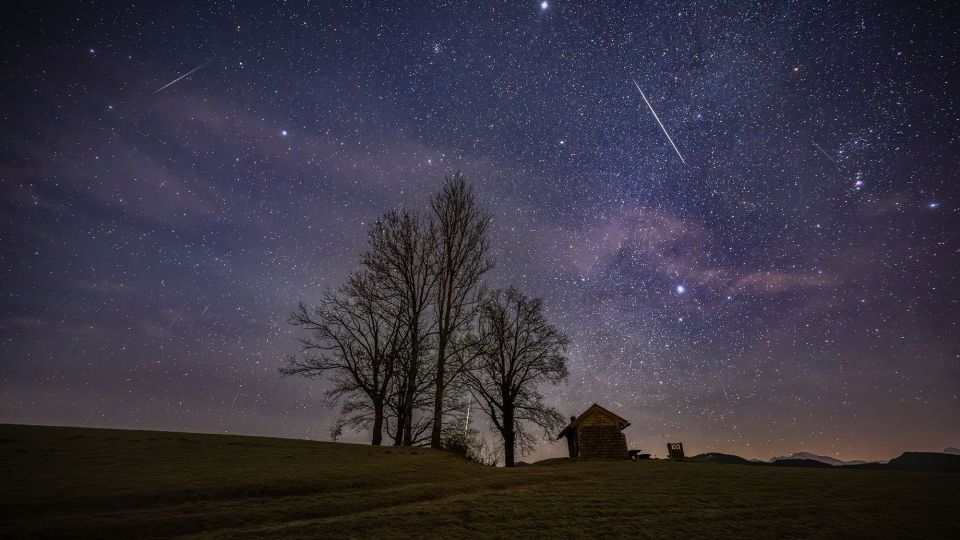
A bright full moon, dazzling meteor showers and a dramatic total solar eclipse will give stargazers plenty of reasons to look up to the skies in 2026.
The New Year kicks off with Saturday’s Full Wolf Moon, the first of three supermoons this year. According to EarthSky, Jupiter, the largest planet in the solar system, will appear to the south of the silvery sphere.
Because the supermoon is so close to Earth, it will be brighter and rounder than a regular full moon, potentially hampering the visibility of the Quadrantid meteor shower.
The Quadrantid meteor shower is expected to peak between 4 and 7 p.m. ET on Saturday, when the full moon will dominate the night sky.
But Robert Lunsford, fireball reporting coordinator for the American Meteor Society, said there are more meteor showers and celestial events to look forward to in 2026.
super moon and full moon


The supermoon rises behind the Benedictine monastery in Krakow, Poland, in November. – Omar Marquez/Anadolu/Getty Images
Most years there are 12 full moons, one in each month. But by 2026, there will be 13, including two in May.
The second full moon in a month is called a “blue moon” – as in the phrase “once in a blue moon”.
Typically, a full moon occurs every 29 days, and most months in our calendar last 30 or 31 days, so the month and moon phase don’t exactly line up – resulting in a Blue Moon approximately every 2.5 years.
After January’s supermoon, the next two supermoons will be in November and December. On average, the Moon is about 238,900 miles (384,472 kilometers) from Earth. But December’s supermoon will be the closest supermoon of the year, EarthSky reports, at a distance of 221,667 miles (356,740 kilometers).
According to the Farmer’s Almanac, here are the remaining full moons in 2026:
-
September 26: Mid-Autumn Festival
-
October 26: Hunter’s Month
meteor shower

In August, the Perseid meteor shower streaked over the Temple of Zeus in the ancient Turkish city of Aizanoi. – Kemal Aslan/AFP/Getty Images
After the Quadrantids peak in early January, skywatchers will have to wait a while until April’s Lyrids.
Here are the peak dates for the remaining meteor showers in 2026, according to the American Meteor Society.
-
Southern Delta Aquarids Meteor Shower: July 30-31
-
Alpha Capricorn: July 30-31
-
Southern Taurids Meteor Shower: November 4-5
-
Northern Taurids Meteor Shower: November 11-12
“The Perseid and Geminid meteor showers will be the best meteor showers of the year,” Lunsford said. “The Perseid meteor shower is expected to peak without lunar interference.”
Lunsford noted that the Geminid meteor shower produced a powerful meteor shower in 2025, with a rate of up to 135 meteors per hour.
“There’s no reason why we can’t expect a similar situation after the moon sets in 2026.”
eclipse

In October 2024, an annular solar eclipse appeared over the port of San Julian, Argentina. – Juan Mabromata/AFP/Getty Images
Sky watchers can look forward to two dramatic solar and two lunar eclipses this year, according to NASA.
On February 17, an annular solar eclipse will occur over Antarctica. This phenomenon occurs each year when the Moon passes between the Earth and the Sun, either when it is close to or at its furthest point from the Earth. Therefore, the moon cannot completely block the sun as it does during a total solar eclipse. Instead, the sun’s fire surrounds the moon’s shadow, creating a ring of fire effect. Meanwhile, Antarctica, Africa and South America will see a crescent-shaped partial solar eclipse.
Be sure to wear appropriate eclipse glasses to view the eclipse safely, as sunlight can damage your eyes.
On August 12, a total solar eclipse will be visible in parts of Greenland, Iceland, Spain, Russia and Portugal. Viewers in Europe, Africa and North America will see a partial solar eclipse.
lunar eclipse
On March 3, a total lunar eclipse will appear in the night skies of Asia, Australia, the Pacific Islands and the Americas.
A lunar eclipse only occurs during a full moon, when the sun, Earth, and moon align and the moon enters the Earth’s shadow. When this happens, the Earth casts two shadows on the Moon. The partial outer shadow is called the penumbra; the full dark shadow is the umbra.
When the full moon enters the Earth’s shadow, it dims but does not disappear. Instead, sunlight passing through Earth’s atmosphere lit up the moon in dramatic fashion, turning it red—which is why the event is often called a “blood moon.”

People view the Blood Moon during the total lunar eclipse in Dankoe in September. – Mads Claus Rasmussen/Ritzau Scanpix Denmark/Reuters
This happens because blue light undergoes stronger atmospheric scattering than red light, so when sunlight passes through our atmosphere and casts light onto the moon, red is the dominant color. Depending on weather conditions in your area, the moon may appear rusty or brick-red.
A partial lunar eclipse will be visible in the Americas, Europe, Africa and Western Asia from August 27th to 28th. A partial lunar eclipse occurs when the Sun, Earth, and Moon are not perfectly aligned and only part of the Moon enters the shadow.
Check the time and date website to find out the exact times and locations of these eclipses.
Planet Tours and Appearances

In April, a new moon and bright Venus can be seen over southern Alberta. – Alan Dyer/VWPics/Universal Image Group/Getty Images
A tour of the six planets visible in the night sky will be held in February.
According to EarthSky, Saturn will be close to the horizon, while Venus and Mercury will appear above the setting sun. Neptune will also appear alongside Saturn, but the distant ice giant can only be seen through a telescope or binoculars.
Meanwhile, on February 23, Uranus will be visible near the moon—again with the help of binoculars or a telescope. In the evening, sky watchers looking eastward can also see the glowing planet Jupiter. The Moon and Jupiter will be very close together on February 26th.
After sunset on May 19, the new moon will twinkle between Jupiter and Venus. Then, during the first week of June, Jupiter and Venus will appear side by side due to their orbital positions, although the two planets are not close neighbors in space. According to EarthSky , on the evening of June 8 and 9, Venus and Jupiter will swap places in the night sky, creating the illusion of a double planet.
In just over a week, Venus will appear above the First Quarter Moon, while below it, Jupiter and Mercury will be visible.
Another celestial optical illusion that delights skywatchers is the disappearance of Jupiter in the fall. In the early morning hours of October 6, the new moon and Jupiter will appear so close that to those watching east of St. Louis in North America, the moon will appear to temporarily hide Jupiter for about an hour before reappearing on the other side.
Before dawn on November 16, the red glow of Mars will appear close to Jupiter in the eastern sky. On the morning of December 4, the new moon will pair with bright Venus, while Jupiter and Mars will form another twinkling double star.
Sign up for CNN’s Miracle Theory Science newsletter. Explore the universe and get news about fascinating discoveries, scientific advancements, and more.
For more CNN news and newsletters, create an account at CNN.com