NEW YORK (AP) — For decades, the strongest evidence of the earliest human settlement in the Americas came from a site in Chile called Monteverde.
Scientists have found traces of human presence dating back some 14,500 years, including footprints, wooden tools, the foundations of buildings and the remains of ancient fire pits. They dated sediments and artifacts from the site.
A new study has cast doubt on the age of this important site, suggesting that Monteverde may be much younger than scientists thought. But not everyone agrees with this finding.
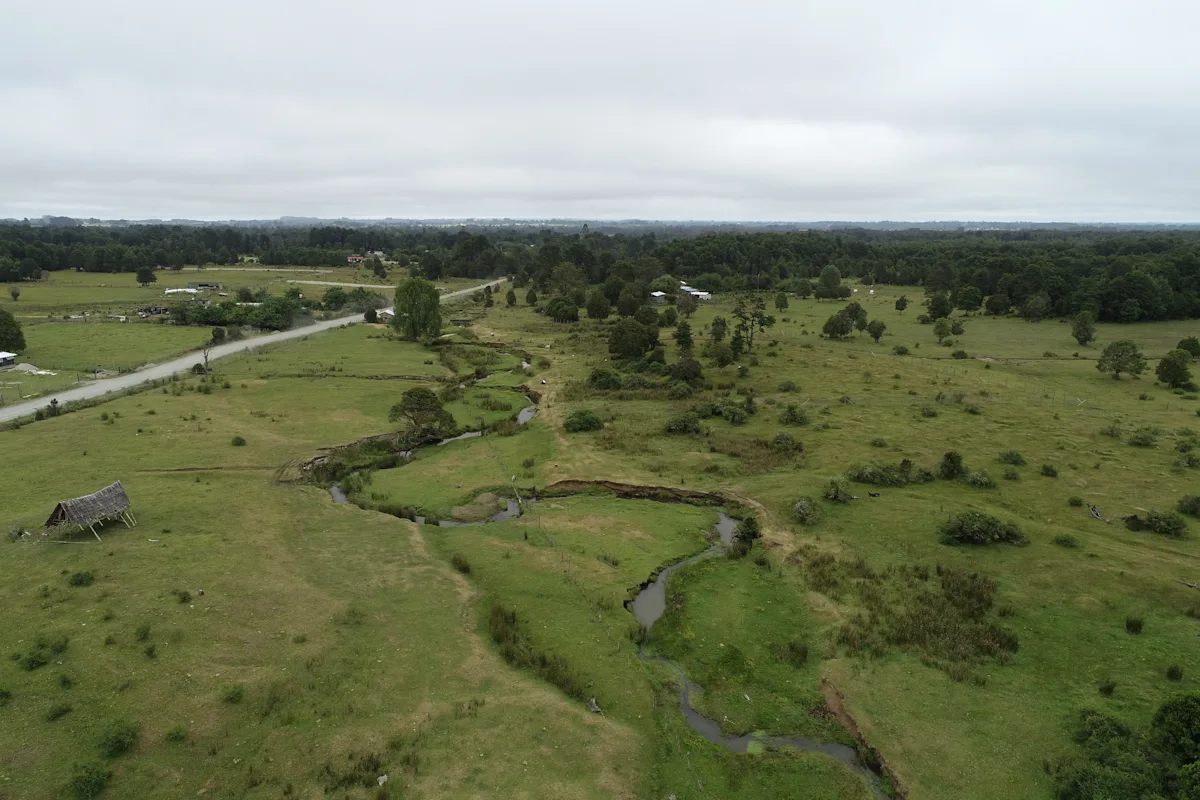
Scientists sampled and dated sediments from nine areas along Chinchwapi Creek and analyzed changes in the landscape over thousands of years. They discovered a layer of volcanic ash from an eruption about 11,000 years ago.
Anything above that layer — in this case, Monte Verde timber and artifacts — must be younger, said study co-author Claudio Latorre.
“We basically reinterpreted the geology of the site. We concluded that the Monte Verde site cannot be older than 8,200 years ago,” said Latorre, who works at the Pontifical Catholic University of Chile.
Researchers believe changes in the landscape, including streams eroding the rock, may have mixed older layers with newer ones, leading researchers to date the ancient wood as part of the Monte Verde site.
The findings were published Thursday in the journal Science. Some scientists, including those involved in the original excavations, have questioned the results.
“At best, they provide a working hypothesis, but the data they provide do not support that hypothesis,” said Michael Waters of Texas A&M University, who was not involved in either study.
Experts not involved in the study, which included the analysis of samples from the area surrounding Monte Verde, said the geology of the area was not comparable to the site itself. They say there’s not enough evidence to suggest layers of volcanic ash once covered the entire landscape.
They also said the study did not provide an adequate explanation for artifacts found at the site that date back directly to 14,500 years ago, including mastodon tusks that were fashioned into tools, a wooden spear and a digging stick with a burnt tip.
“This interpretation ignores a large amount of outdated cultural evidence,” Vanderbilt University archaeologist Tom Dillehay, who led the first excavation of the site, said in an email.
The authors of the new study disagree with those criticisms, saying they sampled inside, upstream and downstream of the site. Co-author Todd Surowell of the University of Wyoming said there’s not enough evidence to suggest the site’s old artifacts are really that old.
The Monte Verde site is crucial for scientists to understand how people arrived in the Americas. Scientists once believed that the first arrivals were a group of people 13,000 years ago who made pointed stone tools called Clovis points. The discovery and dating of Monteverde was initially mired in controversy, but this now appears to have been resolved.
It’s unclear how the site’s new date might affect Human Stories. Since Monteverde, researchers have discovered pre-Clovis sites across North America, such as Cooper’s Ferry in Idaho and the Debra L. Friedkin site in Texas.
But another big question is how exactly people got from Asia to the Americas, moving south of the two giant ice sheets that cover Canada. Did the humans arrive in time for the sheets to part, revealing a frost-free corridor? Did they travel along the coast by boat, or by a combination of land and water?
Revising Monteverde’s date could reopen discussions about the most likely route of early humans, Surovell said. Future independent analyzes of other early human sites could provide more clarity.
“Given enough time and the ability to do scientific research, science corrects itself,” Surovell said. “The truth will eventually be reached.”
___
The Associated Press Health & Science Department receives support from the Howard Hughes Medical Institute’s Department of Science Education and the Robert Wood Johnson Foundation. The Associated Press is solely responsible for all content.