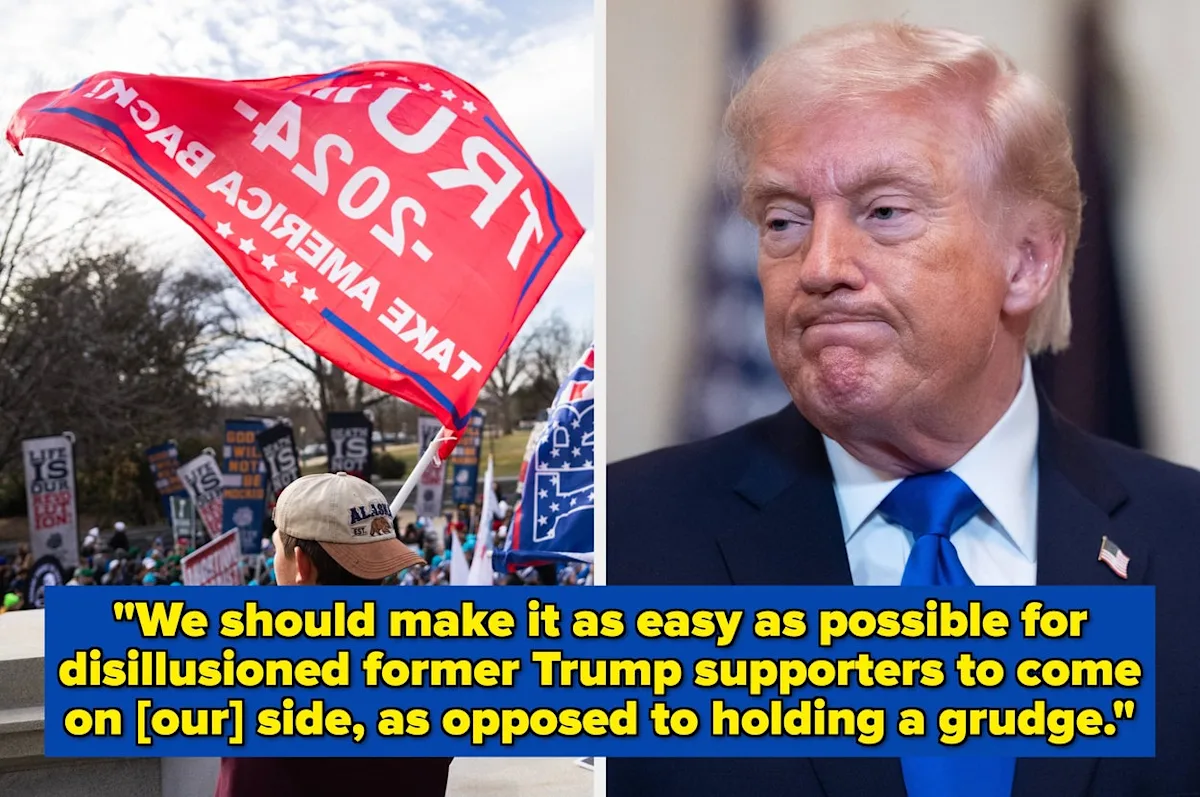
Trump’s overall approval has dropped significantly since his return to office, with his ratings stagnating in the high 30s to low 40s throughout his second term. An AP-NORC poll from earlier this month found that 59% disapprove of his handling of the economy — the issue that carried him back to the White House. As these numbers have mounted, some Americans who voted for Trump have begun expressing disappointment in their choice, and, in some cases, regret.

Bloomberg / Getty Images
Recently, the title of a post on the r/GenZ subreddit read, “We should make it as easy as possible for disillusioned former Trump supporters to come on [our] side, as opposed to holding a grudge.” Though the body of the post and the original poster’s account have since been deleted, the comments — over 100 of them — have not.
In the 2024 election, roughly 77 million Americans voted for Trump — nearly half of all voters who cast ballots and his highest turnout in three elections. The thread’s response to making it “as easy as possible” for former Trump supporters was, for the most part, unequivocal.

Roberto Schmidt / Getty Images
The top comment, from u/Positive-Avocado-881, set the tone: “I tried to after January 6, and a lot of them voted for him a third time.” It has 49 upvotes.

Brent Stirton / Getty Images
Below it, u/playtheukulele replied: “At this point, it has become either willful ignorance or outright malice. People who want to get away from Trump need to put in the fucking effort first. They can say all they want to, but until I see changed actions from them, it’s all just talk. I expect they’ll pretend they’ve seen the light and then just vote for Trump again anyway or whatever the f—k they’re gunning for now.”
Related: Former Patients Are Sharing Their Most Humiliating Doctor Visits, And I’m Dying From Secondhand Embarrassment
It’s a sentiment echoed throughout the thread. u/Sentry_Buster2 wrote, “They elected the guy to run the country for the next four years after they already saw what he did in his first term. So no, they made their choice, and there will be no simple forgiveness.”
Meanwhile, u/localhalloweenskunk kept it brief: “Naw. Fuck ’em.”

ELIJAH NOUVELAGE / AFP via Getty Images
The thread’s most personal comment came from u/TheCoolIdeagenerator, who described how Trump fractured their own family — a relative threatening to kick out a cousin over a vote, Thanksgiving dinners derailed by political arguments, and a community of Mexican Americans that slowly went quiet about their support as the consequences set in. Separately, they described being harassed on two occasions by white women who asked if they were “legal.”
“And do you know what’s the funniest part?” they wrote. “There is no gloating or ‘haha gotcha’ from fellow my Brown people and me. Trump destroyed a family of Mexican Americans and destroyed a community because of his bullshit. Trump said he was gonna deport the CRIMINALS first, right? Nope, he didn’t; he deported actual citizens. Obama may have deported more people, but he’s not the one telling his supporters that it’s OK to openly harass Mexican Americans. I was HARASSED and asked if I was legal TWICE by two different white women. There are people online being bold, being ignorant, and hateful because Trump is empowering them and making them feel safe.” The comment ends: “So no, fuck them and especially fuck the Brown MAGA supporters.”
That anger has a documented dimension. Political psychologist Karen Stenner’s research has established that roughly one-third of the population in any liberal democracy carries a latent authoritarian predisposition — a psychological trait that lies dormant until activated by perceived threats to social cohesion, like cultural upheaval or rising perceptions of disorder. Diana Mutz’s 2018 research at the University of Pennsylvania found that what drove Trump support in 2016 wasn’t financial well-being but status threat: the feeling among traditionally dominant groups that their position in the social hierarchy was slipping.

Tom Williams / Getty Images
Likewise, researchers Petersen, Osmundsen, and Arceneaux identified a trait they called a “Need for Chaos” — a desire to tear down existing structures — that predicted hostile political engagement better than partisanship alone. About 25% of 2024 voters told AP VoteCast they wanted “complete and total upheaval.”
In other words, what u/TheCoolIdeagenerator experienced — the emboldened harassment, the sense that Trump made people feel “safe” to be openly hostile — isn’t anecdotal. It maps onto a body of research that documents a measurable authoritarian dimension within the coalition. But it doesn’t take a study to understand what it feels like to be asked if you’re “legal” in your own country, let alone harmed, terrified, or even brutalized and stripped of your rights.
In a separate exchange, u/Netblock drew a distinction between intent and consequence that ran beneath much of the debate. “It isn’t exactly an overgeneralization when we purely take a look at the consequences of their actions,” they wrote. “It’s like watching someone shoot themselves in the foot and thinking they fully intended that action.” They acknowledged that many conservative voters are “ignorant of what they’re supporting” rather than actively malicious — but argued the distinction changes very little in practice. “Their ideologies, when enacted into law or in the home, cause queer kids to die,” they wrote. “The ignorant, after all, are easy to grift.”

Jack Taylor / Getty Images
Related: These 46 Funny Tweets From The Week Have Me Genuinely Howling Like My Dog After Hearing A Squeaky Toy, And Trust Me, I Don’t Laugh At Just Anything
One dimension the thread barely touches, though, is who, exactly, voted for Trump.
When commenters describe Trump voters, the implicit picture is white, rural, and culturally reactionary. But in 2024, the coalition became less white, not more. Trump’s share of the Latine vote rose to 48% — up from 28% in 2016 — with Latino men swinging from Biden +23 in 2020 to Trump +10 in 2024, though the motivations varied significantly within that bloc. For instance, Cuban and Venezuelan Americans were driven largely by anti-socialism messaging rooted in personal or family experience fleeing leftist regimes.

Anna Moneymaker / Getty Images
Trump also roughly doubled his share of the Black vote, from about 8% to 15–16%, with the shift concentrated among Black men under 45. Asian American support rose from 28% to roughly 39–40%. The motivations across these groups were overwhelmingly economic: among Latine voters who named the economy as their top issue, 67% voted for Trump, and among Black voters, the share naming the economy as their primary concern more than tripled from 2020 to 2024.
By mid-2025, Trump’s approval among Black voters had dropped from 28% to 15%, more than 1 in 3 of his Latino supporters expressed regret or disappointment, and Asian American disapproval surged to nearly 70%.
The economy those voters responded to was, in many ways, a felt economy rather than a measured one. Inflation peaked at 9% in June 2022 — a 40-year high — and even after it subsided, prices stayed elevated. Grocery costs rose 20% over four years. For a family earning between $30,000 and $99,000 a year — too much for government assistance, not enough to feel financially secure — it didn’t matter what the GDP report said.

Ryan Murphy / Getty Images
Economist Kyla Scanlon coined the term “vibecession” to describe a period where the data looks fine, but the collective mood is awful, and researchers at the University of Michigan and Brookings identified what they called “referred pain” — anger about cultural or political grievances bleeding into how people assess the economy. Trump won that income bracket.
The Democracy Fund Voter Study Group identified five distinct types of Trump voters — American Preservationists (driven by racial and Christian identity), Staunch Conservatives, Anti-Elites, Free Marketeers, and the Disengaged — with fundamentally different motivations. A Free Marketeer voting on tax policy and an American Preservationist voting on white Christian identity have almost nothing in common, but they show up as the same data point.
A recurring phrase in the thread — from u/Sentry_Buster2, from u/Positive-Avocado-881, and from several others — is some version of “they already saw what he did.” It’s the foundation of the argument: Trump voters had the information, they made their choice, and they should own it.
Related: 95 Best Dark Humor Jokes That Are So, So, So So, So, So, So Terrible, But Also, So, So, So So, So, So, So Funny
However, that framing takes for granted that all 77 million voters were operating within the same informational reality. The research on media ecosystems suggests they were not — which doesn’t settle the question of what those voters owe the people they harmed, but it does explain why the kind of clean, self-aware reckoning the thread demands is so rare.
In 2022, researchers at UC Berkeley and Yale paid roughly 300 regular Fox News viewers to watch CNN instead for 30 days. The participants developed measurably different factual beliefs — they became more likely to believe in long COVID, more likely to think other countries handled the pandemic better, and significantly less likely to believe Biden supporters were happy when police officers were shot. Within two months of returning to Fox, those effects disappeared entirely. The researchers described this as partisan media constantly “replenishing” partisan beliefs.

Jamie Mccarthy / Getty Images
A Fairleigh Dickinson University study found that Fox News viewers scored the lowest of any media consumers on factual knowledge questions — lower, even, than people who watched no news at all. Meanwhile, a Harvard-led analysis of 4 million online messages documented what the researchers called “asymmetric polarization”: the right-wing media ecosystem operates as a closed, self-reinforcing loop, while center-left media remains more connected to professional journalism’s self-correction mechanisms.
Compounding this, over 3,200 print newspapers have closed since 2005, leaving 206 US counties with zero local news organizations. The highest concentration of these news deserts falls in solidly red states. When local news disappears, people turn to national partisan sources. When those are the only sources, the information gap widens.
Elsewhere in the thread, the conversation turns strategic — and skeptical. u/WildlyAwesome, whose comment has 24 upvotes, pointed out that “people who are former Trump supporters aren’t just going to go left.”
u/Ghost-Mechanic agreed: “National elections aren’t won by converting Trump supporters to Democratic voters. They are won by getting more people to get out and vote for the Democrats. Remember that the biggest group of voters didn’t vote at all.”

Bloomberg / Bloomberg via Getty Images
u/Winter_XwX put it more bluntly: “Why should we constantly cater to the disproportionately loud minority? Instead of, like, I don’t know, the many, many, many disillusioned people who don’t vote and are significantly less likely to be awful, miserable people?”
u/GOAT718 went further, noting that “the disappointed Trump voters are upset he’s not keeping his promises of mass deportations and no foreign wars. They’ll be looking for candidates further right, not further left.”
But not everyone in the thread was interested in strategy. After u/playtheukulele called supporting Trump “either willful ignorance or outright malice,” another commenter, u/DaeganstaniHandcuff, challenged them: “Do you want to win, or do you want to grandstand?” u/Playtheukulele rejected the framing: “I don’t want to win. I want to make this country safe and profitable for ALL of us, and I don’t think people who voted for Trump are smart enough to do that. So no, I don’t give a flying fart about accepting racists and misogynists into my fold just so I can ‘win.'”
Related: 23 Examples Of Adults Who Have Absolutely No Frickin’ Clue What They Are Doing, Like We Should Be So, So, So Worried
It’s a comment that political scientist Katherine Cramer might recognize — though not in the way u/playtheukulele might expect. Cramer spent years conducting ethnographic research in rural Wisconsin, where she identified three things rural voters felt they were being denied: a fair share of power, resources, and respect. Of those three, the respect deficit cut deepest. People told her, essentially, that they were assumed to be ignorant and racist simply because they lived in a small town.

Kamil Krzaczynski / Getty Images
Sociologist Arlie Russell Hochschild found a similar emotional undercurrent during five years of interviews with conservative voters in rural Louisiana for her book Strangers in Their Own Land. Many described a shared narrative: They were patiently waiting in line for the American dream and perceived that other groups were cutting ahead of them while the government held the door open. Trump validated that feeling. Hochschild’s insight was that people don’t vote against their economic interests — they vote for their emotional interests, for a candidate who makes them feel seen.
A 2024 Princeton ethnographic study of the MAGA movement in Northeast Pennsylvania found that supporters attended rallies not primarily for campaign strategy but for belonging — the movement engaged people through cultural practices, emotional connection, and celebration, rather than just policy positions. Supporters explicitly adopted labels like “deplorables” and “chumps” as in-group badges of honor, reclaiming terms that were used to dismiss them.
The Reddit thread isn’t entirely without dissent — it’s just that the dissenting voices didn’t get much traction. One commenter, u/behannrp, shared that they had personally left the alt-right pipeline after January 6. “I listened to the other side, broke from the alt-right pipeline and have become pretty far left since then,” they wrote, before adding: “Can’t say it’s the case for most. I had a friend who claimed to hate Trump after Jan. 6, just to vote for him again. Some of us learned. Some of us never will.”

Brent Stirton / Getty Images
u/teenytinytexas offered what may be the thread’s most measured take: “Ostracizing them is how Trump got his claws in them in the first place. They need a place to belong. And we need it to be here, in reality.” That comment received zero upvotes.
Near the bottom of the thread, there’s a comment from u/banandananagram: “How about I fight for them to get healthcare and basic civil rights because they’re human beings and leave it at that.” It didn’t generate a single upvote.
To be fair, this is roughly 100 comments on a Gen Z subreddit — not a representative sample of the American left or a definitive measure of where the country stands on forgiveness. But the pattern within it is hard to ignore: The commenters urging restraint or nuance were consistently drowned out, not because they were wrong but because the thread wasn’t really structured for hearing them. The bridge-builders got zero upvotes. The pragmatists who argued the whole question was strategically irrelevant were mostly ignored. The fury was, by a wide margin, what resonated.
The original post asked whether Americans should make it easy for disillusioned Trump voters to come back. What do you think? Share your thoughts in the comments or the anonymous form below.
You Might Like: 33 Versatile Travel Pieces That Are Perfect For When You’ve Committed To Packing Light
You Might Like: This One TikTok-Viral Product Can Give You Perfect Air-Dried Hair
Also in Internet Finds: People Are Confessing The “Horrifyingly Cringy” Experiences They Wish They Could Erase From Their Memories, And Whew, I’m Getting Secondhand Embarrassment Reading These
Read it on BuzzFeed.com