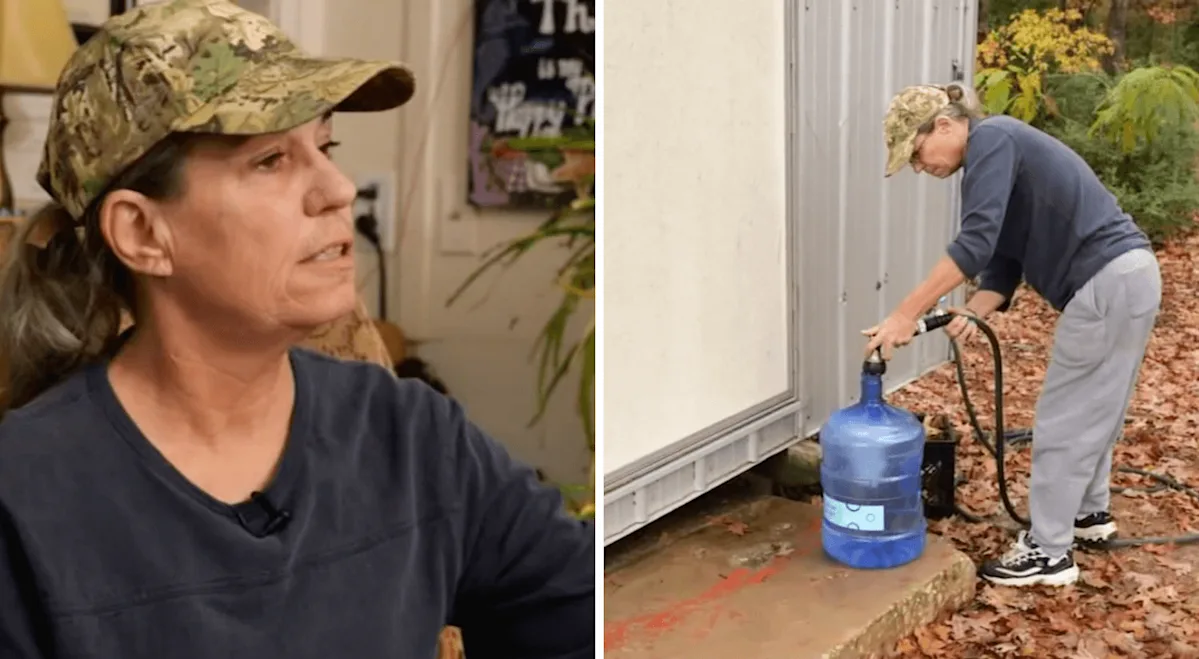
Four years ago, Christina Mann retired from Cleveland, Texas, and moved to the small community of Point Blanc. She wanted to retire near the water, it was her dream. Now, water has become her nightmare, making it impossible for her to make ends meet.
Every other day, Mann would drive a few miles to a friend’s house and fill a five-gallon jug with water from a garden hose. The water is what she uses to wash dishes, wash her hands and flush toilets – her only source of water after she decided to completely cut off water service last November.
“I choose to eat, and I tell them, every time you go up there, I’m spending my money every month on food,” Mann told ABC13’s 13 Investigates(1).
Mann lives alone on her monthly Social Security check, an amount she carefully budgeted for her retirement. The money was enough to pay her bills, but just barely. When base charges from her provider, a for-profit company called Texas Water, kept climbing, she felt cornered. The pink slip came and she didn’t resist. “You don’t have to send me one. Just come and cut off my water. I can’t afford it,” she said.
According to a copy of Mann’s bill reviewed by 13 Investigates, she was charged $169 for using just 2,000 gallons of water per month. The charges for July alone — water and sewer, transfer fees and state fees — totaled $150.18. her actual water and sewage usage The billing period is $9.34.
That means about 94 percent of her bill has nothing to do with the amount of water coming out of the tap.
By September 2025, those base charges had dropped slightly to $138.58, but were still well beyond what her budget could afford. A customer in Houston used the same 2,000 gallons and paid a total of $57.
Mann said she could manage if her bill came close to the roughly $60 she repays each month in Cleveland.
Mann’s supplier, Texas Water, is an investor-owned utility — a for-profit company rather than a city-run system. Texas Water, which serves about 60,000 customers in 32 counties, is acquiring at least four other companies and has applied for a $34-a-month “system improvement fee” increase to recoup more than $80 million in infrastructure spending.
The company is expanding. But the cost problem it represents is spreading across the country.
Research from the University of Wisconsin-Madison found that even after controlling for system size, water source, and region, average rates for investor-owned water utilities were much higher than those for publicly owned water utilities (2). A 2024 analysis from Bluefield Research found that the water and sewer bill for a typical American household increased by 4.6% in one year and approximately 24% in five years (3). In Birmingham, Alabama, and Cleveland, Ohio, those bills now exceed the EPA’s affordability threshold of 4.5 percent of median household income.
And the industry is consolidating rapidly. At the end of 2025, American Water Works and Essential Utilities announced a $40 billion merger of the two largest municipal water and wastewater companies in the United States (4). Food & Water Watch described the deal as a step toward a “dangerous, anti-consumer monopoly”(5).
Part of what makes these bills so painful for low-usage customers like Mann is their structure. A December 2024 EPA report to Congress found that water rate structures have become more regressive over time—utilities collect less through volume charges based on actual consumption and more through flat fees regardless of how much water a household uses (6). That’s the math behind a $9 water bill that actually costs $169.
Meanwhile, the safety net has thinned. The Low Income Home Water Assistance Program (LIHWAP), a pandemic-era federal program that helped more than 1.5 million households pay their water bills, expired on March 31, 2024, with no replacement (7). There is no permanent federal water assistance program similar to LIHEAP that covers heating and cooling. In a January 2026 analysis, the National Consumer Law Center and Natural Resources Defense Council argued that water affordability requires the same policy urgency as energy costs, with seniors on fixed incomes bearing a disproportionate burden (8).
Read more: The average American net worth is a surprising $620,654. But that makes almost no sense. Here are the numbers that matter (and how to make them soar)
Texas Water told 13 Investigates that its customers do not pay separate Municipal Utility District (MUD) rates, so its monthly bills represent the full cost of service, with all rates approved by the Texas Public Utilities Commission. The PUCT said investor-owned utilities must demonstrate why rate increases are necessary and the commission will only approve rate increases it deems just and reasonable.
The company also offers a $40 per month financial assistance program to qualifying customers.
When 13 Investigates recently tracked Mann down, she had retired — in large part, she said, because of her water bill. She was still dragging the can. Still choosing between water and groceries.
“They’re not policing them. You let them do what they want and people are complaining, but basically they’re getting the same response I was getting,” she said.
You can’t fix a broken rate structure on your own, but you don’t have to quietly accept it, either.
1. Read your bills like your financial statements. Figure out which fees are fixed and which are usage-related. If expenses make up the bulk of your bill — like Mann’s — then taking shorter showers won’t make much of a difference. But understanding the breakdown can tell you where to focus your battle.
2. Address loopholes before settling on a budget. The EPA estimates that households leak approximately 10,000 gallons of waste annually(9). Just one operating toilet can burn hundreds of gallons of water a day. Quick test: Drop food coloring into the jar, wait 10 minutes, then check the bowl.
3. Replace the low flow device. Products with the EPA WaterSense label use at least 20% less water than standard models. WaterSense toilets can reduce toilet-related water usage by up to 60%, or approximately 13,000 gallons per year. A faucet aerator costs a few dollars to run and pays for itself within one or two billing cycles.
4. Apply for aid—even if you don’t think you qualify. Federal LIHWAP funding has disappeared, but many utilities and states are still running their own programs. Texas Water is offering a $40 monthly discount to qualified customers. American Water’s H2O Help to Others program provides annual grants of up to $500(10). Your local community action agency or Benefits.gov can tell you about services available in your area.
5. File a complaint with your state Public Utilities Commission. In Texas, the PUCT accepts consumer complaints directly(11). Each state has a version. Formal complaints create a paper trail that regulators are obliged to review, and when enough complaints pile up, a case is opened for review.
Join more than 200,000 readers and get first access to Moneywise’s best stories and exclusive interviews – curated and delivered with clear insights every week. Subscribe now.
—
We rely only on vetted sources and reliable third-party reports. For more information, see our Editorial Ethics and Guidelines.
ABC13/KTRK Houston, 13 Investigates (1); University of Wisconsin-Madison/Water and Health Advisory Committee (2); Bluefield Research (3); why/NPR(4); food and water observation (5); U.S. Environmental Protection Agency (6, 9); U.S. Administration for Children and Families (7); National Consumer Law Center/NRDC (8); American Water Company (10); Texas Public Utilities Commission (11)
This article provides information only and should not be considered advice. It is provided without any warranty of any kind.