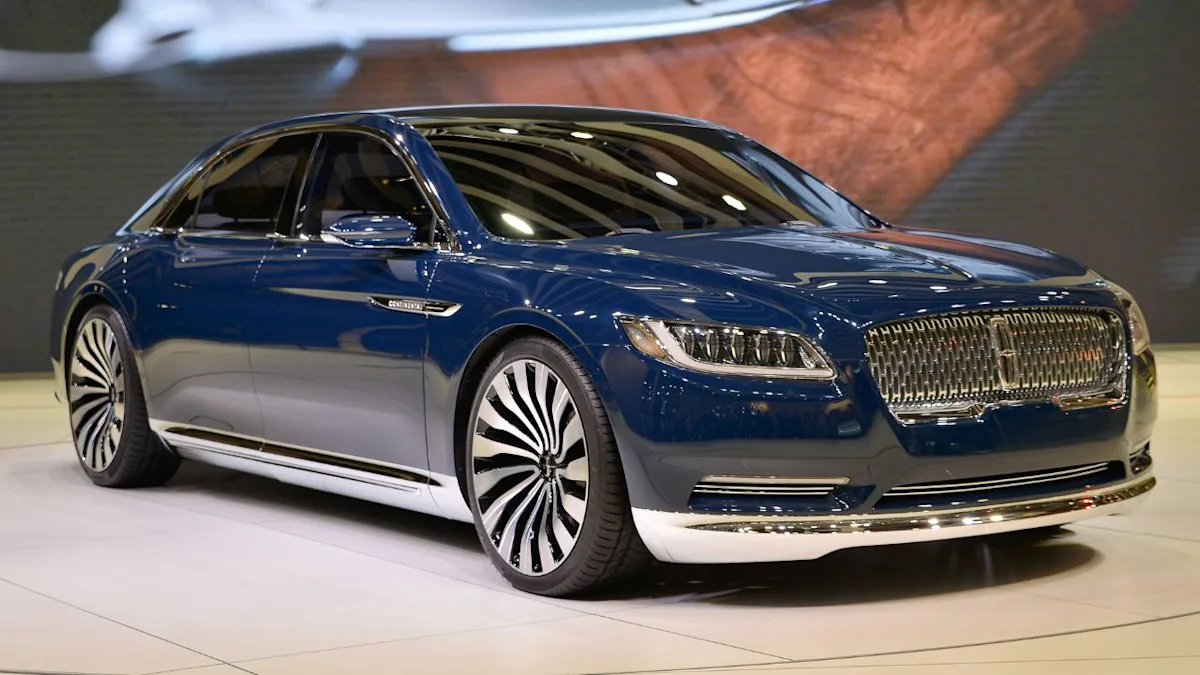
Image credit: emperorornie – Lincoln Continental 2015, CC BY-SA 2.0/Wiki Commons.
Ford Motor Co. has confirmed that its Lincoln luxury brand will move its corporate headquarters to Detroit’s Michigan Central Station in February 2026, a move that will resonate well beyond a simple office address change.
The new location will house Lincoln’s marketing, sales and service leadership teams, while design and engineering functions will remain at Ford’s main campus in Dearborn, now based at the new Ford World Headquarters.
On the surface, the move may look like a real estate shakeout. But to industry observers looking at long-term strategy, it represents a deliberate effort by Ford to reshape Lincoln’s identity and create a unique role for the luxury brand in a crowded and fast-growing market.
Image credit: Martin Gonzalez – CC BY 2.0, Wikimedia.
Michigan Central Station was once one of the most iconic transportation hubs in the United States. It opened in 1913 and served thousands of passengers daily until rail travel declined sharply in the mid-20th century.
After decades of disuse, Ford began acquiring and undertaking extensive renovations of the station and surrounding campus in 2018, creating a 640,000-square-foot innovation district designed to attract technology partners and startups as well as Ford employees.
This context is important because Ford’s decision to locate Lincoln in the heart of Michigan couldn’t have been more than a branding exercise. It places luxury brands at the center of a test bed for future technologies, from autonomous driving systems to new mobility services.
The Innovation District already has Ford’s Model e electric vehicle team and external partners like Newlab, and Lincoln leaders must hope that the synergies will spark new thinking.
Lincoln has historically been closely tied to Ford’s operations. Until recently, the brand’s leaders shared office space with Ford’s global executives in Dearborn’s famed Glass House, a mid-century landmark that served as Ford’s headquarters from 1956 until late 2025.
The new Ford World Headquarters (referred to internally as “The Center”) has replaced the Glass House as Ford’s administrative center. It enables thousands of employees to collaborate more closely on product development and company strategy. But Lincoln’s leadership certainly saw an opportunity to move beyond this heartland.
Lincoln president Joaquín Nuno-Whelan reportedly said the move would allow the brand to “be present in different contexts” while maintaining close ties to Ford’s broader enterprise.
“How do we intend [do] We are in touch with the entire Ford enterprise and are very close to what we need to do together, but how [do] When we need to do that, we do it in a slightly independent way to establish Lincoln as a special luxury brand,” Whelan said in an interview published by Automotive News.
This language signals a balance between autonomy and continued integration with Ford’s core business.
Image credit: Art Operations via Shutterstock.
The move comes as Lincoln, like other traditional luxury brands, grapples with how to remain relevant to affluent consumers amid changing tastes. SUVs and crossovers dominate sales at Ford and Lincoln, ultimately putting traditional luxury sedans and coupes at risk of further decline in the market.
While electric vehicles are reshaping product portfolios across the industry, Lincoln’s electrification strategy isn’t as publicly defined as that of some rivals. Its product lineup is still dominated by internal combustion engines and hybrids, with electric models now on the roadmap.
By locating its headquarters in a vibrant innovation center, Lincoln can be close to electric and autonomous driving teams, technology startups and potential future partners without diluting its luxury positioning. To be sure, culture, environment and the natural environment can influence brand direction just as much as product decisions.
For Detroit, Ford’s investment in Michigan Center has become a powerful symbol of the city’s renaissance. The historic station has been carefully restored with attention to architectural detail, attracting visitors, local businesses and large corporate tenants. Current plans include hotels such as NoMad Detroit as well as other retail and cultural spaces.
Image source: Q world by Shutterstock.
As well as its symbolic value, there are real economic benefits to the area around Corktown. Local businesses receive community grant and training support related to Michigan Center projects. Workforce development programs plan to create thousands of jobs linked to the broader mobility area.
The relocation of the Lincoln headquarters further solidifies the area’s status as an innovation and business destination. It sends a signal to competitors and potential partners that Ford wants Detroit to remain central to its automotive and mobility leadership long into the future.
In the automotive industry, it’s unusual for luxury brands to have their headquarters far away from their owners’ campuses. Luxury divisions typically sit within the operational core of their parent companies to ensure consistency in product development, dealer strategy and global planning. Ford’s decision to depart from this norm demonstrated his confidence in Lincoln’s ability to provide an independent voice.
The risk is that confusion could create operational friction or weaken accountability. The Lincoln team will need to work closely with Ford’s engineering and design department, which is still based in Dearborn. Success will depend on strong communication and a shared strategic framework.
Meanwhile, Ford’s broader business is facing headwinds. The company’s approach to electric vehicles, battery production and digital retail continues to evolve, with some high-profile shifts and supply agreement changes. Relocating Lincoln’s headquarters will not by itself solve these challenges.
What it can do is reposition Lincoln as a brand with its own narrative and tap into a creative ecosystem focused on the next generation of mobility.