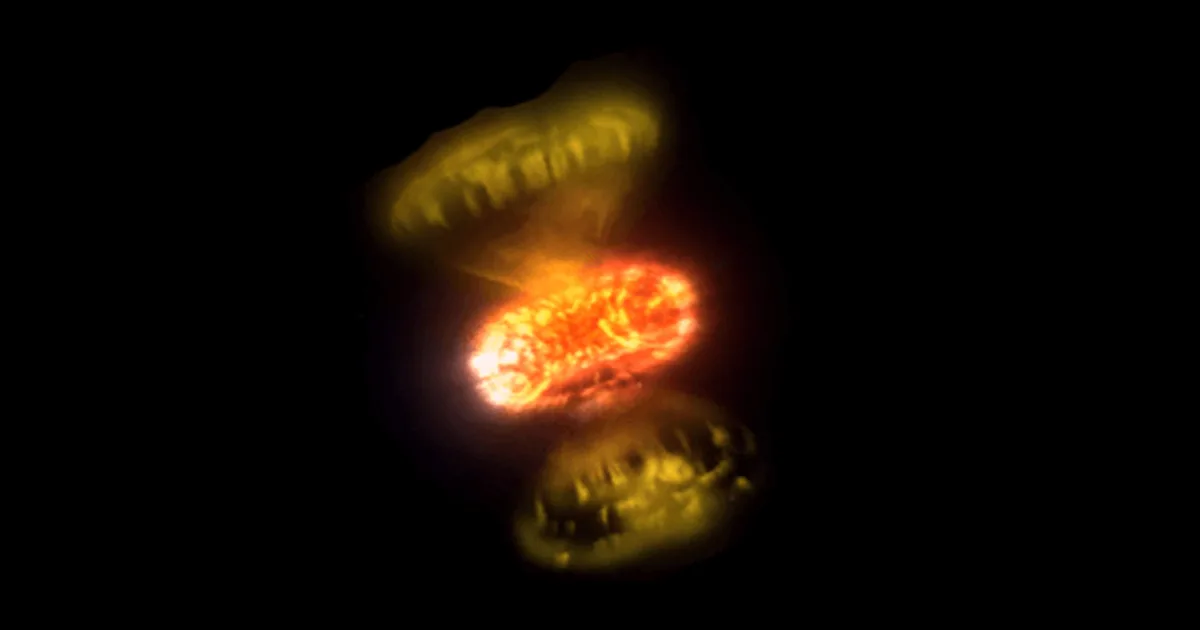
Two incredible images taken at the moment two different stars exploded also show exactly how our fragile minds are melted by the awe-inspiring yet terrifying cosmic forces on display.
The images, taken by multiple telescopes at Georgia State University’s CHARA array, capture a type of stellar catastrophe known as a nova, in which the extremely dense remnant of a star that was once like our sun, called a white dwarf, sucks material from its dangerously orbiting companion star nearby, eventually causing a thermonuclear explosion that the white dwarf ultimately survives. Once the stripped material (mainly hydrogen) accumulates on the surface of the white dwarf and reaches a critical mass, an explosion occurs. In other words, novae are naturally occurring hydrogen bombs that release as much energy in an instant as our star does in about 100,000 years.
Despite lighting up the night sky, astronomers can only infer what happened in the early stages of these horrific explosions, as direct observation has proven difficult, especially since the exploding material appears as a single point of light, making finer detection impossible. Now, new images offer a peek behind the scenes.
“These observations allow us to observe stellar explosions in real time, a very complex phenomenon that has long been considered extremely challenging,” said Elias Aydi, lead author of a new study published in the journal. natural astronomyand professor of physics and astronomy at Texas Tech University, in a statement about the work. “What we are now seeing goes beyond a simple flash of light and reveals the true complexity of how these explosions unfold.”

Screenshots on the paper show two nova images, along with an artist’s illustration of what the phenomenon might look like.
The images were primarily taken using a technique called interferometry, in which multiple light sources are smashed together to create interference patterns that astronomers can analyze. This is accomplished by collecting data using telescope arrays such as CHARA, which consists of dozens of antennas spread over a large area, equivalent to one large telescope when all trained on the same point in the sky. The CHARA data then provide images taken by other telescopes, such as NASA’s Fermi telescope (a space lens used to monitor high-energy radiation in gamma rays) and the Gemini Observatory in Hawaii.
This work shows that novae are much more complex than we thought and cannot be reduced to a single destructive explosion. One of the imaged novae, V1674 Herculis, proved to be one of the fastest novae on record, reaching peak brightness in just a few days before disappearing. It showed two separate outflows of gas, suggesting the explosion involved multiple powerful jets of material interacting with each other. But the real shocker was that the gamma rays emitted by these ejections were detected by NASA’s Fermi, showing that these explosions are capable of producing some of the most energetic radiation in the universe, which is often associated with supernovae from black holes.
Another imaged nova, V1405 Cassiopeiae, appeared to unfold in spectacular slow motion, taking more than fifty days to finally eject all the explosive material. For nearly two months, the white dwarf shrouded itself in a sphere of stripped gas, eventually engulfing both stars, creating an extremely rare structure called a common envelope. Remarkably, when this envelope finally dispersed, the jet produced its own gamma-ray burst, which NASA’s Fermi was able to observe.
Laura Chomiuk, a professor of physics and astronomy at Michigan State University, said in the statement that both events produced detectable gamma rays, suggesting that novae are “laboratories of extreme physics” that could help us “connect the dots between nuclear reactions at the star’s surface, the geometry of the ejected material, and the high-energy radiation we detect from space.”
More about space: New paper claims outer space is a viscous fluid
