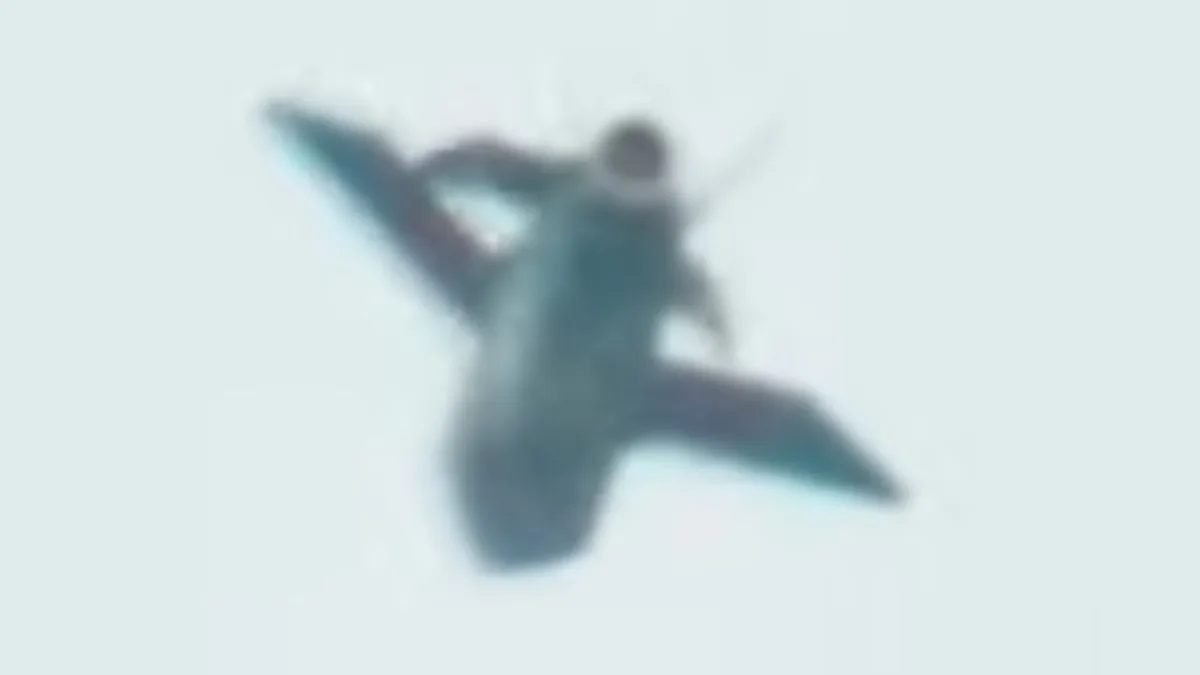
A new long-range anti-ship cruise missile being developed by Japan can be seen performing a series of barrel rolls in official video footage. The purpose of the spiral trajectory is to make the weapon, currently known as the Island Defense Missile or simply the New SSM, more difficult to intercept during the final stages of its flight. Work on the new SSM has been ongoing since 2023 due to growing concerns about regional threats, particularly from China. The missile may be the first in a modular series of advanced cruise missiles.
A video clip recently posted online by Japan’s Defense Ministry’s Acquisition Technology and Logistics Agency (ATLA) contains footage of the new SSM performing a rolling maneuver during testing. The video was first shown publicly to attendees at ATLA’s annual Defense Technology Symposium last year, but has only now been widely distributed. Kawasaki Heavy Industries (KHI) is the main contractor.
A demonstration of New SSM’s barrel rolling capabilities can be seen in the video starting around 0:49 into the runtime.
The screenshots in the video above provide a general look at the new SSM prototype. ATLA capture
The current new subsonic SSM is powered by an XKJ301-1 turbofan engine based on the KHI KJ300 design, which was developed specifically for cruise missiles and unmanned aerial vehicles. The KJ300 is a twin-spool type designed to provide significant fuel economy and, in turn, greater range. To date, Japanese authorities do not appear to have confirmed the weapon’s maximum range, but have stated that its range will exceed that of the Type 12 anti-ship cruise missile.
The 2024 ATLA diagram discusses the new SSM’s XKJ301-1. ATLA
The base Model 12 has a maximum range of approximately 124 miles (200 kilometers), while improved versions have reportedly been subsequently developed with approximately twice that range. A further upgraded Type 12 missile, which can hit targets 560 to 620 miles (900 to 1,000 kilometers) away, is also currently in development. It is assumed that the new SSM will have a longer maximum range.
Type 12 anti-ship cruise missile launched from a ground launcher. Japan Ground Self-Defense Force
The new SSM features pop-up main wings, each consisting of three separate sections that lock into place after deployment. It also has two vertical stabilizers and a pair of horizontal stabilizers, all fixed to the tail of the missile. The missile is designed to be fired from launchers on the ground and ships, and air-launched from larger aircraft such as tactical jets such as the F-2 and P-1 maritime patrol aircraft. Rocket boosters provide initial thrust before the fall, after which the XKJ301-1 turbofan engine starts.
Screenshots from the ATLA video show the left rocket booster falling, and various stages of main wing deployment after launch. ATLA capture
The weapon has a number of stealth features, including distinct ridges running along the sides behind the beak-like nose, as well as panels with jagged and other heavily angled edges. The XKJ301-1’s air inlet also adopts an S-shaped design, which is another common feature on stealth missiles and aircraft.
A closer look at some of the invisible features visible on the nose of the new SSM prototype. ATLA capture
XKJ301 location and performance of XKJ301とも売りにしているそうで、His Sense弾へのDevelopmentなどを强くconsciousnessしているそう pic.twitter.com/QXs0hLIOzS
– Citrus (@MeYkikka) November 11, 2025
The shape of the nose is also related to the missile’s intended guidance system. According to Japanese authorities’ explanations so far, the new SSM will use a GPS-assisted inertial guidance system (INS) to navigate to its designated target. A dual-mode seeker with imaging infrared (IIR) and radio frequency (RF) homing modes will then take over the final phase of flight. Combining these two seeker capabilities provides significant benefits, increasing the likelihood of a hit while also reducing exposure to jamming and other countermeasures. It will also help make the weapon more effective in the complex coastal environments where they may be used. This guidance combination is also just one of many potential modular nose sections that could be installed on the missile, which we’ll discuss later.
A previously released cross-section of the new SSM design, highlighting the seeker system in green and the warhead in red. Ministry of Defense of Japan
Japan’s ATLA has previously stated that the new SSM will be able to maneuver to a certain extent on the way to the target to reduce the chance of long-range interception, which would otherwise cause problems for defenders. Then there is the aforementioned final stage of barrel rolling, which is said to be mainly to avoid the firepower of artillery-based shipboard short-range defense systems, such as China’s Type 730 equipped with 30mm Gatling cannons. Official graphics from the Japanese government depict the new SSM circling past what appears to represent a Type 730, as seen in the social media post below.
An improved version of the Model 730, the Model 1130, with 11 barrels instead of 7, is also currently in service in China, and that country has at least tried the same approach with larger designs. Similar short-range weapons systems have been found on ships in service with many other naval forces around the world, including Russia, the United States and Japan itself.
It’s unclear if there is any hard data on the effectiveness of the new SSM’s special mobility capabilities. The idea of giving anti-ship cruise missiles a high degree of terminal maneuverability to improve their survivability is not new. As a comparative example, the Naval Strike Missile (NSM) developed by the Norwegian company Kongsberg and increasingly popular around the world is also designed to perform high-g evasive maneuvers during the final stages of an engagement. However, its flight path is more like a U-shape than a complete spiral, at least according to publicly available information.
Kongsberg previously released this diagram showing how the NSM maneuvers from the target’s perspective late in flight. Kongsberg
The final configuration of the new SSM may also include electronic support measures systems or other self-protection features.
ATLA is also openly talking about using the new SSM as the basis for a variety of other capabilities that utilize the modular nose section. This could include land attack variants capable of engaging fixed or moving targets, as well as variants designed to perform non-kinetic missions. As shown in the slideshow below, variants of the design can act as dedicated decoys or loitering surveillance assets, with the ability to immediately attack discovered targets. This modularity also makes it easier to add new warheads, seeker systems and other features to the design. In many ways, the new SSM blurs the lines between traditional cruise missiles and drones, indicative of broader global trends. TWZ Highlight regularly.
Graphics ATLA released in 2024 show possible future configurations of the new SSM using a modular nose section. ATLA
Another ATLA diagram from 2024 shows different variations of the new SSM “platform” performing different tasks. ATLA
A “platform” like this, with a range well over 620 miles and capable of being launched from the ground, sea or land, would open the door to a range of operational possibilities for Japan. This range also translates into significant wandering stamina. Ships, aircraft and launchers on the ground can be positioned closer to the target area before launch, extending the system’s functional range or ability to linger in specific parts of the battlespace.
In its anti-ship form, the new SSM could provide Japan with a valuable new way to attack ships from multiple directions simultaneously and increase survivability. As the term “island defense missile” emphasizes, the development of this weapon also comes at a time when Japanese authorities see increasing maritime (and other) threats to the country’s home islands and remote territories from long-time regional rival North Korea, as well as Russia and China. The new SSM is one of several long-range strike capabilities Japan is developing in response to the changing security environment, which also includes new hypersonic missiles. In line with this, Japan’s upcoming cruiser-sized Aegis System Vehicles (ASEV) have been steadily evolving from floating ballistic missile defense platforms to assets with more multi-role maritime strike and land attack capabilities.
With all this in mind, Japan’s current government has taken a particularly open and tough stance in responding to any potential future Chinese interference in Taiwan. This in turn prompted a significant show of force by the People’s Liberation Army, apparently intended to send a signal to Tokyo and Taipei. Japan’s Yonaguni Island, only about 70 miles off the north coast of Taiwan, has become a focus of discussion. Even with a range of only 620 miles, the new SSMs stationed there would be able to reach certain areas of mainland China as well as the waters surrounding Taiwan and targets beyond. The Japanese Self-Defense Forces have begun to strengthen the air defense of Yonaguni Island.
Map showing the approximate location of Yonaguni Island relative to western Taiwan. At upper right is the highly strategic Japanese island of Okinawa, which has a large U.S. military presence and is located approximately 400 miles southwest of mainland Japan. Google Earth
When it comes to the new SSM in particular, Japanese authorities have previously pointed to 2027 as a target time frame to begin mass production and deployment of the missiles. As ATLA’s video montage shows, flight testing of the barrel-rolling weapon is underway.
Contact the author: joe@twz.com